
Seven Experiments to Find the Learning Rate
A month ago we found something that looked important. Just before a small model suddenly gets good at its task, one direction in its training stands out. Push the model a little further along that direction and it learns sooner. Push a different model along it and nothing useful happens. We wrote that up as a special direction that belongs to the model that grew it.
This week we asked what made it special. It took seven experiments to find out, and the answer was the most ordinary thing in machine learning.
Each check removed one layer
First, it was not the direction. We built a random direction that shared just one property with the special one: how far it leaned toward where the model was already heading. It did exactly the same thing, model by model. Pushing straight along the model's own average heading did twice as much, on every model.
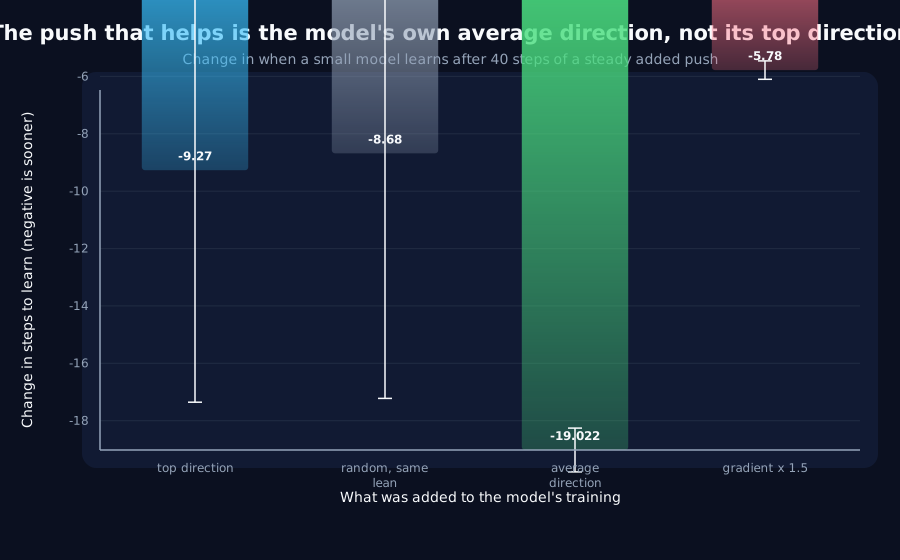
Then it was not even a push. Simply raising the learning rate, how big a step the model takes each time it is corrected, for those same 40 steps did exactly what the push did. And one fixed moment worked as well as perfect timing, so no hindsight was needed either.
Then it lost to the plainest alternative. If a short burst of faster learning helps, perhaps the model should just learn faster all the time. It should. A learning rate a quarter higher for the whole run beat the clever burst, and doubling it made the models learn 38% sooner.
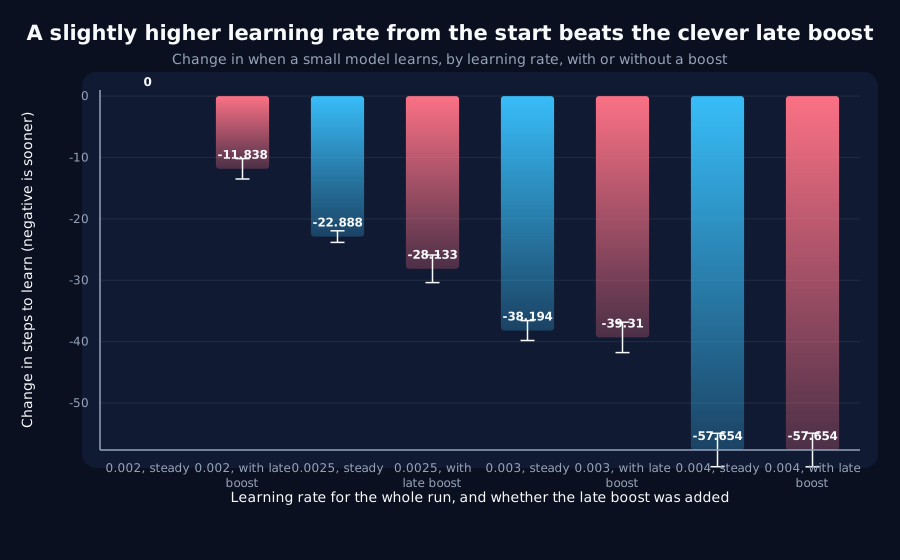
The learning rate on that setup had never been tuned. It had been set low on purpose, months earlier, for an experiment about spotting the moment of learning in advance, where a slow model gives you more time to watch. Nobody changed it when the same setup was later used to measure speed-ups. The data showing how slow it was had been sitting in our own archive for a month.
Then we audited everything
If one thread could be explained by an untuned setting, others might be. So we read the code behind every speed-up we have ever published and checked which learning rate it really used. None had been tuned. For most, though, the usual setting happened to sit close to the best one, so the rate could explain only a small part of the effect. Our strongest result, a head start one model gets from another's trained parts, held up when we re-ran it at the tuned rate.
The one free speed-up, and why we do not trust it yet
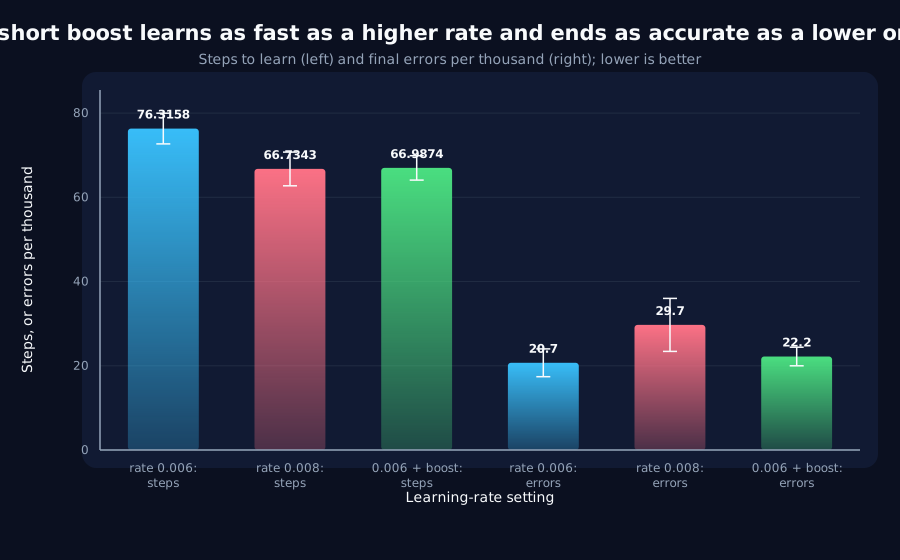
Tuning properly showed a trade-off: faster rates learn sooner but end slightly less accurate. A short, early burst of the faster rate got both, the speed of the high rate and the accuracy of the low one. That is 12% less time to learn, for nothing.
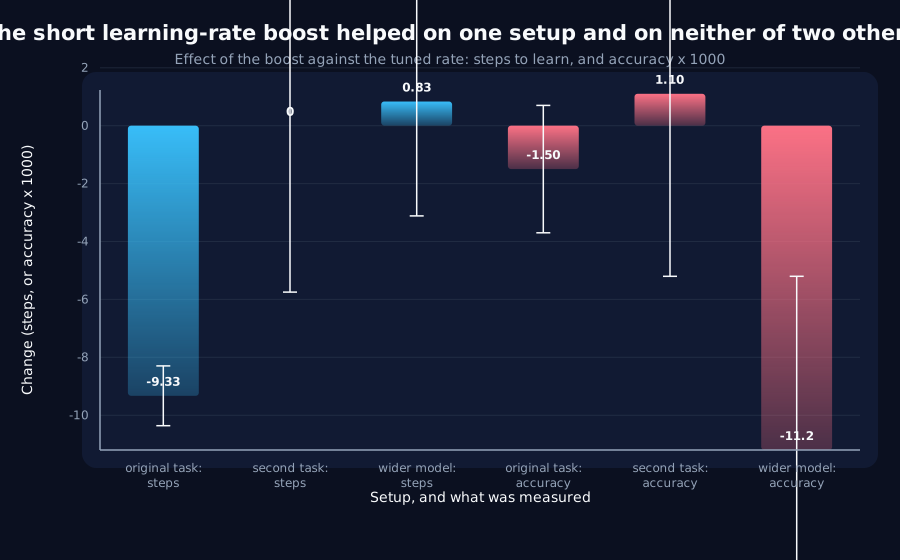
Our own rules say a trick found on one setup has to be tried on another. We repeated the whole recipe from scratch on a different task and on a wider model. On the new task it did nothing. On the wider model it cost accuracy. The free speed-up was a fact about one setup.
What to take from it
Check the most boring explanation first. We checked it last. Each experiment tested only the next layer down, so it took seven steps to reach a setting anyone could have checked on day one.
Tune the thing you are comparing against. A trick measured against an untuned baseline can look useful simply because it partly fixes the baseline.
Look at what you already have. The answer was in our own archive, collected for a different purpose. A settings choice that makes sense for one kind of experiment can quietly undermine another kind that reuses the same setup.
And a trick that works once is a hypothesis. The one real speed-up we found did not survive a second setup, which is exactly why we tried one.
These are small models on simple tasks. The lesson about baselines applies at any scale; the specific numbers do not.
Get new results as we publish them
Roughly monthly, one finding per email, in plain English first. Including the approaches that turned out not to work, which are usually the useful ones. No sales email.
Double opt-in: we send a confirmation link and add nobody who does not click it. One-click unsubscribe on every email.