
We Tried to Kill Our Own Finding
Our research programme has one positive result. Almost everything else in it is a negative: an idea we had, a test we designed to kill it, and the record of it dying. The one survivor is a specific reorganisation that happens inside a model at the moment it learns a task.
Every experiment that produced that result used the same training algorithm, AdamW. It is the standard choice, we never varied it, and that meant the result might not have been about learning at all. It might have been about AdamW.
So we set out to break it.
Making the comparison fair first
You cannot simply swap the algorithm and rerun. Plain gradient descent at the same settings learns much later, and a later transition is a different transition. We would have been comparing two things at once.
So we tuned each algorithm's learning rate until all three learned the task at the same point, using a separate tuning run whose random seed was deliberately excluded from the measurement runs. Plain gradient descent needed a learning rate 320 times larger than AdamW's. All three then solved the task in 10 runs out of 10.
Half survived
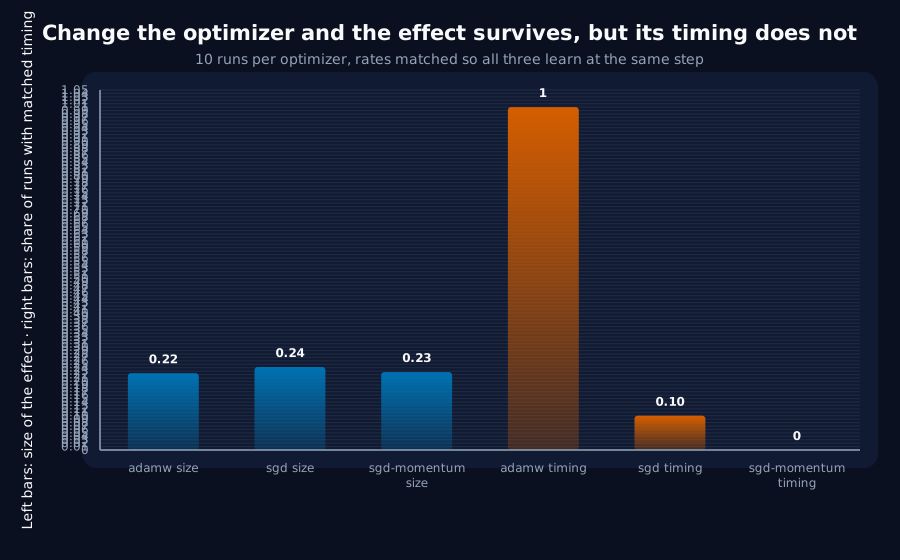
The size of the effect is essentially identical across all three: +0.2239 for AdamW, +0.2421 for plain gradient descent, +0.2273 with momentum. Within 8% of each other, and all three clear the threshold we had committed to in advance.
That is good news, and it is the more important half. The phenomenon shows up at full strength under plain gradient descent, which has no adaptive scaling, no momentum, and no per-parameter bookkeeping at all. It is not an artefact of a fashionable optimiser.
Half did not
The published version of this result had a second claim: the reorganisation happens at the same moment the model learns. Twelve runs out of twelve, within 50 steps.
That claim belongs to AdamW. Under AdamW the reorganisation lands 0.5 steps from the moment of learning, in 10 runs out of 10. Under plain gradient descent it lands 243 steps later, in 1 run out of 10. With momentum, 170 steps later, in 0 out of 10.
Several planned experiments wanted to use that timing as a clock, to trigger something at the right moment during training. Those experiments are now scoped to one optimiser until shown otherwise.
In plain English
Suppose you find that a particular engine noise reliably happens at the exact moment a car reaches highway speed. Useful: you could use the noise as a signal.
Then you test a different transmission. The noise still happens, just as loudly, so it is a real property of the car and not of the gearbox. But now it happens well after the car reaches speed. The noise was real. Its usefulness as a signal was a property of the gearbox you happened to be using.
A trap we had to avoid on the way
One detail is worth showing, because it is the kind of thing that quietly ruins comparisons.
We wanted a second measurement to back up the first. The obvious one was to measure the change from the moment of learning to the peak. That would have been useless here, because the peak lands almost immediately under AdamW and about 240 steps later under gradient descent. It would have compared a five-step window against a two-hundred-step window and called the difference a result.
We used a fixed 100-step window instead, identical for every arm. Every algorithm shows the effect on that measurement too. The first version of the analysis is recorded in the study document rather than quietly deleted, because how a measurement was wrong is often more useful than the corrected number.
Why we publish the half that failed
The tempting version of this article reports that our result survived a hard test, which is true. The complete version reports that a specific claim we had published did not, which is also true and considerably more useful to anyone deciding whether to trust the rest.
The same standard is what we would want applied to a vendor. When someone tells you a result is robust, the question is what they varied to find out, and what broke when they did. A robustness check that everything passes was probably not a robustness check.
Read the full record, including the code that produces every number
Get new results as we publish them
Roughly monthly, one finding per email, in plain English first. Including the approaches that turned out not to work, which are usually the useful ones. No sales email.
Double opt-in: we send a confirmation link and add nobody who does not click it. One-click unsubscribe on every email.