
What a Model Has to Build, and What It Gets for Free
A useful question about any AI system is which parts of it are doing real work. Not which parts are large, or expensive, or fashionable. Which parts, if you stopped training them, would actually break something.
In our research programme there is a cheap way to ask that: freeze a part and see what happens.
The experiment
The models we study have three pieces. An input layer that turns tokens into numbers, a memory that carries information forward through a sequence, and an output layer that turns the memory's state into an answer.
We froze the memory at its random starting values and trained only the input and output layers. The model could learn to read its memory as well as it liked. It just could not change how that memory worked.
This is a known technique with a name, reservoir computing, and it sometimes works surprisingly well. We had a specific reason to expect it might: in a separate experiment we found that even an untrained memory carries real information about the right answer, about five times better than guessing.
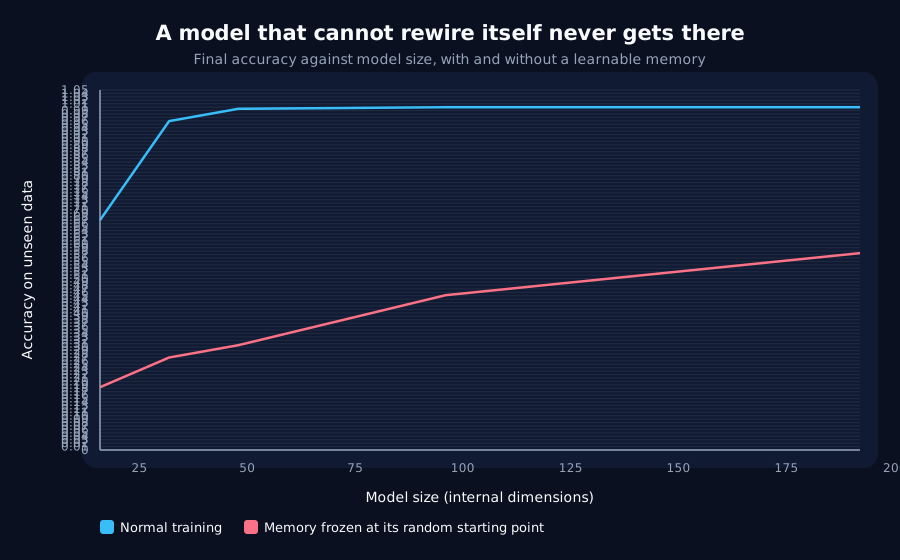
It never catches up
Normal training has essentially solved the task by the third size, at 99.5% accuracy. The frozen version reaches 30.6% at that size. Making the model four times larger gets the frozen version to 57.4%, and normal training is at 99.97% there.
The gap never closes at any size we tested.
The part we would have got wrong
Stopping there would have produced a tidy and slightly misleading article, and the reason is a measurement rule we hold ourselves to.
A frozen model is cheaper to train per step, because there is less to compute. Comparing the two at the same number of steps therefore gives the frozen version less total compute, and quietly stacks the comparison. Our rule is that efficiency comparisons must be matched on compute, not on steps.
So we gave the frozen version four times the training budget. It changes the conclusion in an interesting way.
With four times the training, the frozen model does eventually clear the bar we use to say a model has learned the task. So "it cannot learn" would have been the wrong claim, and it is the claim the first version of this comparison supported.
What it cannot do is learn suddenly. Normal training goes from a quarter to three quarters of its final ability in 63 steps. The frozen version takes 1,175 steps to cover the same stretch, and still ends at 47% rather than 99.5%. That is about nineteen times more gradual.
In plain English
Think of the difference between rearranging your kitchen and learning to cook in someone else's. In your own kitchen you can move things, and once you do, everything gets fast at once. In a kitchen you cannot rearrange you will still improve, by memorising where everything already is, and you will improve steadily rather than suddenly, and you will never get as fast.
The sudden part of learning, in these models, requires being able to move the furniture.
What we take from it
Two things, and the second matters more than the first.
Random structure gives a real head start, and it is not enough. An untrained memory carries usable information, roughly ten times better than guessing once you attach a trained readout. That is genuinely something. It is also nowhere near a working system, and the distance between the two is most of the problem.
Reaching the same place is not the same as getting there the same way. Our original comparison used a simple pass or fail: did the model learn the task? With enough budget, the frozen version passes. Only when we measured how abruptly each one improved did the actual difference show up, and it is a factor of nineteen.
That second point generalises past this experiment. A benchmark score is a snapshot of where a system ended up. Two systems with the same score can have completely different shapes behind them, and the shape is often what you actually care about: how much data it took, how suddenly it became useful, whether it will keep improving or has flattened out. If you are comparing AI systems on a single final number, you are comparing the destinations and ignoring the routes.
Read the full record, including the compute-matched comparison
Get new results as we publish them
Roughly monthly, one finding per email, in plain English first. Including the approaches that turned out not to work, which are usually the useful ones. No sales email.
Double opt-in: we send a confirmation link and add nobody who does not click it. One-click unsubscribe on every email.