
The Operation and the Component
Ongoing research. This is an experimental result from active work, not a settled conclusion. The numbers are what we measured and the method is described so you can judge it, but the programme is still running and later experiments may revise what it means.
A note on the language in these records. This is a working laboratory notebook for research into training AI models more cheaply and efficiently, so you will read that an approach did not work, that a result did not hold up, or that one method was worse than another. That is the research doing its job, not a verdict on the engineering we deliver to clients. Ruling an approach out is how the search narrows, and these are the pages that teach us the most: nearly every technique we now rely on came from understanding why something else fell short. Testing our own ideas at least as hard as anyone else's is the point of publishing them. More about this programme and why we run it.
Part of a bigger question: Is the task we are studying actually hard? – Often it is not. A rule from 1990 with no parameters beats the trained model on the task most of these results were measured on, and what an intervention costs is set by the task's own structure.
In plain English
What we asked. Why did easy examples help on our adding task but not our copying task? One idea: the easy sums share a part of the hard sum, the symbol two steps back. We compared easy sums that share that part with easy sums that share nothing.
What we found. Both helped. Easy sums sharing nothing still got the model to the solution about 1,500 steps sooner than ordinary training, and easy sums sharing the part got there about 1,400 steps sooner again. About half the benefit is practising addition; half is practising a piece of the real task.
Why it matters. On the copying task there is no operation worth practising, which may be why easy examples did nothing there that a learning-rate warm-up could not.
The rest of this page is the technical record: the design, every number, and the limits. It is written for a reviewer, and you do not need it to have understood the result above.
New here? How to read a research record
- Start at the verdict. Every record states, before the experiment was run, what result would have made us abandon the idea. That is the "kill test". Then it says whether the test fired. Nothing gets reinterpreted after the fact.
- Numbers in square brackets are uncertainty.
23.4 [18.1, 28.7]means our best estimate is 23.4 and the true value is probably somewhere in that range. If a range includes zero, we cannot claim an effect. - Results that rule an idea out are kept. Roughly half of what is published here says an approach did not work, including plenty of our own. Those pages are the output, not a shortfall: knowing which direction is a dead end is what lets the next experiment go somewhere better, and most of what we now rely on came out of understanding why something else fell short. Work that only publishes what worked is not measuring anything.
- Read the Limits section. Every record ends with what it does not show. It is the most honest part of any experiment and usually the shortest.
- Pro tip: the figures near the top are designed to carry the result on their own. If you read nothing else, read the caption under each one, which says what it shows and what to take from it.
EXPLORATORY. Not a preregistered study. Local CPU,48training runs of8000steps on sixteen fresh seeds. The design and the kill test were committed (881e929) before any run.
Program v2 Bucket A, item A49. Decisive computation: analysis/sum_shared_component.pyanalysis/sum_shared_component.json
The question
On modular sum an early mix of easier sums reaches the solution in about 40% fewer steps than the best plain recipe (A44); on the copy task the same idea was only a learning-rate warm-up (A33). arXiv 2505.18369 reports easy tasks help a hard one only when they share computational components. The helpful easy sums (2,3)/(2,4)/(2,5) all share the target (2, 7)'s first offset. Is the shared component what makes them work?
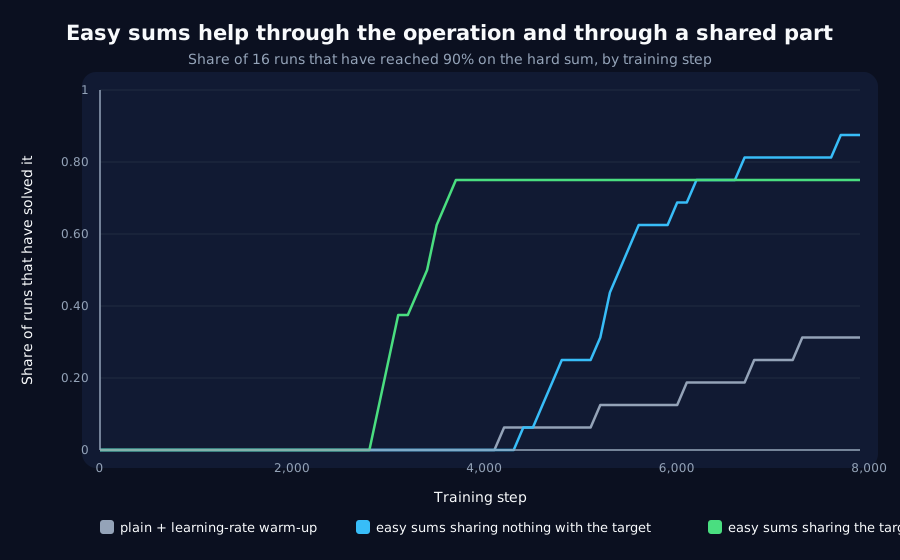
Design: target (2, 7) at 0.003, 8000 steps, sixteen fresh seeds 17001-17016. Shared: 2000 steps of (2,3)/(2,4)/(2,5). Unshared: 2000 steps of (4,5)/(4,6)/(5,6) -- the same operation, similar spans, no offset in common with the target. Plain: a 500-step learning-rate warm-up to 0.003. Endpoint: steps to 0.9 (never = 8000). Kill test, fixed before execution: shared minus unshared includes zero or lies above it. Anchor, in code: the shared arm reproduces A40's mixed run on its first seed -- held.
Results
| Arm (sixteen fresh seeds) | Median steps to 0.9 | Solved by 8000 |
|---|---|---|
| shared-offset easy sums | 3375 | 12 |
| unshared easy sums | 5430 | 14 |
| plain, learning-rate warm-up | 8000 (budget) | 5 |
| Paired difference in steps to solve | |
|---|---|
| shared minus unshared | -1405.6 [-2344.9, -466.3] |
| unshared minus plain | -1521.9 [-2171.6, -872.2] |
| shared minus plain | -2927.5 [-4027.8, -1827.2] |
The kill test does not fire. Easy sums that share the target's first offset reach the solution about 1400 steps sooner than easy sums that share none. But the unshared sums also beat the plain recipe, by about 1500 steps. The mixture's saving over plain splits roughly in half: one part from practising the operation (adding two symbols mod 32), the other from practising a component of the target itself.
What it says
This explains, at least in part, why modular sum and the copy task gave opposite answers. On modular sum there is a piece of the hard task -- the addition table -- that any easy sum teaches and that the plain run must otherwise learn from the hard task alone; a learning-rate warm-up cannot supply that, and even easy sums sharing nothing with the target beat it. On the copy task the "operation" is trivial, and the easy lags' only contribution was protecting the first steps from the rate (A33). It agrees with 2505.18369 that shared structure matters, and adds that on this task a shared operation carries about as much as a shared component.
What stands
- A49: kill test does not fire. Shared minus unshared in steps to solve:
-1405.6[-2344.9, -466.3]. - Unshared easy sums still beat the plain recipe (
-1521.9[-2171.6, -872.2]): about half the saving is the operation, half the shared component.
Limits
- Sixteen seeds; one set of unshared pairs; the budget (
8000) censors the plain arm (11of16unsolved), which understates its gaps. The "addition table" reading is an interpretation, not measured here.
Terms on this page
Every piece of vocabulary this record uses, in plain language. Generated from the text above, so it cannot drift out of step with it.
- kill test
- A condition written down before running the experiment that says what result would make us abandon the idea. Fixing it in advance is what stops a disappointing result being reinterpreted as an encouraging one.
- learning rate
- How big a step training takes each time it updates the model. Too small and nothing happens; too big and it never settles.
- seed
- The number that fixes all the randomness in a training run. Same seed, same run. Running several seeds is how you tell a real effect from a lucky one.
Get new results as we publish them
Roughly monthly, one finding per email, in plain English first. Including the approaches that turned out not to work, which are usually the useful ones. No sales email.
Double opt-in: we send a confirmation link and add nobody who does not click it. One-click unsubscribe on every email.