
The Prerequisite Forecasts the Skill
Ongoing research. This is an experimental result from active work, not a settled conclusion. The numbers are what we measured and the method is described so you can judge it, but the programme is still running and later experiments may revise what it means.
A note on the language in these records. This is a working laboratory notebook for research into training AI models more cheaply and efficiently, so you will read that an approach did not work, that a result did not hold up, or that one method was worse than another. That is the research doing its job, not a verdict on the engineering we deliver to clients. Ruling an approach out is how the search narrows, and these are the pages that teach us the most: nearly every technique we now rely on came from understanding why something else fell short. Testing our own ideas at least as hard as anyone else's is the point of publishing them. More about this programme and why we run it.
Part of a bigger question: What actually happens at the moment a model learns? – It builds machinery rather than selecting it, working through the task in a reproducible order and trying a simpler wrong rule on the way. The visible training curve cannot tell you which is happening.
In plain English
What we asked. A 2026 paper showed that in language models, when one internal mechanism forms predicts when a more complex one will form, at a fixed multiple of the time. Our experiments have the same shape built in: combined skills and the simpler skills they are built from. So we tested the same rule on runs we already had, without training anything new.
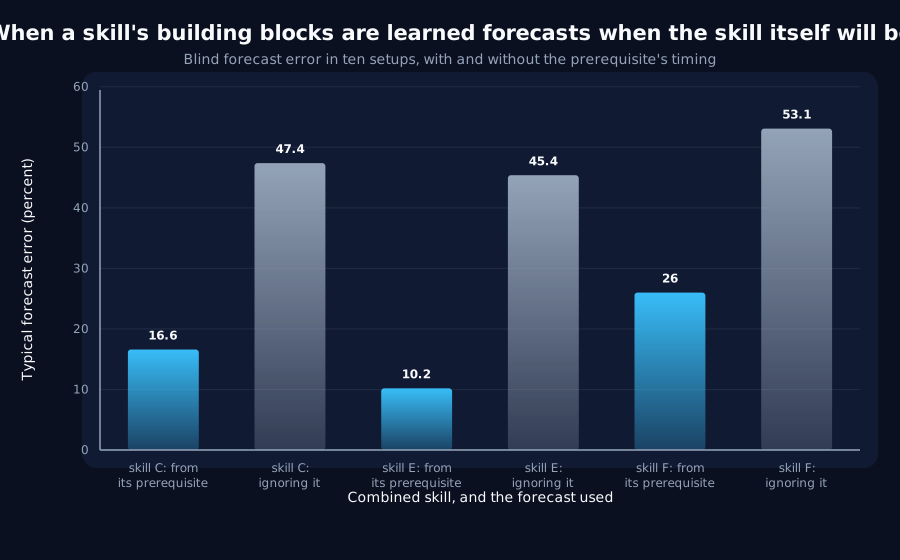
What we found. It worked. Forecasting a combined skill as a fixed multiple of when its last building block was learned cut the error to about a third of a forecast that ignores the building blocks, and the multiple stayed almost the same across ten quite different setups. It is better at predicting typical timing than at ranking individual runs.
Why it matters. This is our new habit of reading recent research paying off directly: a rule from someone else's work, checked against our own data in an afternoon.
The rest of this page is the technical record: the design, every number, and the limits. It is written for a reviewer, and you do not need it to have understood the result above.
New here? How to read a research record
- Start at the verdict. Every record states, before the experiment was run, what result would have made us abandon the idea. That is the "kill test". Then it says whether the test fired. Nothing gets reinterpreted after the fact.
- Numbers in square brackets are uncertainty.
23.4 [18.1, 28.7]means our best estimate is 23.4 and the true value is probably somewhere in that range. If a range includes zero, we cannot claim an effect. - Results that rule an idea out are kept. Roughly half of what is published here says an approach did not work, including plenty of our own. Those pages are the output, not a shortfall: knowing which direction is a dead end is what lets the next experiment go somewhere better, and most of what we now rely on came out of understanding why something else fell short. Work that only publishes what worked is not measuring anything.
- Read the Limits section. Every record ends with what it does not show. It is the most honest part of any experiment and usually the shortest.
- Pro tip: the figures near the top are designed to carry the result on their own. If you read nothing else, read the caption under each one, which says what it shows and what to take from it.
EXPLORATORY. Not a preregistered study. No training: the committed runs of six earlier records. The script and kill test were committed before it was run.
Program v2 Bucket T, item T5, from the second standing source search (see docs/sources.mdanalysis/anchor_forecast.pyanalysis/anchor_forecast.jsonpython analysis/anchor_forecast.py (seconds).
The question
arXiv 2609.19000, "Capability Emergence Can Be Forecast: Per-Seed, In Advance, With Calibrated Intervals, Certified False Alarms, and a Blind Pre-Registered Gate" (Howe), forecasts when an induction head forms from when its mechanistic precursor, the previous-token head, forms, with a multiplicative rule (t_event ~ 1.19 x t_anchor) that passed blind validation on unseen configurations; its reported rank correlation across 30 same-configuration transformers is 0.977. Only the abstract was read.
This programme has the same structure planted by design: composite skills (C = A + B, F = B + D, E = C + D) and the prerequisites they are built from, acquired per seed in six committed experiments -- O11, O12, O17, O20, O21 and O24 -- spanning five-, six- and seven-skill tasks, widths 64 and 128, two budgets and three teaching doses. Ten configurations qualify: every committed arm in which neither of a composite's prerequisites was manipulated.
The rule, fixed before execution: the anchor is the latest prerequisite's acquisition step; the forecast is k x anchor, with k the median ratio over the other configurations (each configuration held out in turn). The baseline: the median acquisition step of the composite over the other configurations, ignoring the anchor. Endpoint: mean over held-out configurations of the median absolute percentage error per run.
Kill test, fixed before execution: for C, the anchor rule's error is not smaller than the baseline's.
Result: the kill test does not fire
| Composite | Configurations | Anchor rule error | Baseline error | k (pooled) | Mean within-configuration rank correlation |
|---|---|---|---|---|---|
C = A + B | 10 | 16.6% | 47.4% | 2.21 | 0.47 |
E = C + D | 10 | 10.2% | 45.4% | 1.61 | 0.45 |
F = B + D | 9 | 26.0% | 53.1% | 3.22 | -0.01 |
Knowing when a composite's last prerequisite was acquired forecasts when the composite will be, blind, with a third of the baseline's error or less -- for every composite. The ratio is strikingly stable: across all ten held-out fits k for C stays between 2.15 and 2.29, although the configurations differ in task size, width, budget and how often an unneeded skill is taught. That is the same kind of stability 2609.19000 reports for its induction-head rule.
Where it is weaker than the paper: ranking seeds within one configuration. The paper reports 0.977 across same-configuration runs; here C and E average 0.45-0.47 and F about zero. Most of the rule's power is in carrying each configuration's scale -- a wider or less-crowded model learns everything faster, and the anchor measures that -- rather than in ordering individual seeds.
It is a forecast in advance. The anchor arrives when the composite is still k - 1 times further away: for C, about 1.2 anchor-lengths ahead.
What stands
- Kill test does not fire. The anchor rule's blind error is
16.6%forC, against47.4%for a forecast that ignores it;10.2%forEand26.0%forF. - The composite-to-prerequisite ratio is nearly constant across ten configurations (
C:2.15-2.29). - Per-seed ranking within a configuration is weak (
0.47forC, about zero forF), unlike the paper's induction heads. - This is the first positive forecasting result from the planted-skill tasks, and it is free: it uses acquisition times the runs already produce.
Limits
- Abstract only for
2609.19000; its method is richer (calibrated intervals, certified false alarms) than the multiplicative rule tested here. - Configurations share one task family and one learning rate; the rule's constant is a property of this task, not a universal.
- Acquisition is P3's threshold definition, the same for anchor and target; a different definition could change
k.
Terms on this page
Every piece of vocabulary this record uses, in plain language. Generated from the text above, so it cannot drift out of step with it.
- baseline
- The thing you compare against. A result without one is not a result.
- calibrated
- A model is calibrated when its confidence matches how often it is right: answers it gives with 90% confidence should be right about 90% of the time.
- held-out
- Data the model was never trained on, kept back specifically to test it. Scoring a model on data it has already seen measures memorisation, not learning.
- kill test
- A condition written down before running the experiment that says what result would make us abandon the idea. Fixing it in advance is what stops a disappointing result being reinterpreted as an encouraging one.
- learning rate
- How big a step training takes each time it updates the model. Too small and nothing happens; too big and it never settles.
- rank
- How many independent directions a set of numbers really uses. A low-rank structure is one that looks high-dimensional but is actually simple underneath.
- seed
- The number that fixes all the randomness in a training run. Same seed, same run. Running several seeds is how you tell a real effect from a lucky one.
- transformer
- The architecture behind most modern large language models. It uses attention to look at every part of the input at once, rather than reading in order.
- width
- How many internal numbers a model uses at each layer. The usual way we vary model size in these experiments.
Get new results as we publish them
Roughly monthly, one finding per email, in plain English first. Including the approaches that turned out not to work, which are usually the useful ones. No sales email.
Double opt-in: we send a confirmation link and add nobody who does not click it. One-click unsubscribe on every email.