
The Teacher Found a Plan
Ongoing research. This is an experimental result from active work, not a settled conclusion. The numbers are what we measured and the method is described so you can judge it, but the programme is still running and later experiments may revise what it means.
A note on the language in these records. This is a working laboratory notebook for research into training AI models more cheaply and efficiently, so you will read that an approach did not work, that a result did not hold up, or that one method was worse than another. That is the research doing its job, not a verdict on the engineering we deliver to clients. Ruling an approach out is how the search narrows, and these are the pages that teach us the most: nearly every technique we now rely on came from understanding why something else fell short. Testing our own ideas at least as hard as anyone else's is the point of publishing them. More about this programme and why we run it.
Part of a bigger question: What actually makes training cheaper? – One thing has worked: stopping part of the training early saved about 7% with no loss of quality. Everything else tested has been matched by a simpler or cheaper method -- and in two cases the clever method was only winning because it was quietly being given more.
In plain English
What we asked. When a model learns several related tasks, the order and mix it practises them in can matter. A paper this week trains models on material generated to sit right at the edge of what they can currently do. We tested a small version: a simple automatic teacher that keeps choosing the tasks our model gets about 70% right, against choosing at random and against the best of several fixed easy-to-hard plans we wrote ourselves.
What we found. The teacher won. It beat random choice clearly and beat our best fixed plan by a smaller but reliable margin, and it got the model to a useful level soonest. That is a first in this project: three earlier clever methods were all matched by a plain fixed plan. But we also replayed one run's teacher choices on a different run, without the teacher watching at all, and that did almost exactly as well. So the teacher's value was not in reacting to the model. It was in the plan it discovered.
Why it matters. The plan is simple once you see it: practise the easy tasks first, drop each one almost entirely once it is learned, and spend the time on whatever is just becoming learnable. Our own fixed plans kept everything learned so far in the mix, and so spent most of the late training on tasks the model had already mastered. The practical lesson: run an adaptive teacher once, write down what it chose, and reuse that. And if you design a curriculum by hand, retire what has been learned.
The rest of this page is the technical record: the design, every number, and the limits. It is written for a reviewer, and you do not need it to have understood the result above.
New here? How to read a research record
- Start at the verdict. Every record states, before the experiment was run, what result would have made us abandon the idea. That is the "kill test". Then it says whether the test fired. Nothing gets reinterpreted after the fact.
- Numbers in square brackets are uncertainty.
23.4 [18.1, 28.7]means our best estimate is 23.4 and the true value is probably somewhere in that range. If a range includes zero, we cannot claim an effect. - Results that rule an idea out are kept. Roughly half of what is published here says an approach did not work, including plenty of our own. Those pages are the output, not a shortfall: knowing which direction is a dead end is what lets the next experiment go somewhere better, and most of what we now rely on came out of understanding why something else fell short. Work that only publishes what worked is not measuring anything.
- Read the Limits section. Every record ends with what it does not show. It is the most honest part of any experiment and usually the shortest.
- Pro tip: the figures near the top are designed to carry the result on their own. If you read nothing else, read the caption under each one, which says what it shows and what to take from it.
EXPLORATORY. Not a preregistered study. Local CPU, six seeds plus one screening seed. The design and kill test were committed (7a56fcc) before any measured run; calibration used a seed disjoint from these and found the mixed-lag family ill-posed without a cue token, which is disclosed in the program doc.
Program v2 Bucket S, item S2. Decisive computation: analysis/frontier_curriculum.pyanalysis/frontier_curriculum.jsonpython analysis/frontier_curriculum.py (about forty minutes on a throttled laptop CPU); --reuse re-derives every endpoint from the saved curves.
The question
Self-Play Pretraining with Zero Data (arXiv 2609.30063, 2026-09-24) trains a generator by reinforcement learning to produce sequences "at the frontier of the learner's capabilities", and reports a learner that improves on natural data without ever seeing any. The maintainer's report proposed the miniature: a teacher over task parameters, rewarded when the learner sits around 60-80% accuracy, against random task generation at equal compute.
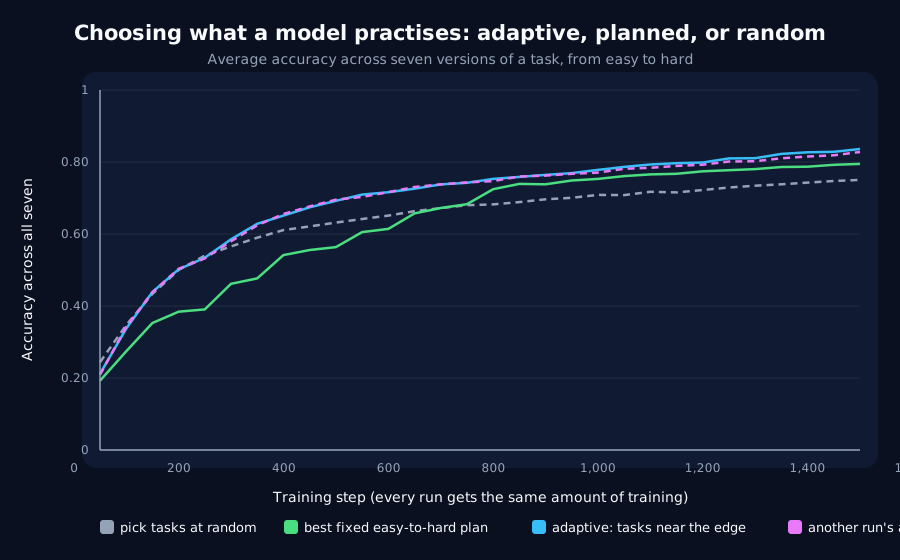
This programme has a standing reason to be sceptical. Three results here -- K2, J7 and N14 -- found an adaptive mechanism matched exactly by a fixed schedule someone could have written down in advance, and the rule that came out of them is that an adaptive mechanism must beat the best fixed schedule you can find, not just beat doing nothing.
Kill test, fixed before execution: the frontier teacher's final family accuracy does not exceed the best fixed schedule's, paired over six seeds with an interval excluding zero.
Prior recorded in advance: low against the best fixed schedule; moderate against uniform.
Design
A width-48 GRU learns a family of seven cued delayed-copy tasks -- lags 2, 3, 4, 6, 8, 10, 12, the first token stating which -- for 1500 steps at batch 64. The target is the whole family: mean held-out accuracy across all seven. Every arm trains the same model for the same steps on the same batch size and sequence length; only the mix of lags in each batch differs.
| Arm | How each batch's lags are chosen |
|---|---|
| uniform | at random, the report's "random task generation" |
| frontier | a bandit teacher: weight exp(-((acc - 0.70) / 0.15)^2) on each lag's running accuracy, 10% uniform floor |
| best fixed | the best of four easy-to-hard ramps, screened on a separate seed |
| frontier, replayed | another seed's frontier weights, step by step -- the same schedule shape, blind to this learner |
The teacher costs nothing to run. Its only input is the learner's accuracy on the batch it has just trained on, which the forward pass already computed. It is a bandit, the minimal teacher, not a learned program generator.
The fixed schedule was chosen fairly. Four ramps, admitting the next-hardest lag at a fixed rate until the whole family is in at 30%, 50%, 70% or 90% of the run, were run on a screening seed disjoint from the six measurement seeds: 0.799, 0.803, 0.792, 0.774. The 50% ramp was then run on the measurement seeds.
Result: the kill test does not fire
Final family accuracy (mean of the last three evaluations), six seeds:
| Arm | Family accuracy | Steps to 0.60 |
|---|---|---|
| uniform | 0.747 [0.724, 0.769] | 400 |
best fixed (50% ramp) | 0.791 [0.785, 0.797] | 550 |
| frontier | 0.830 [0.806, 0.855] | 333 |
| frontier, replayed | 0.821 [0.804, 0.837] | 350 |
| Paired contrast | Family accuracy |
|---|---|
| frontier minus best fixed | +0.039 [+0.014, +0.064] |
| frontier minus uniform | +0.084 [+0.040, +0.128] |
| best fixed minus uniform | +0.044 [+0.025, +0.064] |
| frontier minus frontier-replayed | +0.010 [-0.006, +0.025] |
This is the first adaptive mechanism in this programme to beat the best fixed schedule it was tested against. It reaches a family accuracy of 0.60 first, too -- 333 steps against 400 for uniform and 550 for the ramp, which holds back the hard lags until halfway.
And then the control that matters
Replaying another seed's frontier schedule does almost exactly as well -- 0.821 against 0.830, an interval that includes zero. The replayed arm never looks at the learner it is training. It just plays back, step by step, the lag weights a different run's teacher chose.
So the teacher's value is not that it responds to this learner. It is that it found a better schedule than the four ramps, and that schedule transfers between seeds. The standing rule was right about which comparison mattered, and wrong about how it would come out: the adaptive mechanism won against the best fixed schedule we could think of, and lost -- or rather tied -- against the fixed schedule it discovered.
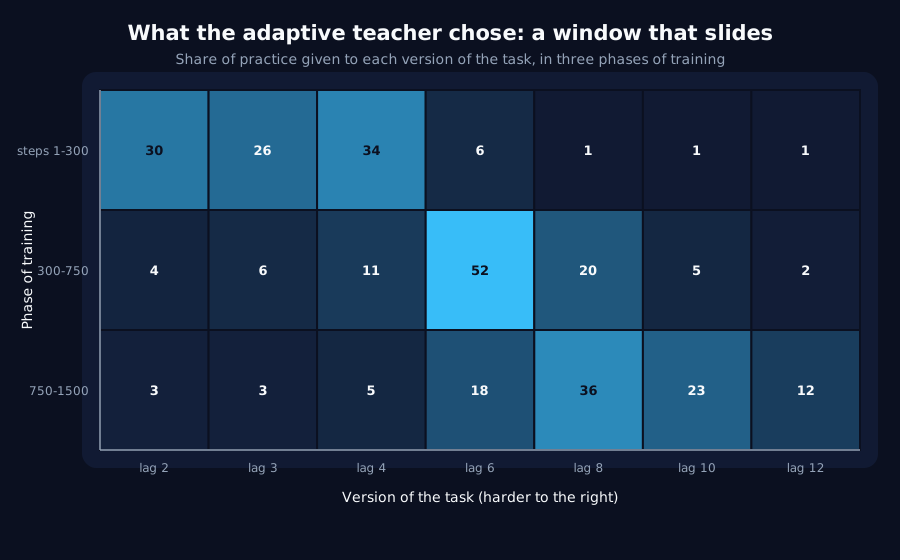
What the teacher found
The teacher's average sampling weight per lag, in three phases of the run:
| Steps | lag 2 | 3 | 4 | 6 | 8 | 10 | 12 |
|---|---|---|---|---|---|---|---|
1-300 | 0.30 | 0.26 | 0.34 | 0.06 | 0.01 | 0.01 | 0.01 |
300-750 | 0.04 | 0.06 | 0.11 | 0.52 | 0.20 | 0.05 | 0.02 |
750-1500 | 0.03 | 0.03 | 0.05 | 0.18 | 0.36 | 0.23 | 0.12 |
A sliding window. It works the easy lags early, then abandons them once they are solved -- about 3% of batches each for the rest of the run -- and concentrates on the one or two lags that are currently learnable. The ramps do the opposite: they keep equal weight on every admitted lag, so by the end of a run four of seven batches are spent on lags already at 0.97-1.00.
All six seeds found nearly the same schedule -- late in training, 68% to 77% of each teacher's batches went to lags 8-12 -- which is why a replayed schedule works as well as a live one.
By lag, the trade is visible: the frontier gives up a little on the easiest lags (0.981 against the ramp's 1.000 at lag 2) and gains a lot on the hard ones (0.752 against 0.644 at lag 8, 0.656 against 0.532 at lag 12).
What stands
- The kill test does not fire. A free bandit teacher beats the best of four fixed ramps by
+0.039and uniform sampling by+0.084, at equal compute, and gets to0.60fastest. - The gain is in the schedule, not the adaptivity. Replaying another run's schedule matches it (
+0.010, interval including zero). The teacher is valuable as a schedule finder. - The schedule is a sliding window: drop what is solved, concentrate on the band that is currently learnable. A fixed "equal weight on everything admitted so far" ramp -- the natural hand-written curriculum -- spends most of the late run on solved tasks.
- The practical reading: run an adaptive teacher once, record what it chose, and ship the recorded schedule. And if you write a curriculum by hand, retire what is learned rather than keeping it in the mix at full weight.
Limits
- The fixed-schedule family was narrow. Four ramps, all "admit and keep at equal weight". A hand-written sliding window might match the teacher outright; that is the obvious next test, and this record does not claim a hand-written schedule cannot do it -- it shows that the one the teacher wrote can.
- One task family, one width, one budget. Seven lags of one copy task; a width-48 GRU that is still climbing at
1500steps. Whether the teacher's schedule transfers across widths or budgets, not just across seeds, was not tested. - A bandit over seven cells, not a program generator. The paper's teacher invents tasks from an unbounded space; ours reweights a fixed menu. The finding is about curriculum over a known family, and says nothing about the paper's claim that zero-data self-play transfers to natural data.
- The replayed arm's
+0.010is small but its interval is not tight enough to rule out a real benefit of live adaptation of about two points. What is ruled out is that adaptation is where most of the+0.039comes from.
Terms on this page
Every piece of vocabulary this record uses, in plain language. Generated from the text above, so it cannot drift out of step with it.
- accuracy
- The fraction of answers a model gets right on questions it was not trained on.
- batch size
- How many examples the model looks at before updating itself once. Bigger batches give a steadier but more expensive update.
- calibration
- Working out an instrument's settings from runs whose answer you already know, so it can be used on a run whose answer you do not.
- curriculum
- The order and mix in which a model is shown its training material, for example easy examples first and harder ones later.
- GRU
- Gated Recurrent Unit. A compact design for processing sequences one item at a time, with internal switches controlling what it keeps in memory.
- held-out
- Data the model was never trained on, kept back specifically to test it. Scoring a model on data it has already seen measures memorisation, not learning.
- kill test
- A condition written down before running the experiment that says what result would make us abandon the idea. Fixing it in advance is what stops a disappointing result being reinterpreted as an encouraging one.
- parameters
- The adjustable numbers inside a model. Training is the process of setting them. Model size is usually quoted as a count of these.
- seed
- The number that fixes all the randomness in a training run. Same seed, same run. Running several seeds is how you tell a real effect from a lucky one.
- width
- How many internal numbers a model uses at each layer. The usual way we vary model size in these experiments.
Get new results as we publish them
Roughly monthly, one finding per email, in plain English first. Including the approaches that turned out not to work, which are usually the useful ones. No sales email.
Double opt-in: we send a confirmation link and add nobody who does not click it. One-click unsubscribe on every email.