
AI Models Have Critical Periods Too
Biologists have a term for a stretch of time in which something has to happen or development goes wrong: a critical period. A kitten's visual system needs light during a specific window early in life. Miss it and the wiring does not form properly, and providing the light later does not fix it.
We went looking for the equivalent in a small AI model, and found one.
The setup
The models we study do not improve smoothly. They sit at a low score for a long stretch and then suddenly get the task right. Something must be getting built during the stretch before that jump.
A model has distinct parts: a piece that reads the input, a memory that carries information forward, and a readout that turns the internal state into an answer. We wanted to know which part has to be working, and when.
So we stopped one part at a time from learning, for forty steps, and then let it resume. Then we measured how much later the model got there.
Almost nothing cares when you interrupt it
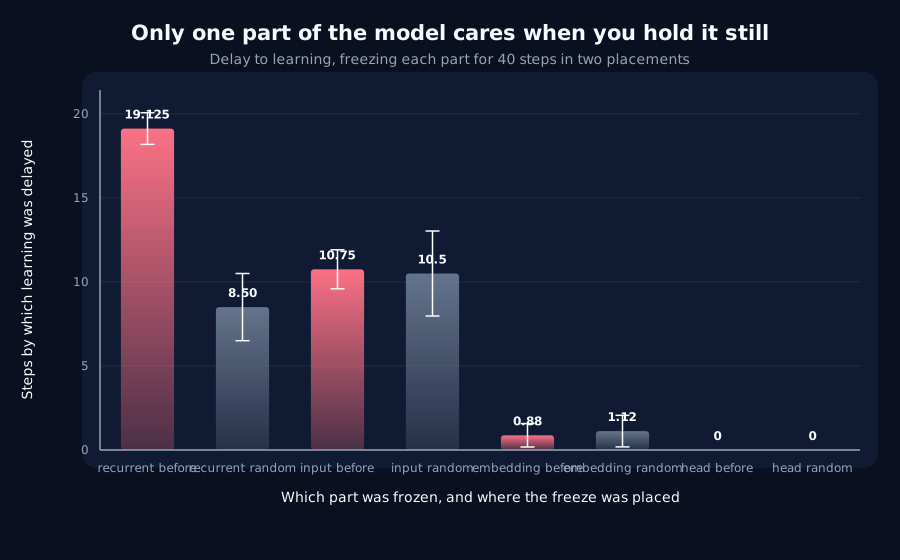
For three of the four parts, the two bars match. Pausing them costs the same wherever you do it, which means they have no special window.
Look at the rightmost pair. That is the model's output layer, and both bars are exactly zero. You can switch off the part that produces the actual answers for forty steps and the timing of learning does not notice. This lined up with a separate experiment of ours that had reached the same conclusion by a completely different route, which is the sort of agreement that makes a result more believable.
The memory is the exception. Pausing it just before the model learns costs more than twice as much as pausing it earlier.
The check that made it a real finding
There was a problem with that comparison, and it is the kind that is easy to miss. The pause placed "just before the model learns" is also, necessarily, the later of the two pauses. So a part whose interruptions simply get more expensive as training goes on would produce exactly the result we saw, with nothing special about the moment of learning at all.
Those two possibilities look identical in the first figure and are completely different claims. Separating them meant sliding the same forty-step pause along the training run and measuring the cost at each position.
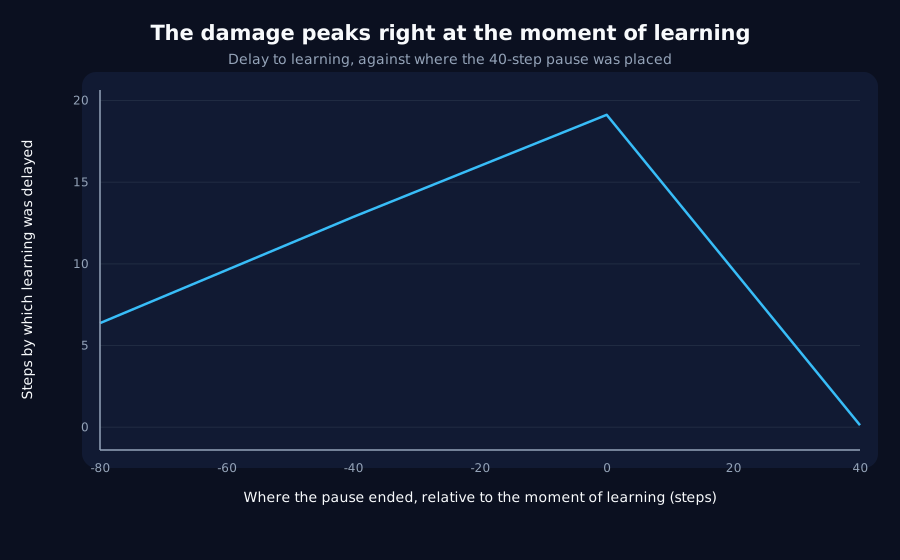
The cost climbs as the pause approaches the moment of learning, peaks right at it, and then falls off a cliff. Forty steps after the model has learned, pausing the same part for the same forty steps costs essentially nothing.
So the memory goes from being the most timing-sensitive part of the model to completely irrelevant, in the space of forty steps. That is a critical period, and it is a narrow one.
In plain English
Think of building an arch. There is a window during construction when the supporting frame is holding everything up and removing it would collapse the whole thing. Before that, there is not much to collapse. After the keystone goes in, the arch holds itself up and the frame can be taken away without anyone noticing.
The model's memory is that frame, and the moment of learning is the keystone going in.
Nothing was broken
Worth being clear about, because it is the part that surprised us: every version of the model still learned the task, to the same accuracy, in every single run.
We changed when learning happened. We never changed whether it could.
That is a meaningfully different result from "this part is essential". The model is more robust than the critical-period framing might suggest. Interrupt the important part at the important moment and it recovers, just later. Nothing here is a single point of failure.
Why we bothered with the second figure
The honest answer is that the first figure alone would have been publishable and wrong, or at least unsupported. It showed a real difference, and a real difference is consistent with two explanations that mean opposite things.
The extra experiment cost about half an hour of laptop time. This is the third time in as many weeks that the deciding factor in one of our results was a control run rather than the original measurement, and the pattern is getting hard to ignore: the interesting question is usually not "is the effect real" but "is the effect the thing I think it is".
The full record, with every number and the limits
Get new results as we publish them
Roughly monthly, one finding per email, in plain English first. Including the approaches that turned out not to work, which are usually the useful ones. No sales email.
Double opt-in: we send a confirmation link and add nobody who does not click it. One-click unsubscribe on every email.