
A Boost off the Frontier
Ongoing research. This is an experimental result from active work, not a settled conclusion. The numbers are what we measured and the method is described so you can judge it, but the programme is still running and later experiments may revise what it means.
A note on the language in these records. This is a working laboratory notebook for research into training AI models more cheaply and efficiently, so you will read that an approach did not work, that a result did not hold up, or that one method was worse than another. That is the research doing its job, not a verdict on the engineering we deliver to clients. Ruling an approach out is how the search narrows, and these are the pages that teach us the most: nearly every technique we now rely on came from understanding why something else fell short. Testing our own ideas at least as hard as anyone else's is the point of publishing them. More about this programme and why we run it.
Part of a bigger question: What actually makes training cheaper? – One thing has worked: stopping part of the training early saved about 7% with no loss of quality. Everything else tested has been matched by a simpler or cheaper method -- and in two cases the clever method was only winning because it was quietly being given more.
In plain English
What we asked. Last time we found that making a small model learn faster, by raising its learning rate, also made it end up slightly less accurate. We wondered whether raising the rate only briefly, early in training, could get the speed without the cost.
What we found. It did. Raising the rate by half for 40 steps made the models learn just as soon as the permanently higher rate, and they ended up just as accurate as with the lower rate. That is 12% less time to learn, for free, on this setup.
Why it matters. Short, early boosts like this are an established idea in training practice, so this is not a new method. It matters here because it is where a long chain of our experiments ended up: something that started as a mysterious special direction inside a model turned out to be a simple, useful learning-rate schedule. Next we test it on other setups.
The rest of this page is the technical record: the design, every number, and the limits. It is written for a reviewer, and you do not need it to have understood the result above.
New here? How to read a research record
- Start at the verdict. Every record states, before the experiment was run, what result would have made us abandon the idea. That is the "kill test". Then it says whether the test fired. Nothing gets reinterpreted after the fact.
- Numbers in square brackets are uncertainty.
23.4 [18.1, 28.7]means our best estimate is 23.4 and the true value is probably somewhere in that range. If a range includes zero, we cannot claim an effect. - Results that rule an idea out are kept. Roughly half of what is published here says an approach did not work, including plenty of our own. Those pages are the output, not a shortfall: knowing which direction is a dead end is what lets the next experiment go somewhere better, and most of what we now rely on came out of understanding why something else fell short. Work that only publishes what worked is not measuring anything.
- Read the Limits section. Every record ends with what it does not show. It is the most honest part of any experiment and usually the shortest.
- Pro tip: the figures near the top are designed to carry the result on their own. If you read nothing else, read the caption under each one, which says what it shows and what to take from it.
EXPLORATORY. Not a preregistered study. Local CPU, 24 training runs. The design and kill test were committed (aab83f9) before any run.
Program v2 Bucket O, item O18. Decisive computation: analysis/boost_accuracy.pyanalysis/boost_accuracy.jsonpython analysis/boost_accuracy.py (about five minutes on a throttled laptop CPU); --reuse re-derives every endpoint from the saved runs, and was checked to print the identical summary.
The question
O16 found J8's substrate (width-48 GRU, delayed copy, lag 4) has a speed-accuracy frontier: faster whole-run learning rates reach the transition sooner and end less accurate, and the fastest rate keeping accuracy is 0.006. It also found a 1.5x boost for forty steps at 0.006 reaches the transition about where a whole-run 0.008 does -- and a whole-run 0.008 ends 0.011 less accurate. Does the boost keep the accuracy? If so, it sits off the frontier.
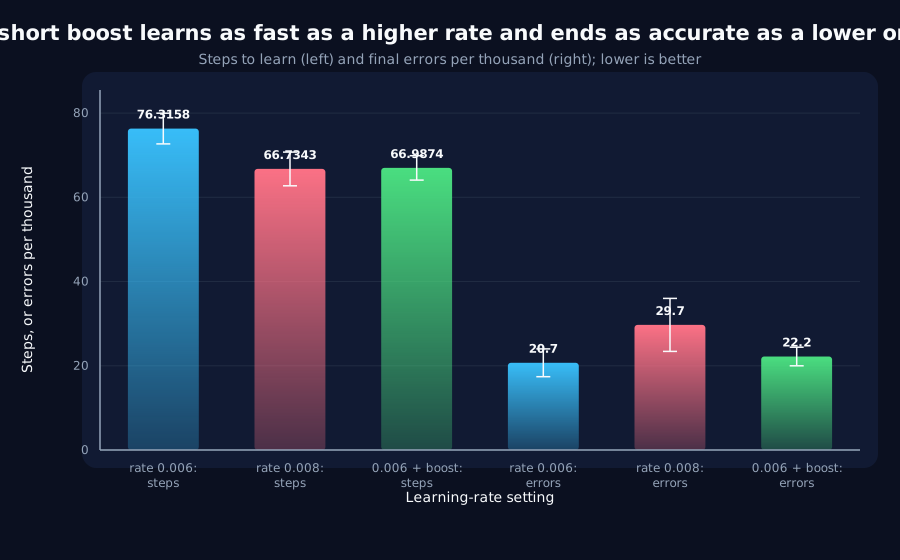
Every run is J8's own train() on J8's eight receivers: whole-run 0.006, whole-run 0.008, and 0.006 boosted 1.5x for steps 36-75 (O16's window), recording the transition and the final held-out accuracy (step 460).
Kill test, fixed before execution: the boosted run's final accuracy minus whole-run 0.008's has an interval including zero or lying below it.
Anchor, in code: every whole-run transition and final accuracy, and every boosted transition, equals O16's committed value exactly. All do.
Result: the kill test does not fire
| Arm | Transition (steps) | Final accuracy |
|---|---|---|
whole-run 0.006 (tuned) | 76.32 [72.68, 79.95] | 0.9793 [0.9760, 0.9826] |
whole-run 0.008 | 66.73 [62.74, 70.73] | 0.9703 [0.9640, 0.9766] |
0.006, boosted for 40 steps | 66.99 [64.09, 69.88] | 0.9778 [0.9756, 0.9801] |
| Paired difference | Transition | Final accuracy |
|---|---|---|
boosted minus whole-run 0.008 | +0.25 [-1.08, +1.58] | +0.0075 [+0.0024, +0.0127] |
boosted minus whole-run 0.006 | -9.33 [-10.36, -8.30] | -0.0015 [-0.0037, +0.0008] |
The boost reaches the transition as soon as the higher rate -- a quarter of a step apart, well inside one evaluation interval (5 steps) -- and ends as accurate as the tuned rate: 0.0075 above the higher rate with an interval clear of zero, and indistinguishable from 0.006. Forty steps of a higher rate, early, buy 12% of the time to the transition at no measurable accuracy cost.
What this is, and is not
- It is an ordinary learning-rate schedule: a short raised rate early, then back down. Schedules of this shape (warm-up and one-cycle policies) are standard practice, so this is not a new method. What is new here is where it came from: the end of a thread that began as a "special direction" (J8), which three records of controls reduced to a learning-rate change and two more priced against a tuned baseline. It is the first thing in that thread that beats the plainest alternative.
- It is on one substrate. Standing rule: an efficiency manoeuvre validated at one width can reverse sign at another (Q1), and a single-task result is R1's exposure. Generates O19: the same boost on a second task and at width
192, each with its own tuned rate. - It has not been compared against the best offline schedule. A boost is one schedule among many; whether a smoother one does better is untested.
What stands
- Kill test does not fire. A
1.5xboost for steps36-75at the tuned0.006matches a whole-run0.008's time to transition (+0.25) and keeps0.0075more final accuracy ([+0.0024, +0.0127]). - Against the tuned rate it saves
9.33steps (12%) with final accuracy unchanged (-0.0015[-0.0037, +0.0008]).
Limits
- One substrate, eight receivers,
460steps, one boost size and one window. - Final accuracy at step
460only; a longer run could close or widen the accuracy gap. - Time to the transition, not compute to a quality target. The boost costs nothing extra per step, so the two agree here, but that is an assumption about the endpoint.
Terms on this page
Every piece of vocabulary this record uses, in plain language. Generated from the text above, so it cannot drift out of step with it.
- accuracy
- The fraction of answers a model gets right on questions it was not trained on.
- baseline
- The thing you compare against. A result without one is not a result.
- evaluation interval
- The gap between successive checks of a model during training. It is the smallest difference in timing a measurement can resolve, so two results closer together than one interval cannot be told apart.
- GRU
- Gated Recurrent Unit. A compact design for processing sequences one item at a time, with internal switches controlling what it keeps in memory.
- held-out
- Data the model was never trained on, kept back specifically to test it. Scoring a model on data it has already seen measures memorisation, not learning.
- kill test
- A condition written down before running the experiment that says what result would make us abandon the idea. Fixing it in advance is what stops a disappointing result being reinterpreted as an encouraging one.
- learning rate
- How big a step training takes each time it updates the model. Too small and nothing happens; too big and it never settles.
- width
- How many internal numbers a model uses at each layer. The usual way we vary model size in these experiments.
Get new results as we publish them
Roughly monthly, one finding per email, in plain English first. Including the approaches that turned out not to work, which are usually the useful ones. No sales email.
Double opt-in: we send a confirmation link and add nobody who does not click it. One-click unsubscribe on every email.