
Being Choosy About Data Costs More Than It Saves
Ongoing research. This is an experimental result from active work, not a settled conclusion. The numbers are what we measured and the method is described so you can judge it, but the programme is still running and later experiments may revise what it means.
A note on the language in these records. This is a working laboratory notebook for research into training AI models more cheaply and efficiently, so you will read that an approach did not work, that a result did not hold up, or that one method was worse than another. That is the research doing its job, not a verdict on the engineering we deliver to clients. Ruling an approach out is how the search narrows, and these are the pages that teach us the most: nearly every technique we now rely on came from understanding why something else fell short. Testing our own ideas at least as hard as anyone else's is the point of publishing them. More about this programme and why we run it.
Part of a bigger question: What actually makes training cheaper? – One thing has worked: stopping part of the training early saved about 7% with no loss of quality. Everything else tested has been matched by a simpler or cheaper method -- and in two cases the clever method was only winning because it was quietly being given more.
In plain English
What we asked. Training a model normally means feeding it whatever data comes next. An appealing alternative is to be selective: look at several candidate batches, work out which one teaches the most, and train only on that. The idea is that data covering ground the model has already learned is close to wasted effort.
What we found. It does not work here, and the reason is not the one we expected. We assumed selection would help and the problem would be affording it, since inspecting data costs time too. In fact selection did not help at all. We even tried a version that cheats, examining each candidate as thoroughly as actually training on it would, which no real system could afford. That version beat picking arbitrarily by half a step out of ninety-four.
Why it matters. This closes the idea at our scale rather than everywhere, and the distinction matters. The most likely explanation is our test data: every batch is drawn the same way from the same source, so there may be genuinely little to choose between them. On messy real-world data, where some examples really are more informative than others, the answer could differ. What we can say is that being selective is not automatically worthwhile, and that the usual argument for it, that you save the training you skip, assumes a benefit that has to be measured rather than presumed.
The rest of this page is the technical record: the design, every number, and the limits. It is written for a reviewer, and you do not need it to have understood the result above.
New here? How to read a research record
- Start at the verdict. Every record states, before the experiment was run, what result would have made us abandon the idea. That is the "kill test". Then it says whether the test fired. Nothing gets reinterpreted after the fact.
- Numbers in square brackets are uncertainty.
23.4 [18.1, 28.7]means our best estimate is 23.4 and the true value is probably somewhere in that range. If a range includes zero, we cannot claim an effect. - Results that rule an idea out are kept. Roughly half of what is published here says an approach did not work, including plenty of our own. Those pages are the output, not a shortfall: knowing which direction is a dead end is what lets the next experiment go somewhere better, and most of what we now rely on came out of understanding why something else fell short. Work that only publishes what worked is not measuring anything.
- Read the Limits section. Every record ends with what it does not show. It is the most honest part of any experiment and usually the shortest.
- Pro tip: the figures near the top are designed to carry the result on their own. If you read nothing else, read the caption under each one, which says what it shows and what to take from it.
EXPLORATORY. Not a preregistered study. Local CPU, 20 training runs, no GPU, no cost.
Program v2 tier 4, item B4. Decisive computation: analysis/gradient_novelty.pyanalysis/gradient_novelty.jsonpython analysis/gradient_novelty.py in about thirty minutes on a throttled laptop CPU.
The question
Score candidate batches by how much of their gradient is unexplained by recent gradients, and spend a full training step only on the novel ones. A batch pointing where training has already gone teaches little, so skipping it should buy back compute.
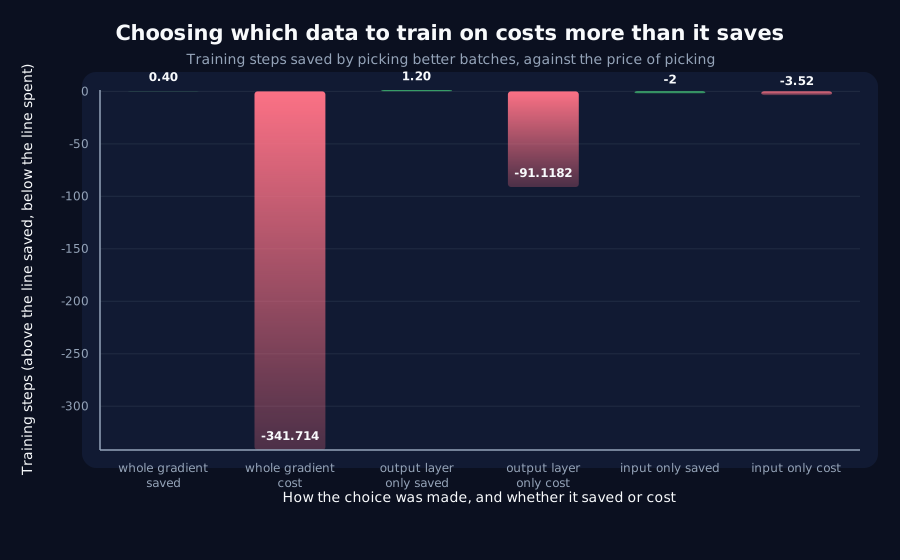
Kill test, from docs/research-program-v2.md: the whole difficulty is making scoring cheaper than the training it saves. That is the kill test, not the effect size.
Four arms, each training on exactly one of four candidates per step, so every arm takes the same number of training steps and differs only in which batch each step used:
| Arm | How a candidate is scored | Cost per scoring pass |
|---|---|---|
| random | take the first candidate, the control | 0 |
| full | the whole gradient. The upper bound on benefit, and not a practical method: it computes exactly what it is trying to avoid computing | 0.92 steps |
| head | the output layer's gradient in closed form from the forward pass, (softmax − onehot)ᵀ @ hidden. One forward, one matmul, no backward | 0.25 steps |
| embed | novelty of the batch's mean token embedding. A lookup and nothing else | 0.01 steps |
The first version's cheap arm was not cheap. It calledloss.backward()and read only the head's gradient, so the backward still traversed the whole recurrence:3.107ms against the full gradient's3.057ms, identical. A rule needing a backward pass to decide whether to do a backward pass was never a candidate, and the smoke test caught the arm doing exactly that. The closed form above is what makes B4's kill test answerable at all.
The kill test never gets to apply
| Arm | Steps to the transition | Overlaps the control? |
|---|---|---|
| random | 93.6 [90.4, 96.8] | , |
| full | 93.2 [90.4, 96.0] | yes |
| head | 92.4 [89.7, 95.1] | yes |
| embed | 95.6 [93.5, 97.7] | yes |
Every arm is indistinguishable from picking the first batch that arrives. All five seeds solved in every arm, and every interval overlaps the control's. The best arm saves 1.2 steps out of 93.6, 1.3%, and the cheapest arm is 2.0 steps worse than random.
Most tellingly, the full-gradient arm saves +0.4 steps. That arm is the upper bound: it has perfect information about each candidate's gradient, at a cost no practical method could pay, and it does not beat choosing arbitrarily.
So the economics never arise. The question was whether scoring could be made cheaper than the training it saves, and there is no training being saved.
The bound closes it
Five seeds cannot prove a zero, so the honest statement is a bound rather than an absence. The control's interval is 6.5 steps wide, 6.9% of the transition, so a benefit smaller than about that would not have been detected.
That bound is still not enough:
- Undetectable benefit is at most ~6.5 steps.
- The cheapest possible scoring bill: the embedding proxy, 80x cheaper than a gradient, is
0.01steps per candidate x 4 candidates x 93.6 steps =3.5steps. - The next cheapest, the closed-form head gradient, bills
23steps.
So the embedding proxy is the only rule whose bill even fits inside the measurement error, and it was the worst-performing arm. A benefit large enough to pay for anything more informative than a lookup would have been visible, and was not.
Verdict
The kill test fires, and for a stronger reason than it anticipated. B4 was framed as an engineering problem: selection helps, but can selection be made cheap enough? On this task the premise fails first: gradient novelty does not select usefully at all, even given the whole gradient for free.
Consequence: gradient-novelty data selection is closed at this scale, and the follow-up is not a cheaper proxy. A cheaper proxy multiplies a benefit that is not there.
Limits
- The benefit measurement is the transferable half; the cost measurement is not. Whether novelty selection picks usefully is a property of the method. The ratio of scoring cost to training cost is a property of this machine at this size: on a width-48 GRU on a CPU, fixed overheads are a large share of a
3.9ms training step, which flatters cheap scoring. On a large model a forward pass is a smaller fraction of a training step, so the head and embedding proxies would look relatively better. That would matter if there were a benefit to scale up. - One task, one width, five seeds, AdamW, 420 steps.
- Novelty is measured against a 16-gradient history with a fixed rule. A different definition, novelty against a longer horizon, or per-example rather than per-batch, is a different experiment. Per-example selection is the version most of the literature actually means, and this pilot does not test it.
- Four candidates per step is one setting. More candidates give selection more to choose between and cost proportionally more; the ratio does not obviously improve.
- The synthetic task's batches are drawn i.i.d. from one distribution, so there may be genuinely little to select between. This is the most likely reason the benefit is zero, and it is the strongest argument that the result is about the task rather than about the method. A task with heterogeneous or curriculum-structured data is the honest follow-up, and is not something this setup can provide.
Terms on this page
Every piece of vocabulary this record uses, in plain language. Generated from the text above, so it cannot drift out of step with it.
- AdamW
- A widely used training algorithm that adapts how big a step it takes for each individual parameter. The default in most modern AI training.
- curriculum
- Training on easier examples first and harder ones later, like a school syllabus, rather than on everything at once.
- gradient
- The direction and amount by which each of a model's internal numbers should change to do slightly better. Training is repeatedly following it.
- GRU
- Gated Recurrent Unit. A compact design for processing sequences one item at a time, with internal switches controlling what it keeps in memory.
- kill test
- A condition written down before running the experiment that says what result would make us abandon the idea. Fixing it in advance is what stops a disappointing result being reinterpreted as an encouraging one.
- seed
- The number that fixes all the randomness in a training run. Same seed, same run. Running several seeds is how you tell a real effect from a lucky one.
- width
- How many internal numbers a model uses at each layer. The usual way we vary model size in these experiments.
Get new results as we publish them
Roughly monthly, one finding per email, in plain English first. Including the approaches that turned out not to work, which are usually the useful ones. No sales email.
Double opt-in: we send a confirmation link and add nobody who does not click it. One-click unsubscribe on every email.