
Neither Half Works Alone
Ongoing research. This is an experimental result from active work, not a settled conclusion. The numbers are what we measured and the method is described so you can judge it, but the programme is still running and later experiments may revise what it means.
A note on the language in these records. This is a working laboratory notebook for research into training AI models more cheaply and efficiently, so you will read that an approach did not work, that a result did not hold up, or that one method was worse than another. That is the research doing its job, not a verdict on the engineering we deliver to clients. Ruling an approach out is how the search narrows, and these are the pages that teach us the most: nearly every technique we now rely on came from understanding why something else fell short. Testing our own ideas at least as hard as anyone else's is the point of publishing them. More about this programme and why we run it.
Part of a bigger question: Which parts of a model actually matter? – The parts that move most are not the parts that matter, and no single component is required -- the model routes around every freeze. What a part is worth shows up only when you remove it.
In plain English
What we asked. A trained model's internal machinery can be described as two things: which directions it works in, and how strongly it works in each direction. Our two previous results found that handing the whole machinery to a fresh model gives it a large head start, but that summary descriptions of that machinery give nothing at all. So we split it down the middle and handed over one half at a time.
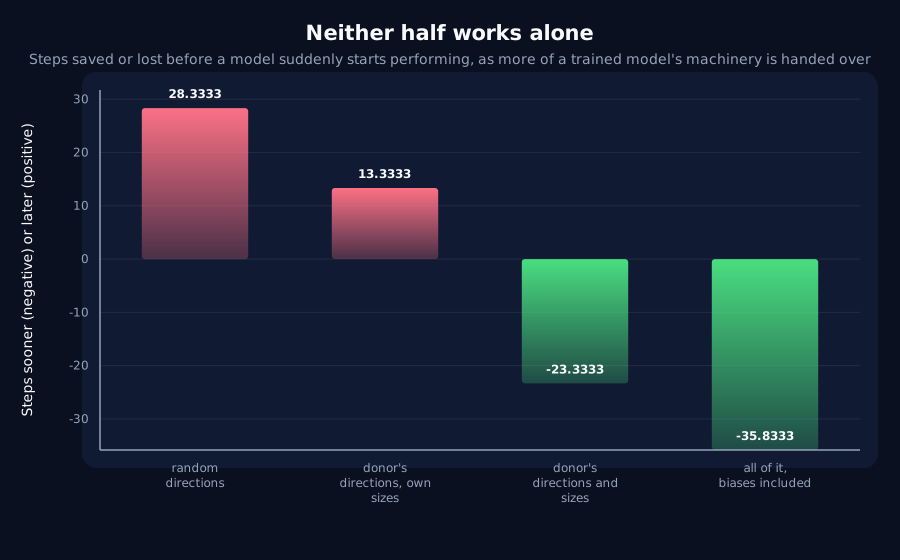
What we found. Neither half does anything. Given the trained model's directions but not its strengths, the fresh model is actually slower than if it had been left alone. A previous experiment found the strengths without the directions behave the same way. Put the two halves together and the result swings by nearly forty steps. What a trained model has built cannot be taken apart and handed over piece by piece.
Why it matters. Two things worth carrying away. The first is that the directions are not worthless, they are just not sufficient: they beat directions chosen at random by about fifteen steps, which is a real difference, and it is still not enough to help. Effects that only exist in combination are easy to miss entirely if you test one ingredient at a time and conclude nothing matters. The second is about a check we included out of habit. We added an arm whose only job was to rebuild the original result exactly, as proof the machinery was working. It failed, and it was right to: we had left out the model's biases, which are under two per cent of its numbers and turn out to carry about a third of the whole benefit. Without that check we would have reported a number a third too small and never noticed.
The rest of this page is the technical record: the design, every number, and the limits. It is written for a reviewer, and you do not need it to have understood the result above.
New here? How to read a research record
- Start at the verdict. Every record states, before the experiment was run, what result would have made us abandon the idea. That is the "kill test". Then it says whether the test fired. Nothing gets reinterpreted after the fact.
- Numbers in square brackets are uncertainty.
23.4 [18.1, 28.7]means our best estimate is 23.4 and the true value is probably somewhere in that range. If a range includes zero, we cannot claim an effect. - Results that rule an idea out are kept. Roughly half of what is published here says an approach did not work, including plenty of our own. Those pages are the output, not a shortfall: knowing which direction is a dead end is what lets the next experiment go somewhere better, and most of what we now rely on came out of understanding why something else fell short. Work that only publishes what worked is not measuring anything.
- Read the Limits section. Every record ends with what it does not show. It is the most honest part of any experiment and usually the shortest.
- Pro tip: the figures near the top are designed to carry the result on their own. If you read nothing else, read the caption under each one, which says what it shows and what to take from it.
EXPLORATORY. Not a preregistered study. Local CPU, 6 receivers across 4 arms, no GPU, no cost.
Program v2 Bucket P, item P6, generated by P5. Decisive computation: analysis/carried_subspace.pyanalysis/carried_subspace.jsonpython analysis/carried_subspace.py; --reuse re-derives every endpoint.
The question
P1 found a donor's converged recurrent weights remove 35.8 steps [-42.0, -29.7] from a receiver's time to transition. P5 imposed the donor's magnitudes: its spectrum, and three other summary statistics, and reproduced none of it. A matrix factors into which directions and how much in each. P5 did the second. This does the first.
Kill test, fixed before execution: the vectors arm does not overlap P1's -35.8 [-42.0, -29.7], or does not separate from a random orthonormal basis.
Anchors, enforced in code: P1's transplant arm and P5's all arm must both re-derive from their committed series. The script exits 2 otherwise.
What we found
Each arm imposes part of a converged donor onto the receiver's own random initialisation. Negative is sooner.
| Arm | Directions | Magnitudes | Biases | Effect |
|---|---|---|---|---|
vectors-random | random | receiver's | receiver's | +28.3 [+22.0, +34.7] |
vectors | donor's | receiver's | receiver's | +13.3 [+9.0, +17.6] |
weights | donor's | donor's | receiver's | -23.3 [-27.6, -19.0] |
weights-and-biases | donor's | donor's | donor's | -35.8 [-42.0, -29.7] |
The bottom row reproduces P1 exactly, which is the reconstruction sanity check and it passes.
The kill test fires. The donor's directions alone land at +13.3, nowhere near -35.8, and still a net delay against doing nothing.
But the directions are not nothing
vectors separates cleanly from vectors-random: +13.3 [+9.0, +17.6] against +28.3 [+22.0, +34.7], intervals well apart. The donor's directions are worth about fifteen steps relative to random directions of the same shape. They just are not worth anything relative to doing nothing at all.
The head start is irreducibly joint
Read against P5, the picture is unusually clean:
- donor's magnitudes alone (P5's
spectrum):+10.0, useless - donor's directions alone (
vectors):+13.3, useless - both together (
weights):-23.3, a swing of nearly 37 steps
Neither factor does anything on its own and together they do most of the work. There is no single carried property, which is why P5 found no statistic and why this record does not name one either. What transfers is a matrix, and a matrix is not the sum of its parts.
288 parameters carry a third of it
weights-and-biases beats weights by 12.5 steps, about a third of the whole effect, and the gate biases are 288 of 17,280 parameters, 1.7% of the model. P5 tested biases alone and got +5.8, nothing. So the biases contribute only in the presence of the donor's weights: another interaction, and a large one for so few numbers.
The sanity check that earned its place
The first execution's top rung stopped at weights and was asserted to reproduce P1. It gave -23.3 against P1's -35.8 and failed. The cause was not a broken reconstruction: the imposition loop skips bias tensors, while P1's arm copies them, so the two were simply different arms. Splitting them into two rungs is what made the bias contribution visible at all.
Had the sanity check been omitted, or written loosely enough to pass, the -23.3 would have been reported as P1's effect reproduced and a third of the phenomenon would have been invisible.
Limits
- The transition endpoint is quantised to 5 steps, so differences smaller than that cannot be ranked. The gaps here are 12 to 37 steps.
- The factorisation is per gate block of each recurrent matrix, which is the natural unit for a GRU but is a choice; a whole-matrix SVD would mix the gates.
vectorskeeps the receiver's singular values in their own order, paired against the donor's vectors by rank. Other pairings are possible and are not swept.- Six receivers, one width, one task, one graft point, one donor per receiver.
- Nothing here is an efficiency claim. The donor still costs 400 steps to save 36.
Terms on this page
Every piece of vocabulary this record uses, in plain language. Generated from the text above, so it cannot drift out of step with it.
- GRU
- Gated Recurrent Unit. A compact design for processing sequences one item at a time, with internal switches controlling what it keeps in memory.
- kill test
- A condition written down before running the experiment that says what result would make us abandon the idea. Fixing it in advance is what stops a disappointing result being reinterpreted as an encouraging one.
- parameters
- The adjustable numbers inside a model. Training is the process of setting them. Model size is usually quoted as a count of these.
- rank
- How many independent directions a set of numbers really uses. A low-rank structure is one that looks high-dimensional but is actually simple underneath.
- recurrent
- A design that reads a sequence one item at a time, carrying memory forward. The main alternative is attention, which looks at everything at once.
- singular value
- A measure of how much a mathematical operation stretches things along one particular direction. The largest one describes the direction of strongest effect.
- SVD
- Singular Value Decomposition. A standard mathematical procedure that breaks a table of numbers into its independent directions, strongest first. It is how we measure internal structure throughout this work.
- width
- How many internal numbers a model uses at each layer. The usual way we vary model size in these experiments.
Get new results as we publish them
Roughly monthly, one finding per email, in plain English first. Including the approaches that turned out not to work, which are usually the useful ones. No sales email.
Double opt-in: we send a confirmation link and add nobody who does not click it. One-click unsubscribe on every email.