
No Part of the Model Is Special
Ongoing research. This is an experimental result from active work, not a settled conclusion. The numbers are what we measured and the method is described so you can judge it, but the programme is still running and later experiments may revise what it means.
A note on the language in these records. This is a working laboratory notebook for research into training AI models more cheaply and efficiently, so you will read that an approach did not work, that a result did not hold up, or that one method was worse than another. That is the research doing its job, not a verdict on the engineering we deliver to clients. Ruling an approach out is how the search narrows, and these are the pages that teach us the most: nearly every technique we now rely on came from understanding why something else fell short. Testing our own ideas at least as hard as anyone else's is the point of publishing them. More about this programme and why we run it.
Part of a bigger question: Which parts of a model actually matter? – The parts that move most are not the parts that matter, and no single component is required -- the model routes around every freeze. What a part is worth shows up only when you remove it.
In plain English
What we asked. A model's memory is a large bundle of numbers with no natural divisions. We forced some divisions on it, splitting the memory into separate compartments that were not allowed to communicate, and asked whether the reorganisation we study concentrates in one compartment. If it did, you could target that compartment: grow it, prune the others, spend your effort where it counts.
What we found. Nothing concentrates. At every split we tried, the compartments differed from each other by no more than two repeats of the same compartment differed from each other, which is another way of saying they did not differ at all. Splitting the model up did make it learn later and score slightly worse, so the connections we cut were doing real work, but no individual piece was carrying the effect.
Why it matters. This closes a line of work we had been holding open. An earlier programme of ours found that you can rearrange a model's internal coordinates almost freely without hurting it, which suggested there was nothing specific to grab hold of. The obvious objection was that coordinates are the wrong unit, and that real compartments might behave differently. They do not. The same negative result holds one level up, which makes it a stronger statement than it was.
The rest of this page is the technical record: the design, every number, and the limits. It is written for a reviewer, and you do not need it to have understood the result above.
New here? How to read a research record
- Start at the verdict. Every record states, before the experiment was run, what result would have made us abandon the idea. That is the "kill test". Then it says whether the test fired. Nothing gets reinterpreted after the fact.
- Numbers in square brackets are uncertainty.
23.4 [18.1, 28.7]means our best estimate is 23.4 and the true value is probably somewhere in that range. If a range includes zero, we cannot claim an effect. - Results that rule an idea out are kept. Roughly half of what is published here says an approach did not work, including plenty of our own. Those pages are the output, not a shortfall: knowing which direction is a dead end is what lets the next experiment go somewhere better, and most of what we now rely on came out of understanding why something else fell short. Work that only publishes what worked is not measuring anything.
- Read the Limits section. Every record ends with what it does not show. It is the most honest part of any experiment and usually the shortest.
- Pro tip: the figures near the top are designed to carry the result on their own. If you read nothing else, read the caption under each one, which says what it shows and what to take from it.
EXPLORATORY. Not a preregistered study. Local CPU, 27 training runs, no GPU, no cost.
Program v2 tier 4, item E8. Decisive computation: analysis/modular_state.pyanalysis/modular_state.jsonpython analysis/modular_state.py in about forty minutes on a throttled laptop CPU.
The question
Program v1 closed on a negative: coordinate-level geometry is fungible. Reshaping which directions a model uses costs nothing, at every width, difficulty, subspace and weight tested. E8 asks the same question one level up, at the architectural level.
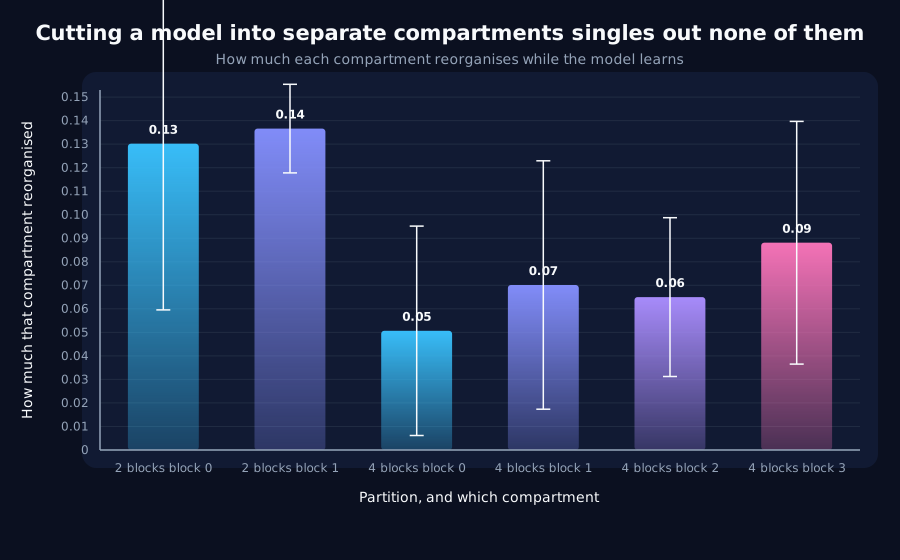
Hard-partition the hidden state into blocks with a block-diagonal recurrence, so the blocks are separate recurrent streams that share an input and a readout. Does the transition and its expansion localise to one block, or spread across all of them?
Localisation would matter. It would give structural interventions their first legitimate target, grow, prune or freeze blocks, where v1's coordinate-level version proved there was nothing to take hold of.
Kill test, from docs/research-program-v2.md: expansion is uniform across blocks at every partition tested.
How the partition is imposed, and why it needed checking
The recurrent matrices are masked to block-diagonal after every optimizer step. Two details matter and both were verified rather than assumed:
- A GRU stacks its three gates in
weight_hh, so the mask is applied to each gate's own square submatrix. Masking the stacked tensor would be a different and meaningless operation. - Re-imposing after every step is essential, because AdamW's update is dense. A single unmasked step leaks cross-block weight back in, and the partition would quietly decay away over training.
Verified directly: off-block entries are exactly zero, with 100% / 50% / 25% of each gate kept at 1 / 2 / 4 blocks, and the unpartitioned arm is a genuine no-op through the same code path.
Result: uniform
| Partition | Between-block spread | Seed spread within one block | Ratio |
|---|---|---|---|
| 2 blocks of 24 | 0.0064 | 0.0360 | 0.18 |
| 4 blocks of 12 | 0.0374 | 0.0368 | 1.02 |
The kill test fires. The right comparison is between-block differences against seed-to-seed variation inside a single block, because with five seeds some block is always largest and the question is whether that means anything.
- At 2 blocks the answer is decisive: blocks differ by a fifth of what seeds do. Whatever separates the two blocks is far smaller than what separates two runs of the same block.
- At 4 blocks the between-block spread is
1.02xthe seed spread, which is to say the blocks differ by exactly as much as chance, since that ratio is the definition of no effect.
The secondary check agrees and is weaker: the largest block is the same one in 60% of runs against 25% by chance. At five seeds that is not evidence of anything, and it is reported as the lesser statistic rather than as support. The variance ratio is the one carrying the verdict.
So v1's coordinate-level result reappears at the architectural level. Partitioning the state into genuinely separate recurrent streams does not concentrate the phenomenon anywhere. Structural interventions still have nothing to grab.
Partitioning is not free
The blocks do not differ from each other, and the partition itself costs plainly:
| Partition | Transition | Final accuracy | Expansion |
|---|---|---|---|
| unpartitioned | 96 | 0.9888 | 0.2261 [0.1814, 0.2707] |
| 2 blocks | 117 | 0.9802 | ~0.133 |
| 4 blocks | 134 | 0.9706 | ~0.068 |
Cutting the recurrence into blocks makes the transition later and the final accuracy lower, monotonically. So the recurrence's cross-block connectivity is doing real work, which is consistent with D1 and D5 finding the recurrence load-bearing and the readout not.
The expansion column is not a controlled comparison and no claim rests on it. Rank is a fixed fraction of block dimension, which makes blocks comparable within a partition: that is what the headline uses. It does not make a 12-dimensional block comparable to a 48-dimensional one: residual energy in a small space behaves differently at a matched fraction. The monotone decrease may be real or may be dimensionality. Settling it needs a design that varies block count at fixed block size, which means varying total width.
Verdict
- Expansion is uniform across blocks at both partitions tested. The kill test fires.
- At 2 blocks this is decisive (ratio
0.18); at 4 blocks the ratio is1.02, which is no-effect rather than a weak effect, though five seeds is thin for the secondary check. - Structural interventions gain no target. This is program v1's central negative, restated at a level v1 did not test.
- Cross-block connectivity is load-bearing, which is a positive finding arriving sideways: partitioning delays the transition and costs accuracy.
Limits
- One task, one width, five seeds, two partitions, AdamW.
- The 4-block arm is underpowered for its secondary check. Distinguishing a 60% argmax consistency from 25% chance needs roughly twenty seeds, not five. The variance ratio does not have that problem and is what the verdict uses.
- Blocks are equal-sized and contiguous. An unequal or interleaved partition is a different experiment, and a phenomenon localising to a set of coordinates that straddles block boundaries would be invisible to this design.
- The expansion endpoint is max-minus-baseline, positive under noise by construction. Only the within-partition comparison between blocks is claimed.
- Only the recurrence is partitioned;
weight_ihand the readout stay dense, by design, so that a block is a separate stream rather than a relabelling of coordinates. A fully partitioned model, input and readout included, is a different and more severe intervention.
Terms on this page
Every piece of vocabulary this record uses, in plain language. Generated from the text above, so it cannot drift out of step with it.
- accuracy
- The fraction of answers a model gets right on questions it was not trained on.
- AdamW
- A widely used training algorithm that adapts how big a step it takes for each individual parameter. The default in most modern AI training.
- argmax
- Short for 'the argument that maximises'. A model outputs a score for every possible next token; the argmax is simply whichever one scored highest. Accuracy is measured on the argmax, which is why accuracy is a thresholded quantity: only the winner counts, and by how much it won is discarded.
- baseline
- The thing you compare against. A result without one is not a result.
- GRU
- Gated Recurrent Unit. A compact design for processing sequences one item at a time, with internal switches controlling what it keeps in memory.
- hidden state
- The model's working memory: the internal numbers it carries from one step of a sequence to the next.
- kill test
- A condition written down before running the experiment that says what result would make us abandon the idea. Fixing it in advance is what stops a disappointing result being reinterpreted as an encouraging one.
- optimizer
- The algorithm that decides how to change the model given the gradient. AdamW and SGD are two common choices and they behave differently.
- rank
- How many independent directions a set of numbers really uses. A low-rank structure is one that looks high-dimensional but is actually simple underneath.
- recurrent
- A design that reads a sequence one item at a time, carrying memory forward. The main alternative is attention, which looks at everything at once.
- residual
- How far the data sits from a proposed description of it, after the description has been fitted as well as it can be. A small residual means the description accounts for what was measured; a large one means something is missing.
- residual energy
- Our measure of how much of a model's internal activity is left over after accounting for its few strongest directions. High means the activity is spread out; low means it is concentrated.
- seed
- The number that fixes all the randomness in a training run. Same seed, same run. Running several seeds is how you tell a real effect from a lucky one.
- subspace
- A slice of a model's internal space: some directions kept, the rest ignored.
- variance
- How spread out a set of numbers is. Rising variance in a signal means it is becoming more erratic.
- width
- How many internal numbers a model uses at each layer. The usual way we vary model size in these experiments.
Get new results as we publish them
Roughly monthly, one finding per email, in plain English first. Including the approaches that turned out not to work, which are usually the useful ones. No sales email.
Double opt-in: we send a confirmation link and add nobody who does not click it. One-click unsubscribe on every email.