
How You Cut a Model Matters, Not Just How Much
Ongoing research. This is an experimental result from active work, not a settled conclusion. The numbers are what we measured and the method is described so you can judge it, but the programme is still running and later experiments may revise what it means.
A note on the language in these records. This is a working laboratory notebook for research into training AI models more cheaply and efficiently, so you will read that an approach did not work, that a result did not hold up, or that one method was worse than another. That is the research doing its job, not a verdict on the engineering we deliver to clients. Ruling an approach out is how the search narrows, and these are the pages that teach us the most: nearly every technique we now rely on came from understanding why something else fell short. Testing our own ideas at least as hard as anyone else's is the point of publishing them. More about this programme and why we run it.
Part of a bigger question: Which parts of a model actually matter? – The parts that move most are not the parts that matter, and no single component is required -- the model routes around every freeze. What a part is worth shows up only when you remove it.
In plain English
What we asked. A model's memory is a grid of connections between its internal units. An earlier experiment showed that cutting a lot of them out costs real performance. This asks a follow-up that sounds pedantic and is not: does the damage come from how many connections you remove, or from which ones?
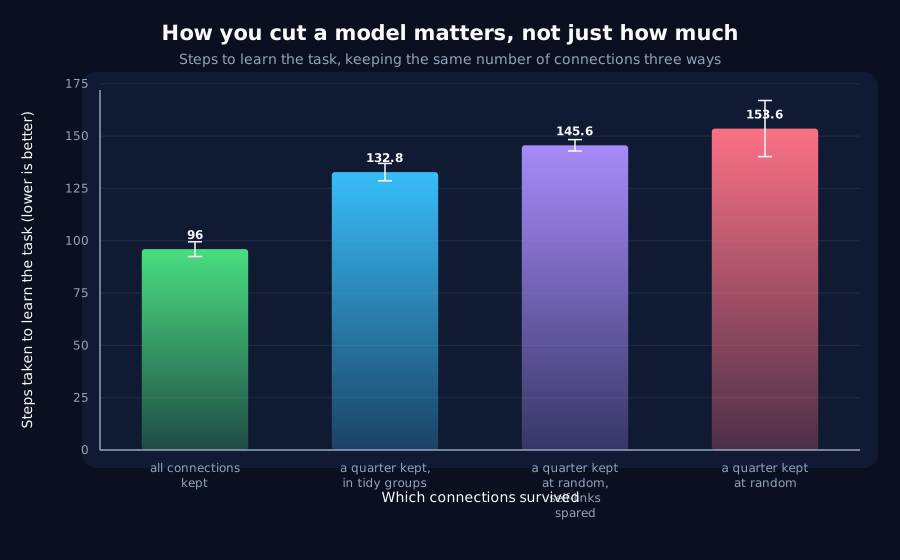
What we found. From which ones, clearly. Removing three quarters of the connections in tidy square groups costs about twenty fewer steps to learn the task than removing exactly the same number at random, and ends five percentage points more accurate. Structure is worth something even at identical cost.
Why it matters. The part worth reading is what nearly went wrong. Tidy groups happen to preserve every unit's connection to itself, and random cutting does not, and a unit's connection to itself is how it remembers anything. So the whole advantage might have been that one detail rather than the grouping. We only noticed while writing up the limitations. Testing it took an extra ten runs and showed the detail explains roughly half the effect, leaving the other half genuinely to the grouping. Without that check we would have claimed all of it.
The rest of this page is the technical record: the design, every number, and the limits. It is written for a reviewer, and you do not need it to have understood the result above.
New here? How to read a research record
- Start at the verdict. Every record states, before the experiment was run, what result would have made us abandon the idea. That is the "kill test". Then it says whether the test fired. Nothing gets reinterpreted after the fact.
- Numbers in square brackets are uncertainty.
23.4 [18.1, 28.7]means our best estimate is 23.4 and the true value is probably somewhere in that range. If a range includes zero, we cannot claim an effect. - Results that rule an idea out are kept. Roughly half of what is published here says an approach did not work, including plenty of our own. Those pages are the output, not a shortfall: knowing which direction is a dead end is what lets the next experiment go somewhere better, and most of what we now rely on came out of understanding why something else fell short. Work that only publishes what worked is not measuring anything.
- Read the Limits section. Every record ends with what it does not show. It is the most honest part of any experiment and usually the shortest.
- Pro tip: the figures near the top are designed to carry the result on their own. If you read nothing else, read the caption under each one, which says what it shows and what to take from it.
EXPLORATORY. Not a preregistered study. Local CPU, 25 training runs, no GPU, no cost.
Program v2 Bucket G, item G4. Decisive computation: analysis/sparse_recurrence.pyanalysis/sparse_recurrence.jsonpython analysis/sparse_recurrence.py in about forty minutes on a throttled laptop CPU.
The question
E8 partitioned the hidden state into blocks and found no block is special, but also that partitioning is not free: the transition moved 96 → 117 → 134 and accuracy fell 0.9888 → 0.9802 → 0.9706 as blocks doubled. Something about cutting those connections cost real performance even though no single block carried the phenomenon.
A block-diagonal mask confounds two things: how many connections remain, and where they are. At two blocks half the recurrent weights are gone; at four blocks, three quarters. E8 cannot say which produced the cost.
Kill test: random sparsity and block-diagonal cost the same at matched density. Then the loss is about how many connections survive, not their arrangement.
The positive control holds almost exactly
The block arms are E8 replicated, so they double as a check that this harness matches the one E8 ran on:
| Arm | G4 transition / accuracy | E8 transition / accuracy |
|---|---|---|
| dense | 96 / 0.9880 | 95 / 0.9889 |
| block, 50% | 117 / 0.9828 | 117 / 0.9801 |
| block, 25% | 133 / 0.9746 | 134 / 0.9706 |
Within one step and four thousandths of accuracy. Whatever the comparison below says, it is not saying it from a different setup.
The confound this record nearly shipped with
The first version of this pilot compared block-diagonal against plain random sparsity, matched on the number of surviving weights. That comparison is confounded, and writing the Limits section is what surfaced it:
| Mask | Entries kept | Self-connections kept |
|---|---|---|
| block, 25% | 576 | 48 / 48 |
| random, 25% | 576 | 12 / 48 |
The diagonal of a recurrent matrix is how a unit retains its own state across time. A block mask keeps all of it by construction; a random mask keeps roughly its density. So "block beats random" could have been entirely "keeping self-connections beats not keeping them", which has nothing to do with grouping.
So a third arm: random with every self-connection kept, the remaining budget spent at random off the diagonal, matched on total count. All three arms keep identical entry counts, and this one matches block on the diagonal too, leaving grouping as the only thing that differs.
Result: the kill test fires, and grouping survives the control
Masks are matched exactly on surviving weights, verified directly rather than assumed.
| Density | Arrangement | Transition | Final accuracy |
|---|---|---|---|
| 100% | dense | 96 [92, 100] | 0.9880 |
| 50% | block | 117 [111, 122] | 0.9828 |
| 50% | random | 125 [117, 133] | 0.9699 |
| 50% | rand + diagonal | 121 [119, 123] | 0.9683 |
| 25% | block | 133 [129, 137] | 0.9746 [0.9713, 0.9778] |
| 25% | random | 154 [140, 167] | 0.9234 [0.9116, 0.9351] |
| 25% | rand + diagonal | 146 [143, 148] | 0.9078 [0.8770, 0.9387] |
At 25% density block-diagonal is better than both random arms. It transitions 21 steps before plain random and 13 steps before random-with-the-diagonal-kept, with the accuracy intervals separating in both comparisons.
How much was the diagonal?
| Density | Block's total advantage | Remaining once the diagonal is matched | Diagonal explains |
|---|---|---|---|
| 50% | -8 steps | -4 steps | 50% |
| 25% | -21 steps | -13 steps | 38% |
Roughly half the effect was the confound, and roughly half was not. Had the control not been run, this record would have claimed the whole 21 steps for grouping. Had the control been run and closed the gap, the headline would have been the opposite. It did neither, which is the outcome that needed the arm to distinguish.
At 50% the block-against-plain-random gap is not material on its own (overlapping intervals), while the block-against-diagonal gap is. That is not a contradiction: the diagonal-preserving arm has much tighter intervals ([119, 123] against [117, 133]), because fixing the diagonal removes a large source of variation between random draws.
What this changes about E8
E8's cost is not a general property of removing that many connections. It is specific to the arrangement E8 tested, and that arrangement turns out to be the favourable one.
The stated prior for this item was "moderate-high that density is what matters". That was wrong, and wrong in the more interesting direction: structure beats randomness at matched cost, and it does so even once self-retention is equalised. A recurrence cut into clean blocks keeps more of its capability than one cut at random with the same number of weights and the same diagonal.
A reading consistent with E8 and G4 together. E8 found no block is special, and G4 finds the block structure is worth something. Those are compatible: no individual block carries the phenomenon, and yet organising the surviving connections into coherent groups preserves more than scattering them. What is being preserved is the ability of a group of units to talk to each other, which is a property of the arrangement rather than of any block in it.
That also sharpens E8's negative. Structural interventions still have nothing to grab in the sense E8 tested: you cannot pick a block to grow or prune, because none is special. But arrangement is not irrelevant, so a structural intervention that changes how connections are grouped rather than which block to target is not ruled out by either record.
Verdict
- The kill test fires. Block-diagonal and random sparsity do not cost the same at matched density.
- Block-diagonal is better, by
21steps and5.1accuracy points at 25% against plain random. - Grouping survives the diagonal control. Block still beats random-with-every-self-connection- kept by
13steps at 25%, so the advantage is not merely self-retention. - Self-retention is 38-50% of it, which is the part this record would have wrongly claimed for grouping without the extra arm.
- E8's cost is arrangement-specific, and E8 happened to test the favourable arrangement.
Limits
- One task, one width, one optimizer, five seeds, two densities.
- The comparison is by interval overlap rather than paired, because the two masks are different objects and the seeds are not matched arms of a single experiment. That is the weaker test, and it is the honest one here.
- Random masks are drawn per seed, so the result does not rest on one unlucky arrangement, but five draws is still a small sample of the space of random masks. A block mask is one specific arrangement out of many structured ones, and this record does not test whether other structures (banded, hierarchical, small-world) behave like blocks or like random.
- Only the recurrence is masked; the input and readout stay dense, following E8.
- The largest alternative explanation was tested and is only half the story. Preserving every self-connection accounts for 38-50% of block's advantage; the remainder is grouping. What grouping is doing is still an account rather than a measurement, and separating it further, for example from the fact that a block mask guarantees every unit has some surviving partners while a random mask can isolate one entirely, would need another arm.
- The diagonal-preserving arm has notably tighter intervals than plain random, which is expected and worth stating: fixing the diagonal removes a large source of variation between random draws.
Terms on this page
Every piece of vocabulary this record uses, in plain language. Generated from the text above, so it cannot drift out of step with it.
- accuracy
- The fraction of answers a model gets right on questions it was not trained on.
- confound
- A second explanation you did not control for. If bigger models both learn faster and score higher, then 'fast learners score higher' may be entirely about size and not about speed.
- harness
- Everything wrapped around a model when it is used as an agent: its instructions, the tools it can call and how they are named, and how the conversation is laid out.
- hidden state
- The model's working memory: the internal numbers it carries from one step of a sequence to the next.
- kill test
- A condition written down before running the experiment that says what result would make us abandon the idea. Fixing it in advance is what stops a disappointing result being reinterpreted as an encouraging one.
- optimizer
- The algorithm that decides how to change the model given the gradient. AdamW and SGD are two common choices and they behave differently.
- recurrent
- A design that reads a sequence one item at a time, carrying memory forward. The main alternative is attention, which looks at everything at once.
- seed
- The number that fixes all the randomness in a training run. Same seed, same run. Running several seeds is how you tell a real effect from a lucky one.
- width
- How many internal numbers a model uses at each layer. The usual way we vary model size in these experiments.
Get new results as we publish them
Roughly monthly, one finding per email, in plain English first. Including the approaches that turned out not to work, which are usually the useful ones. No sales email.
Double opt-in: we send a confirmation link and add nobody who does not click it. One-click unsubscribe on every email.