
The Alarm Never Got To Speak
Ongoing research. This is an experimental result from active work, not a settled conclusion. The numbers are what we measured and the method is described so you can judge it, but the programme is still running and later experiments may revise what it means.
A note on the language in these records. This is a working laboratory notebook for research into training AI models more cheaply and efficiently, so you will read that an approach did not work, that a result did not hold up, or that one method was worse than another. That is the research doing its job, not a verdict on the engineering we deliver to clients. Ruling an approach out is how the search narrows, and these are the pages that teach us the most: nearly every technique we now rely on came from understanding why something else fell short. Testing our own ideas at least as hard as anyone else's is the point of publishing them. More about this programme and why we run it.
Part of a bigger question: How do we know our own results are real? – Repeatedly, the control rather than the measurement decided the result -- and several striking findings dissolved when the right comparison was finally run.
In plain English
What we asked. One of our early-warning rules has to watch a model for 41 steps before it is allowed to raise an alarm, because it needs that much history to judge what is normal. We had tested it in progressively larger models and reported that it stops working in the largest one, and we drew a broad conclusion from that: this whole family of early-warning signals is an artefact of small models.
What we found. The conclusion did not follow. In that largest model the task was so easy that learning finished at step 39, which is two steps before the rule was allowed to say anything. It did not fail to warn us; it never got to speak. Give the same model a harder task, so there are nearly eighty steps of room after the warm-up, and both of our alarms work and give about fifty steps of warning. That is more warning than they give in a smaller model, not less.
Why it matters. This was the last of six results we set out to recheck, and it completes an uncomfortable picture: five of the six turned out to be problems with how we measured rather than facts about model size. The two instruments we had written off entirely both give more warning in bigger models once the task keeps pace with them, which is a coherent story from two unrelated measurements and the opposite of what our own archive said a day earlier. One caution we want to keep attached: an instrument that works is not the same as an instrument worth paying for. A separate result of ours found that acting on these warnings was matched exactly by acting at a random moment, and nothing here changes that.
The rest of this page is the technical record: the design, every number, and the limits. It is written for a reviewer, and you do not need it to have understood the result above.
New here? How to read a research record
- Start at the verdict. Every record states, before the experiment was run, what result would have made us abandon the idea. That is the "kill test". Then it says whether the test fired. Nothing gets reinterpreted after the fact.
- Numbers in square brackets are uncertainty.
23.4 [18.1, 28.7]means our best estimate is 23.4 and the true value is probably somewhere in that range. If a range includes zero, we cannot claim an effect. - Results that rule an idea out are kept. Roughly half of what is published here says an approach did not work, including plenty of our own. Those pages are the output, not a shortfall: knowing which direction is a dead end is what lets the next experiment go somewhere better, and most of what we now rely on came out of understanding why something else fell short. Work that only publishes what worked is not measuring anything.
- Read the Limits section. Every record ends with what it does not show. It is the most honest part of any experiment and usually the shortest.
- Pro tip: the figures near the top are designed to carry the result on their own. If you read nothing else, read the caption under each one, which says what it shows and what to take from it.
EXPLORATORY. Not a preregistered study. Local CPU, 2 difficulty rungs x 5 seeds at width 192, no GPU, no cost.
Program v2 Bucket P, item P12, fourth and last case. Decisive computation: analysis/alarms_matched.pyanalysis/alarms_matched.jsonpython analysis/alarms_matched.py; --reuse re-derives every endpoint.
The question
K1 width-swept two gradient alarms and concluded that "the whole leading-indicator line is a small-model artifact". Its own verdict names the mechanism: at width 192 the model transitions before step 41, "which is the earliest this rule can fire at all", and its committed summary records room_before_warmup of -2.2 steps.
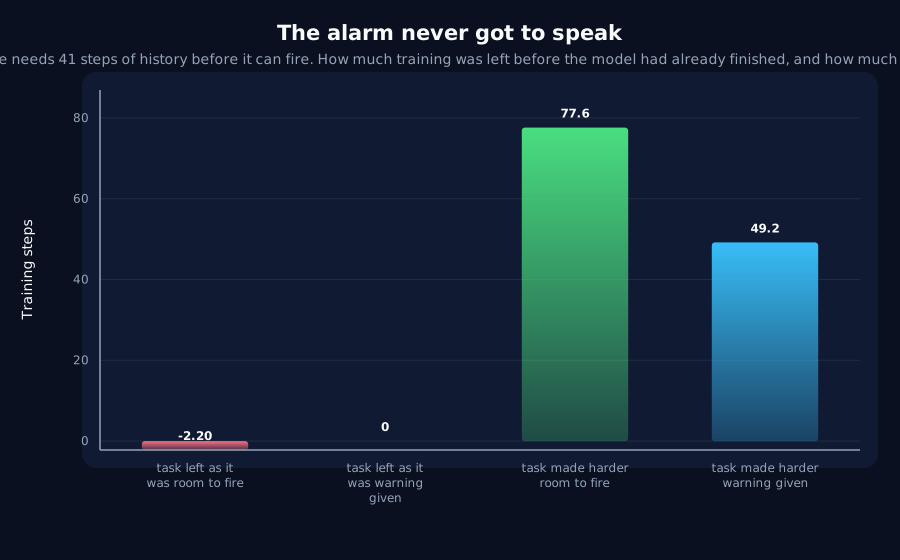
That is not an instrument failing. That is a run shorter than the instrument's warm-up. The alarm needs 41 steps of history before it can speak, and on the fixed lag-4 task a width-192 model has finished at step 38.8.
Kill test, fixed before execution: the alarms still fail to produce a usable lead at width 192 once the task is hardened.
Anchor enforced in code: the easy arm must reproduce K1's width-192 failure, both indicators unusable, room_before_warmup negative. It does, at -2.2.
K1's own guard is carried over unchanged, and it is the one that matters: a threshold firing at the same step in every run is a clock, not a detector, and would win a longest-lead contest by construction. choose_factor rejects thresholds whose firing step does not move.
What we found
| Rung | Lag | Transition | Room before warm-up | Indicators with a usable lead |
|---|---|---|---|---|
easy (K1's own) | 4 | 38.8 | -2.2 | none |
hard | 11 | 118.6 | +77.6 | global_norm, off_top |
| Indicator, hard rung | Fires at | Lead |
|---|---|---|
global_norm | 69.4 | 49.2 steps [30.0, 68.4] |
off_top | 68.8 | 49.8 steps [32.7, 66.9] |
The kill test does not fire. Both alarms work at width 192 once the run is long enough for them to fire at all, and both pass K1's clock guard, so the thresholds selected are genuinely moving with the run rather than firing on a fixed schedule.
And the leads are longer, not shorter. K1 measured 30.8 steps at width 48. At width 192 with difficulty matched, both indicators give about 49.
What this does to K1
K1's conclusion is withdrawn. "The whole leading-indicator line is a small-model artifact" does not follow from its own data: at the one width where the alarms failed, they failed because the model finished before they were allowed to speak. A correction banner is appended; K1's numbers reproduce exactly and the anchor here required that.
The narrower reading K1 could have drawn from the same numbers survives, and is worth keeping: an alarm with a fixed warm-up is unusable on a run shorter than its warm-up. That is a real constraint on deploying one, and it is a statement about the instrument's design rather than about the phenomenon.
P12 is complete, and the picture across all six
| Result | What it reported | What the recheck found |
|---|---|---|
| P9 donor head start | closes with width | confound: flat when matched, 14x larger at width 96 |
| O7 weight spectrum | fades with width | withdrawn: a different flaw, the statistic moves with run length |
| K3 critical period | absent at width 192 | confound, 0.27 of window against a 0.10 floor |
| J5 decode-probe lead | fraction unstable across widths | not the confound, but the lead grows, 14.8 to 39.9 steps |
| K1 two gradient alarms | leading indicators are a small-model artefact | confound: both recover, leads of ~49 steps |
Five of six are measurement artefacts. One stands with its mechanism corrected.
The two instruments that were independently declared unusable at width, J5's decode probe and K1's gradient alarms: both give more warning in bigger models, not less, once the task keeps pace. That is a coherent picture from two unrelated measurements and it is the opposite of what the archive said this morning.
Limits
- Five seeds per rung, one width, one task family. The leads carry wide intervals (
[30.0, 68.4]) and should be read as "the alarm works" rather than as a calibrated number. - Width 192 is still a small model. What is restored is that these instruments survive capacity, not that they survive scale.
- Difficulty is raised through lag only, as in every case of P12.
- The hard rung transitions at
118.6against a target near130; the match is approximate. - This does not revive the economics. J7 found acting on a warning was matched exactly by acting at a random time, and nothing here touches that. An instrument that works is not the same as an instrument worth paying for.
Terms on this page
Every piece of vocabulary this record uses, in plain language. Generated from the text above, so it cannot drift out of step with it.
- calibrated
- A model is calibrated when its confidence matches how often it is right: answers it gives with 90% confidence should be right about 90% of the time.
- confound
- A second explanation you did not control for. If bigger models both learn faster and score higher, then 'fast learners score higher' may be entirely about size and not about speed.
- critical period
- A stretch of time during which something has to happen for development to proceed normally. Borrowed from biology, where it describes windows in which a young brain must receive certain input.
- gradient
- The direction and amount by which each of a model's internal numbers should change to do slightly better. Training is repeatedly following it.
- kill test
- A condition written down before running the experiment that says what result would make us abandon the idea. Fixing it in advance is what stops a disappointing result being reinterpreted as an encouraging one.
- probe
- A small separate model trained to read information out of a bigger model's internals, used as a measuring instrument rather than as a product.
- seed
- The number that fixes all the randomness in a training run. Same seed, same run. Running several seeds is how you tell a real effect from a lucky one.
- width
- How many internal numbers a model uses at each layer. The usual way we vary model size in these experiments.
Get new results as we publish them
Roughly monthly, one finding per email, in plain English first. Including the approaches that turned out not to work, which are usually the useful ones. No sales email.
Double opt-in: we send a confirmation link and add nobody who does not click it. One-click unsubscribe on every email.