
The Window Was There All Along
Ongoing research. This is an experimental result from active work, not a settled conclusion. The numbers are what we measured and the method is described so you can judge it, but the programme is still running and later experiments may revise what it means.
A note on the language in these records. This is a working laboratory notebook for research into training AI models more cheaply and efficiently, so you will read that an approach did not work, that a result did not hold up, or that one method was worse than another. That is the research doing its job, not a verdict on the engineering we deliver to clients. Ruling an approach out is how the search narrows, and these are the pages that teach us the most: nearly every technique we now rely on came from understanding why something else fell short. Testing our own ideas at least as hard as anyone else's is the point of publishing them. More about this programme and why we run it.
Part of a bigger question: How do we know our own results are real? – Repeatedly, the control rather than the measurement decided the result -- and several striking findings dissolved when the right comparison was finally run.
In plain English
What we asked. There is a short window during a model's training where interrupting one part of it does far more damage than interrupting the same part earlier. It is one of the more solid findings we have, and our only genuine efficiency result depends on it. Last week we tested whether it holds in bigger models and reported that it vanishes in the largest one we tried, which scoped a lot of our work down.
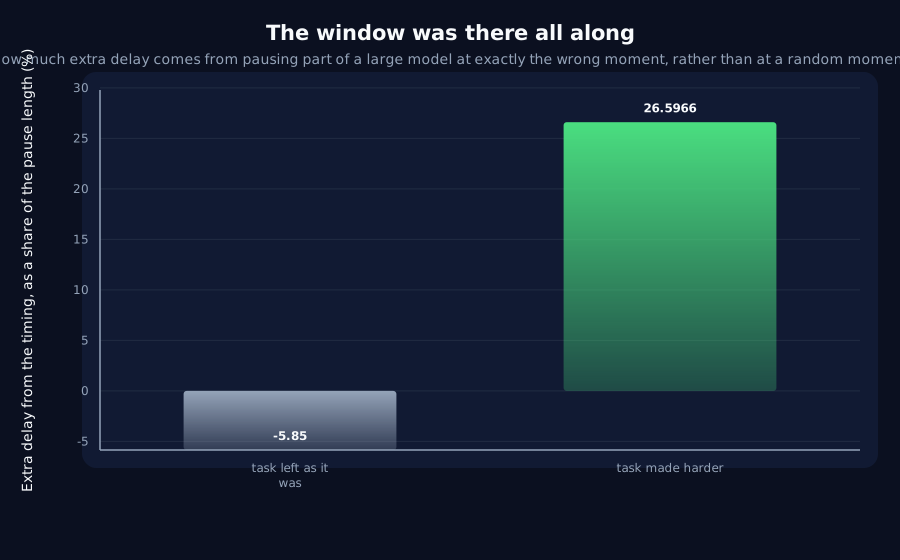
What we found. It does not vanish. That largest model was finishing the task in a third of the time a smaller one takes, because we had made it bigger without making the task any harder, so there was barely any training for a window to sit inside. Give the same large model a harder task and the window is back and comfortably above our threshold for mattering.
Why it matters. This is the second of six results we are rechecking this way, and the second where the disappearance turned out to be our own measurement rather than anything about model size. Two out of two is suggestive but it is not a result, and the other four are still listed as unchecked rather than quietly assumed. Worth noting what the original experiment got right, too: it had already been careful to scale the length of the interruption with the length of the run, which protected it from a different mistake we made elsewhere the same week. Being careful about one thing does not protect you from the thing you were not thinking about.
The rest of this page is the technical record: the design, every number, and the limits. It is written for a reviewer, and you do not need it to have understood the result above.
New here? How to read a research record
- Start at the verdict. Every record states, before the experiment was run, what result would have made us abandon the idea. That is the "kill test". Then it says whether the test fired. Nothing gets reinterpreted after the fact.
- Numbers in square brackets are uncertainty.
23.4 [18.1, 28.7]means our best estimate is 23.4 and the true value is probably somewhere in that range. If a range includes zero, we cannot claim an effect. - Results that rule an idea out are kept. Roughly half of what is published here says an approach did not work, including plenty of our own. Those pages are the output, not a shortfall: knowing which direction is a dead end is what lets the next experiment go somewhere better, and most of what we now rely on came out of understanding why something else fell short. Work that only publishes what worked is not measuring anything.
- Read the Limits section. Every record ends with what it does not show. It is the most honest part of any experiment and usually the shortest.
- Pro tip: the figures near the top are designed to carry the result on their own. If you read nothing else, read the caption under each one, which says what it shows and what to take from it.
EXPLORATORY. Not a preregistered study. Local CPU, 2 difficulty rungs x 8 seeds at width 192, no GPU, no cost.
Program v2 Bucket P, item P12, second of four cases. Decisive computation: analysis/critical_period_matched.pyanalysis/critical_period_matched.jsonpython analysis/critical_period_matched.py; --reuse re-derives every endpoint.
The question
K3 width-swept D5's critical period and found it material at widths 16, 32, 48 and 96 and not at 192. That is the most-cited fade-with-width result here, and it scoped everything resting on D5, including K2, the programme's only positive efficiency result.
P11 showed such a fade can be entirely an artefact of the model outgrowing the task. K3 holds the task fixed: at width 192 with lag 4 the control transitions at step 50.5, against 142 at width 48. The model is finished in a third of the time.
K3 was more careful than O7, and it is worth saying so. Its freeze window already scales with the run, so K3 does not have the fixed-window resolution problem that P12's first case found in O7. What it has is the difficulty confound alone.
Kill test, fixed before execution: the placement effect at width 192 is still immaterial once the task is hardened.
Anchor enforced in code: the easy arm must reproduce K3's width-192 null. It does.
What we found
The endpoint is K3's, unchanged: the delay from a freeze placed at the transition minus the delay from an identical-length freeze placed uniformly at random earlier in the same run. Freezing delays regardless (D3), so only the paired difference isolates placement. Materiality is K3's floor: the effect must clear 0.10 of the window.
| Rung | Lag | Control transition | Window | Placement effect | As a share of the window |
|---|---|---|---|---|---|
easy (K3's own setting) | 4 | 50.5 | 12.5 | -0.8 [-2.9, +1.4] | -0.06 [-0.23, +0.11] |
hard (matched) | 10 | 155.0 | 38.9 | +10.2 [+5.6, +14.9] | +0.27 [+0.15, +0.39] |
The kill test does not fire. At width 192, on a task hard enough that the model takes as long to learn as a width-48 model does, the critical period is present and comfortably material, 0.27 of the window against a floor of 0.10, with the interval well clear.
K3's finding is the same confound P11 found. The critical period does not vanish at width 192. It vanishes when a width-192 model is given a task it finishes in fifty steps.
What this restores
D5's scope, and K2's with it. K3 concluded that "D5's finding is scoped to the sizes where it does [show a placement effect], and every result resting on it inherits that scope". On this evidence that scoping was about task difficulty, not size, and the programme's only positive efficiency result is not width-limited in the way K3 implied. A correction banner is appended to K3's record; its numbers reproduce exactly and the anchor here required that.
This is the second of six re-tested, and the second to be the confound. That is now a pattern in its own right, and the honest reading is that the remaining four are more likely than not to go the same way, but "more likely than not" is not a result, and they are still listed as untested.
What it does not show
- It does not restore anything at scale. Width 192 is still a small model, and the task was made harder to reach it. What is restored is that the critical period survives capacity, not that it survives scale.
- It does not re-derive K2's economics. K2's saving was measured at one width on the easy task. Whether the break-even changes when difficulty is matched is a separate calculation and is not done here.
Limits
- One width, two rungs, eight seeds. The comparison is width 192 hard against width 192 easy; the intermediate widths are not re-run because K3 already found the effect material at all of them.
- The hard rung transitions at
155against width 48's142: matched to about9%, not exactly. - Difficulty is raised through lag only, as in P11. A different lever might not behave the same.
- The window scales with the run, so the hard rung's window is
38.9steps against the easy rung's12.5. The endpoint is a share of the window for exactly that reason, and the raw step effect is reported beside it. - K3's floor of
0.10is inherited, not re-derived.
Terms on this page
Every piece of vocabulary this record uses, in plain language. Generated from the text above, so it cannot drift out of step with it.
- confound
- A second explanation you did not control for. If bigger models both learn faster and score higher, then 'fast learners score higher' may be entirely about size and not about speed.
- critical period
- A stretch of time during which something has to happen for development to proceed normally. Borrowed from biology, where it describes windows in which a young brain must receive certain input.
- freezing
- Stopping one part of a model from changing while the rest carries on learning. A way of asking what that part contributes, by taking it away.
- kill test
- A condition written down before running the experiment that says what result would make us abandon the idea. Fixing it in advance is what stops a disappointing result being reinterpreted as an encouraging one.
- seed
- The number that fixes all the randomness in a training run. Same seed, same run. Running several seeds is how you tell a real effect from a lucky one.
- width
- How many internal numbers a model uses at each layer. The usual way we vary model size in these experiments.
Get new results as we publish them
Roughly monthly, one finding per email, in plain English first. Including the approaches that turned out not to work, which are usually the useful ones. No sales email.
Double opt-in: we send a confirmation link and add nobody who does not click it. One-click unsubscribe on every email.