
We Found a Saving, and It Needed No Instrument
Ongoing research. This is an experimental result from active work, not a settled conclusion. The numbers are what we measured and the method is described so you can judge it, but the programme is still running and later experiments may revise what it means.
A note on the language in these records. This is a working laboratory notebook for research into training AI models more cheaply and efficiently, so you will read that an approach did not work, that a result did not hold up, or that one method was worse than another. That is the research doing its job, not a verdict on the engineering we deliver to clients. Ruling an approach out is how the search narrows, and these are the pages that teach us the most: nearly every technique we now rely on came from understanding why something else fell short. Testing our own ideas at least as hard as anyone else's is the point of publishing them. More about this programme and why we run it.
Part of a bigger question: What actually makes training cheaper? – One thing has worked: stopping part of the training early saved about 7% with no loss of quality. Everything else tested has been matched by a simpler or cheaper method -- and in two cases the clever method was only winning because it was quietly being given more.
In plain English
What we asked. This project exists to find ways of making AI training cheaper, and after forty-seven experiments it had never actually made anything cheaper. This is the one that did. The most expensive part of these models to train is the part that carries information from one moment to the next, and we already knew it stops mattering for WHEN the model learns shortly after it has learned. So we asked whether you can simply stop training it at that point and pocket the saving.
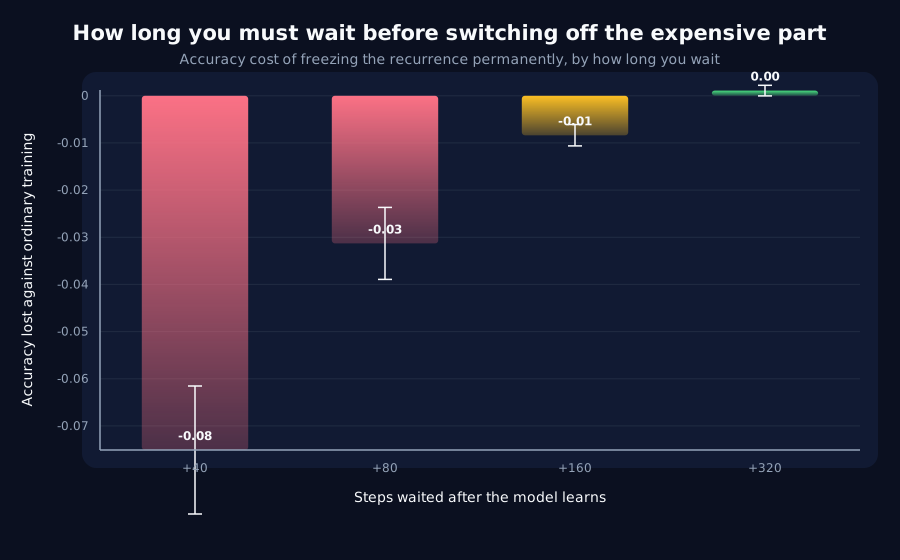
What we found. You can, but not as soon as we expected, and the gap is the interesting part. Switch it off forty steps after the model learns and you lose about seven and a half accuracy points. Wait longer and the loss shrinks: three points, then under one, and by three hundred and twenty steps it is gone entirely. At that point you save about seven percent of the whole training run for nothing. So the part of the model that has stopped influencing when learning happens is still quietly improving how well it works, for a long time afterwards. Those are two different questions and we had been treating them as one.
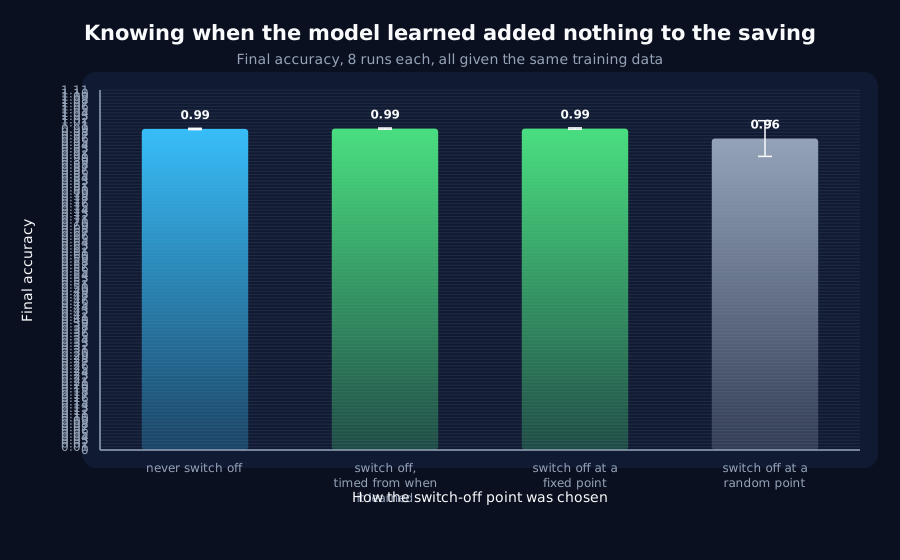
Why it matters. Then we checked the part we were proud of, and it was not doing anything. Our timings were measured from the moment each individual model learned, which requires knowing that moment. But the safe point to switch off turns out to be so far past it that a single fixed schedule, applied identically to every run and using no knowledge of anything, works just as well, matching our careful per-model timing to four decimal places. The saving is real and worth having. The clever part of it was not. That is now the third time in this project that a genuine saving has turned out not to need the detection we built it around, which is starting to look less like a coincidence and more like the finding.
The rest of this page is the technical record: the design, every number, and the limits. It is written for a reviewer, and you do not need it to have understood the result above.
New here? How to read a research record
- Start at the verdict. Every record states, before the experiment was run, what result would have made us abandon the idea. That is the "kill test". Then it says whether the test fired. Nothing gets reinterpreted after the fact.
- Numbers in square brackets are uncertainty.
23.4 [18.1, 28.7]means our best estimate is 23.4 and the true value is probably somewhere in that range. If a range includes zero, we cannot claim an effect. - Results that rule an idea out are kept. Roughly half of what is published here says an approach did not work, including plenty of our own. Those pages are the output, not a shortfall: knowing which direction is a dead end is what lets the next experiment go somewhere better, and most of what we now rely on came out of understanding why something else fell short. Work that only publishes what worked is not measuring anything.
- Read the Limits section. Every record ends with what it does not show. It is the most honest part of any experiment and usually the shortest.
- Pro tip: the figures near the top are designed to carry the result on their own. If you read nothing else, read the caption under each one, which says what it shows and what to take from it.
EXPLORATORY. Not a preregistered study. Local CPU, 64 training runs, no GPU, no cost.
Program v2 Bucket K, item K2. Decisive computation: analysis/freeze_after_transition.pyanalysis/freeze_after_transition.jsonpython analysis/freeze_after_transition.py, or re-decide the floor and boundary from the saved series with --reuse.
The question
D5 found the recurrence's critical period closes hard: freezing it at the transition costs +19.1 [+18.2, +20.1] steps, and freezing it forty steps later costs +0.1 [-0.2, +0.4]. After its window the recurrence is causally irrelevant to timing, while remaining the most expensive part of the model to train. F3 rules out freezing it from the start, a frozen recurrence never reaches full accuracy, which is precisely why nobody had looked at the other end.
Kill test, fixed in advance: at a compute-matched budget, freezing the recurrence after the transition either costs final accuracy beyond a headroom-scaled floor, or saves nothing once the trigger is priced.
The first correction: D5 does not license this
D5 froze the recurrence for a bounded window and then unfroze it. This item freezes it permanently, to stop paying for its gradients at all. Those are different interventions, and D5's +0.1 licenses "a 40-step freeze after the transition costs no timing", not "the recurrence can be abandoned from the transition onward".
The smoke run made the distinction concrete before any full run: freezing permanently at transition + 40 cost 5 to 9 accuracy points, while freezing at step 200+ cost nothing. So the question was never whether the manoeuvre works. It is from when, and a single offset can only answer yes or no, when the useful answer is a boundary.
Result: a boundary, not a yes
Eight seeds, matched budget of 57,600 samples, freeze permanent from the stated step. Paired against each seed's own control.
| Arm | Final accuracy | vs control | Compute saved |
|---|---|---|---|
| control | 0.9904 [0.9885, 0.9924] | , | , |
freeze at transition+40 | 0.9153 [0.9012, 0.9295] | -0.0751 | 11.2% |
freeze at transition+80 | 0.9591 [0.9511, 0.9672] | -0.0313 | 10.6% |
freeze at transition+160 | 0.9821 [0.9792, 0.9850] | -0.0084 | 9.4% |
freeze at transition+320 | 0.9915 [0.9897, 0.9934] | +0.0011 [-0.0000, +0.0022] | 7.1% |
| fixed step (no oracle) | 0.9916 [0.9896, 0.9936] | +0.0011 | 7.1% |
| freeze at a random step | 0.9608 [0.9056, 1.0160] | -0.0296 | , |
freeze at transition-40 (positive control) | 0.5585 [0.5491, 0.5679] | -0.4320 | , |
The positive control passes overwhelmingly. Freezing inside the critical period costs 43 accuracy points, so the endpoint plainly sees freezing, and a null at the boundary means something.
The cost falls smoothly with the offset and reaches zero. From +320 steps past the transition the recurrence can be frozen permanently for 7.1% of total training cost with no accuracy penalty: in fact a hair above control, consistent with mild regularisation, though the interval touches zero and nothing is claimed from it.
Freezing at a random step is not the same thing (-0.0296), so "freeze eventually" is not the finding. The random arm's interval is wide because its steps ranged from 95 to 753; it exceeds 1.0 at the top, which is an artifact of a t-interval on a bounded quantity and is reported rather than trimmed.
The second correction: the oracle contributes nothing
The offsets above are measured from each seed's own known transition, which is an oracle and not a usable method. The first run's verdict therefore ended with "pricing a real detector is the next question".
That was wrong, and the arithmetic says so. The boundary sits 320 steps past a transition whose own spread across seeds is 15 steps, the offset is 21x the spread. So transition + 320 and a single fixed step land within 7 steps of each other in every run.
A fixed-step arm was added, choosing the freeze point as 46% of the training budget with no knowledge of the transition at all. It matches the oracle to 0.0001:
+0.0011(oracle) against+0.0011(fixed step), difference-0.0001.
"Freeze after the transition" and "freeze late" are the same instruction here. The saving is real and it is free, and it is not evidence that the transition is worth detecting.
Verdict
- The kill test does not fire, from a boundary. Permanently freezing the recurrence from
+320steps past the transition saves7.1%of total training cost at no accuracy cost. This is the first positive efficiency result in the programme. - Earlier is not free.
-0.0751,-0.0313,-0.0084at+40,+80,+160. The recurrence goes on contributing accuracy long after its timing contribution has gone, which sharpens D5 rather than contradicting it: a critical period for when is not a critical period for how well. - And it needs no instrument. A fixed fraction of the budget does as well as an oracle. Taken with J7 and K1, every efficiency saving this programme has found is available without knowing when the transition happens. Three items designed to spend transition timing have now produced one real saving between them, and the timing contributed nothing to it.
- The honest size.
7.1%of a small model's training on one synthetic task. It is a genuine saving and a modest one.
Limits
- Eight seeds, one task, one width, one learning rate, four offsets. The boundary is located between
+160and+320; it was not bisected, so+320is an upper bound on where freezing becomes free rather than the boundary itself. - The fixed-step arm's
46%was chosen after seeing where the boundary fell, so it demonstrates that a fixed step suffices, not that this fraction transfers. On a task whose transition varies much more than15steps the two arms would separate, and that is the condition under which the oracle would start to earn its keep. - The saving is measured as a wall-clock ratio in one process under a CPU duty-cycle throttle: freezing removes the recurrence's gradients but not its forward pass, measured at
16.4%of a step. The ratio is portable; the absolute milliseconds are not. - Accuracy sits near
0.99, so the1%floor is a large fraction of the achievable headroom. A task with more room might resolve the+160arm differently. - This is a compute saving, not a data saving. Every arm sees the same
57,600samples; what changes is the cost of processing them.
CORRECTION (2026-09-01, v0.144.0): the boundary was convergence, and it does not survive the ladder
Q5 re-ran this configuration through this record's own train() and reproduced its headline exactly: paired accuracy at +320 of +0.0011 [-0.0000, +0.0022]. Two things change.
The saving does not survive matched difficulty and a larger width. At width 192 on lag 11 no offset in a sweep reaching +1280 is free. The cost falls monotonically, -0.1809, -0.1109, -0.0729, -0.0354, and never reaches the 1% floor. The positive control passes at -0.27, so the endpoint sees freezing perfectly well.
And the boundary here was not the critical period. It was convergence. At this record's freeze point (step 410) the width-48 control had already reached 0.9881 of a final 0.9920, 99.6% of its improvement was done. At width 192 on lag 11 the furthest freeze in Q5's sweep (step 1,441) sits at 0.8785 of a final 0.9758, with 10% still to come, and freezing stops the model getting it. "Freeze N steps after the transition" was never the operative rule; "freeze once the model has stopped improving" is, and it needs no reference to the transition at all.
The second finding below strengthens rather than weakens: the single fixed step matched each seed's own oracle at every one of Q5's four offsets (gaps +0.0000, +0.0002, +0.0005, +0.0018).
The 7.1% is a floor, not the saving. Per Q9 it is a wall-clock measurement on a width-48 GRU under a duty-cycle throttle, where the arithmetic being skipped is 60.0% of a step against 13.1% timed. Q5 measured the same gap at width 192 and found it narrowed to 2.67x from 4.60x, which is what a framework-overhead explanation requires. Read the figure as "at least 7.1%, on that machine".
Terms on this page
Every piece of vocabulary this record uses, in plain language. Generated from the text above, so it cannot drift out of step with it.
- accuracy
- The fraction of answers a model gets right on questions it was not trained on.
- compute-matched
- Comparing two methods by giving them the same amount of computing power rather than the same number of steps. A method that takes twice as long per step should not get twice the compute for free.
- critical period
- A stretch of time during which something has to happen for development to proceed normally. Borrowed from biology, where it describes windows in which a young brain must receive certain input.
- freezing
- Stopping one part of a model from changing while the rest carries on learning. A way of asking what that part contributes, by taking it away.
- gradient
- The direction and amount by which each of a model's internal numbers should change to do slightly better. Training is repeatedly following it.
- GRU
- Gated Recurrent Unit. A compact design for processing sequences one item at a time, with internal switches controlling what it keeps in memory.
- kill test
- A condition written down before running the experiment that says what result would make us abandon the idea. Fixing it in advance is what stops a disappointing result being reinterpreted as an encouraging one.
- learning rate
- How big a step training takes each time it updates the model. Too small and nothing happens; too big and it never settles.
- regularisation
- Anything added to training to discourage the model from a particular behaviour, usually to help it generalise.
- seed
- The number that fixes all the randomness in a training run. Same seed, same run. Running several seeds is how you tell a real effect from a lucky one.
- width
- How many internal numbers a model uses at each layer. The usual way we vary model size in these experiments.
Get new results as we publish them
Roughly monthly, one finding per email, in plain English first. Including the approaches that turned out not to work, which are usually the useful ones. No sales email.
Double opt-in: we send a confirmation link and add nobody who does not click it. One-click unsubscribe on every email.