
The Window Closes as Models Grow
Ongoing research. This is an experimental result from active work, not a settled conclusion. The numbers are what we measured and the method is described so you can judge it, but the programme is still running and later experiments may revise what it means.
A note on the language in these records. This is a working laboratory notebook for research into training AI models more cheaply and efficiently, so you will read that an approach did not work, that a result did not hold up, or that one method was worse than another. That is the research doing its job, not a verdict on the engineering we deliver to clients. Ruling an approach out is how the search narrows, and these are the pages that teach us the most: nearly every technique we now rely on came from understanding why something else fell short. Testing our own ideas at least as hard as anyone else's is the point of publishing them. More about this programme and why we run it.
Part of a bigger question: What decides when a model learns, and can you change it? – Settings dominate, data barely matters, and there is a brief window before the jump in which interrupting the model is unusually costly. Timing can be delayed but not brought forward.
In plain English
What we asked. These models do not improve gradually. They sit at chance for a while and then get good quite suddenly, and we had found that just before that moment there is a short window during which one part of the model is doing work that cannot be done at any other time. Hold that part still during the window and the model takes noticeably longer to learn; hold it still for the same length of time at some random earlier moment and it barely matters. That difference is the window. We had only ever measured it at one model size.
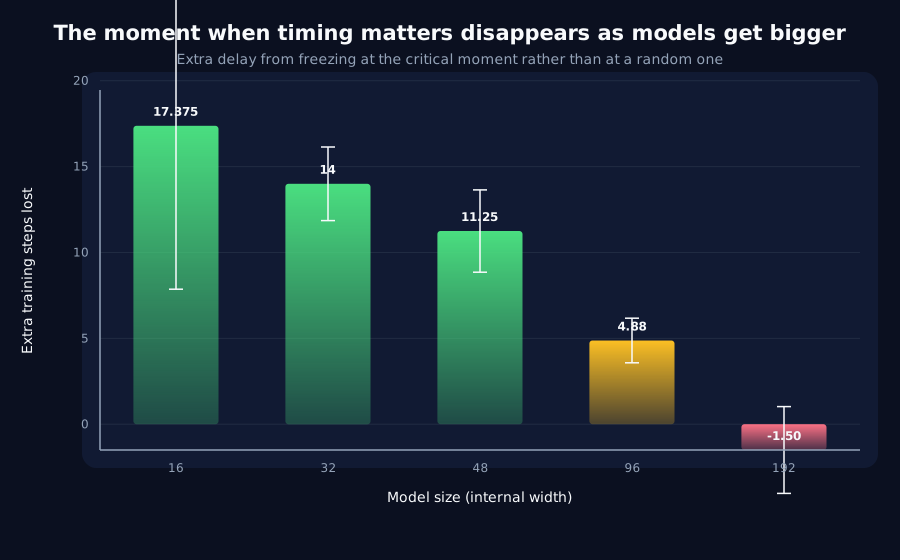
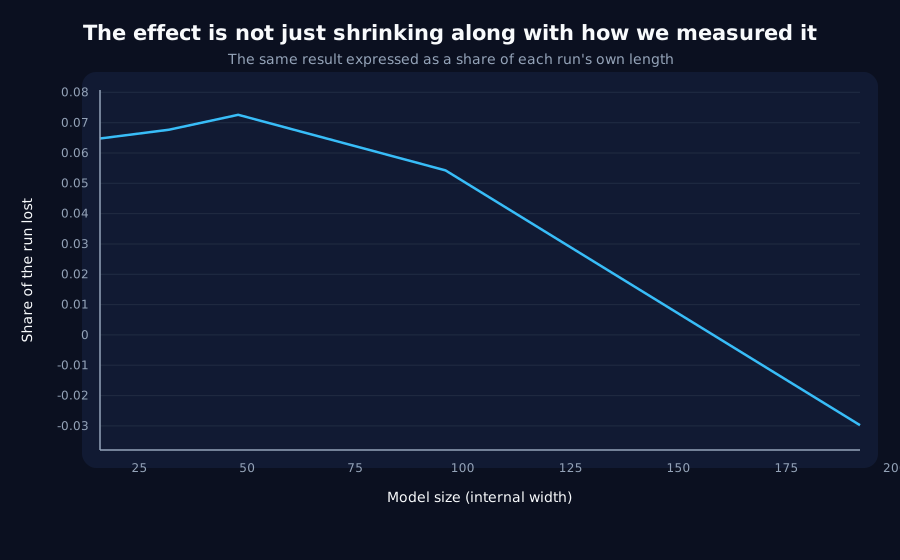
What we found. It shrinks as models get bigger, and at the largest size we tested it is gone entirely. At that size, holding the part still at the supposedly critical moment is no worse than doing it at random. The middle size reproduces our original number exactly, so this is a limit on where the finding applies rather than a contradiction of it. We also checked the obvious objection, that we measured over a shorter stretch in bigger models: expressed as a fraction of each model's own timeline the effect is steady across the small sizes and only then collapses, which is not what a measurement shrinking along with its own ruler would look like.
Why it matters. The part worth your time is how nearly we published the opposite. Our first three attempts at this all reported that the window was absent at every size, including the size where we had originally found it. Each looked like a clean result. What caught them was a single check we ran alongside: repeat the original experiment exactly and confirm it still gives the original answer. It did not, three times running, and each time for a different reason. The last and real one was that our original code held the part still by one method and the new code used another, which sounds equivalent and is not. The written description of a method says what was done; only the code says which of several things that means. When someone shows you a replication, the useful question is whether they re-ran the original alongside it.
The rest of this page is the technical record: the design, every number, and the limits. It is written for a reviewer, and you do not need it to have understood the result above.
New here? How to read a research record
- Start at the verdict. Every record states, before the experiment was run, what result would have made us abandon the idea. That is the "kill test". Then it says whether the test fired. Nothing gets reinterpreted after the fact.
- Numbers in square brackets are uncertainty.
23.4 [18.1, 28.7]means our best estimate is 23.4 and the true value is probably somewhere in that range. If a range includes zero, we cannot claim an effect. - Results that rule an idea out are kept. Roughly half of what is published here says an approach did not work, including plenty of our own. Those pages are the output, not a shortfall: knowing which direction is a dead end is what lets the next experiment go somewhere better, and most of what we now rely on came out of understanding why something else fell short. Work that only publishes what worked is not measuring anything.
- Read the Limits section. Every record ends with what it does not show. It is the most honest part of any experiment and usually the shortest.
- Pro tip: the figures near the top are designed to carry the result on their own. If you read nothing else, read the caption under each one, which says what it shows and what to take from it.
EXPLORATORY. Not a preregistered study. Local CPU, 144 training runs, no GPU, no cost.
Program v2 Bucket K, item K3. Decisive computation: analysis/critical_period_width.pyanalysis/critical_period_width.jsonpython analysis/critical_period_width.py, or re-derive the endpoints from the saved series with --reuse.
CORRECTED 2026-09-01 by P12's second case. The width-192 null is a difficulty artefact, not a scale result. This record scopes D5's critical period to the widths where a placement effect is material and concludes width 192 is not one of them. At width 192 the control transitions at step50.5against142at width 48 -- the model finishes the task in a third of the time. Hardened so a width-192 model takes as long to learn as a width-48 model does (lag 10, transition155.0), the placement effect is+10.2steps[+5.6, +14.9],0.27of the window[+0.15, +0.39]against this record's floor of0.10. Comfortably material. The easy arm reproduces this record's null (-0.06[-0.23, +0.11]) and P12 required that as an anchor, so every number below stands. What is withdrawn is "D5's finding is scoped to the sizes where it does" -- the scoping is by task difficulty, not by size, and K2 does not inherit a width limit from it. This record's window already scaled with the run, which is why it avoided the separate resolution flaw P12's first case found in O7.
The question
J5 width-swept the predictive side of this programme and the result was bad: the decode probe's crossing collapses from step 301.6 to step 5.5 across widths 16 to 192, until at the widest it fires at step 5 of a 34-step run and carries almost no timing information.
Nobody had width-swept the causal side. D5's critical period, G2's 61%-in-one-direction and J3's 6.5x off-diagonal asymmetry are all width-48 facts. And K2, the programme's only positive efficiency result, rests on D5.
Kill test, fixed in advance: D5's paired endpoint, the cost of a targeted freeze minus the cost of a random-time-matched one, does not vary with width beyond seed noise.
Result: the critical period shrinks with width and is gone by 192
Eight seeds per width, D5's configuration, window proportional to each run's own transition.
| Width | Transition | Targeted | Random | Paired (targeted − random) | As share of transition |
|---|---|---|---|---|---|
| 16 | 272.8 | +28.6 | +11.2 | +17.4 [+7.9, +26.9] | +6.5% |
| 32 | 209.1 | +25.2 | +11.2 | +14.0 [+11.9, +16.1] | +6.8% |
| 48 | 155.2 | +19.0 | +7.8 | +11.2 [+8.9, +13.6] | +7.3% |
| 96 | 90.0 | +9.0 | +4.1 | +4.9 [+3.6, +6.2] | +5.4% |
| 192 | 50.5 | +2.5 | +4.0 | -1.5 [-4.0, +1.0] | -3.0% |
The kill test fires. The paired effect varies 18.9 steps across the ladder against 3.6 steps of seed noise, a ratio of 5.3x, and at width 192 it is not material at all: freezing the recurrence at the transition is indistinguishable from freezing it at a random earlier moment, and if anything marginally better.
Width 48 reproduces D5 exactly (+11.2 against D5's +10.6), so this is scope rather than disagreement, the same relationship J5 has to I2.
It is not the shrinking window
The window is proportional to each run's transition, so it shrinks with width (68 steps at width 16, 13 at width 192). The obvious alternative reading is that the effect shrank because the window did.
The share column rules that out. If the effect merely tracked window length, its share of the transition would be constant. Instead it is flat across the narrow end, 6.5%, 6.8%, 7.3%, and then collapses to 5.4% and -3.0%. A flat-then-collapsing share is the signature of a real change in the phenomenon, not of a measurement scaling with its own instrument.
A fixed window cannot be used instead: at width 192 the transition is at step 50, so two non-overlapping 40-step windows do not fit before it and the wide end of the ladder is structurally unmeasurable that way.
Three failed attempts, and the anchor that caught all of them
This record exists because the harness was wrong three times, and each time it produced a confident, publishable-looking answer. D5's own fixed-window design at width 48 was run as an anchor, and it returned +6.2, then +4.2, then +2.9, against D5's +10.6 [+8.3, +13.0], every interval spanning zero. Each run reported "no material critical period at any width", including width 48, where D5 found one.
The causes, in the order they were wrongly diagnosed:
- Logging resolution. Every measured delay was a multiple of 5, the evaluation interval, and the effects were 0-5 steps. Real, and fixed by evaluating every step. Not the cause.
- Learning rate. J5's
0.005was used so the ladder would match J5's; D5 ran at0.002, where the width-48 transition is at155rather than85. Real, and fixed. Still not the cause. - The freeze itself. D5 zeroes the gradient inside the window. The reimplementation cleared
requires_grad. Under AdamW these are different interventions: zeroing leaves the optimiser stepping every parameter so the arms differ only in what the step contains, while clearingrequires_gradmakes it skip the parameter and suspends its momentum and decay as well. D5's code carries a comment saying exactly this. D5 also clips gradients, which had been omitted.
With the freeze corrected the anchor returns +11.0 [+8.4, +13.6] against D5's +10.6 [+8.3, +13.0], and the sweep above becomes interpretable.
The generalisable lesson: a record's prose says "freeze the component". There are several defensible ways to do that and they differ here by a factor of three. To re-test a result, read its code rather than its record, and make the anchor a precondition in code, because the first version printed the sweep and the failing anchor side by side, and the sweep read as a finding.
Verdict
- The kill test fires. The critical period's size is a fact about model size, and at width 192 it is absent altogether.
- D5 is scoped, not overturned. Width 48 reproduces it. Every result resting on D5's placement sensitivity inherits the scope, which includes G2.
- The causal side scales the same way the predictive side did. J5 found the probe's lead collapsing with width; this finds the critical period collapsing with width. Both of the programme's central structures point the wrong way for scaling up, on the same ladder, measured independently.
- K2 is partly insulated. Its saving rests on the recurrence continuing to contribute accuracy long after the transition, which is a different claim from placement sensitivity, and it was shown to need no transition knowledge at all. But it too was measured only at width 48 and is untested elsewhere.
Limits
- Eight seeds, five widths, one task, one learning rate, one component. Only the recurrence was frozen; D5 also mapped the input, embedding and head, and those are not swept here.
- Width and transition time are confounded by design. A fixed learning rate means wider models transition sooner (
273steps at width 16,50at width 192), which is J5's confound inherited deliberately: screening a rate per width would confound size with whatever the screen optimised for. The share column is what separates "the effect scales with the run" from "the effect scales with width", and it is flat before it collapses. - Width 192's transition at step
50is close to the floor where a proportional window and its random counterpart can both be placed. The absence there is measured, but it is measured at the edge of what this design can do. - The window is proportional, D5's was fixed. The anchor establishes the two agree at width 48; it does not establish they would agree everywhere.
- This says nothing about why. A critical period that shrinks with width is consistent with F3's reservoir effect, a wider untrained recurrence is already a better feature extractor, so less of the mechanism has to be built during training, but nothing here tests that.
Terms on this page
Every piece of vocabulary this record uses, in plain language. Generated from the text above, so it cannot drift out of step with it.
- accuracy
- The fraction of answers a model gets right on questions it was not trained on.
- AdamW
- A widely used training algorithm that adapts how big a step it takes for each individual parameter. The default in most modern AI training.
- confound
- A second explanation you did not control for. If bigger models both learn faster and score higher, then 'fast learners score higher' may be entirely about size and not about speed.
- critical period
- A stretch of time during which something has to happen for development to proceed normally. Borrowed from biology, where it describes windows in which a young brain must receive certain input.
- evaluation interval
- The gap between successive checks of a model during training. It is the smallest difference in timing a measurement can resolve, so two results closer together than one interval cannot be told apart.
- freezing
- Stopping one part of a model from changing while the rest carries on learning. A way of asking what that part contributes, by taking it away.
- gradient
- The direction and amount by which each of a model's internal numbers should change to do slightly better. Training is repeatedly following it.
- harness
- Everything wrapped around a model when it is used as an agent: its instructions, the tools it can call and how they are named, and how the conversation is laid out.
- kill test
- A condition written down before running the experiment that says what result would make us abandon the idea. Fixing it in advance is what stops a disappointing result being reinterpreted as an encouraging one.
- learning rate
- How big a step training takes each time it updates the model. Too small and nothing happens; too big and it never settles.
- momentum
- Keeping part of each previous training step in the next one, so training keeps moving in a consistent direction instead of zig-zagging.
- probe
- A small separate model trained to read information out of a bigger model's internals, used as a measuring instrument rather than as a product.
- seed
- The number that fixes all the randomness in a training run. Same seed, same run. Running several seeds is how you tell a real effect from a lucky one.
- width
- How many internal numbers a model uses at each layer. The usual way we vary model size in these experiments.
Get new results as we publish them
Roughly monthly, one finding per email, in plain English first. Including the approaches that turned out not to work, which are usually the useful ones. No sales email.
Double opt-in: we send a confirmation link and add nobody who does not click it. One-click unsubscribe on every email.