
We Had Been Calling It the Right Thing
Ongoing research. This is an experimental result from active work, not a settled conclusion. The numbers are what we measured and the method is described so you can judge it, but the programme is still running and later experiments may revise what it means.
A note on the language in these records. This is a working laboratory notebook for research into training AI models more cheaply and efficiently, so you will read that an approach did not work, that a result did not hold up, or that one method was worse than another. That is the research doing its job, not a verdict on the engineering we deliver to clients. Ruling an approach out is how the search narrows, and these are the pages that teach us the most: nearly every technique we now rely on came from understanding why something else fell short. Testing our own ideas at least as hard as anyone else's is the point of publishing them. More about this programme and why we run it.
Part of a bigger question: What decides when a model learns, and can you change it? – Settings dominate, data barely matters, and there is a brief window before the jump in which interrupting the model is unusually costly. Timing can be delayed but not brought forward.
In plain English
What we asked. For about fifty write-ups we have described the effect we study as belonging to a particular family of model designs: ones that use internal gates to control what they remember from one moment to the next. That description was doing real work, because it is what tells you which models the findings should apply to. And we had only ever tested one design in that family. A name repeated fifty times is not evidence.
What we found. So we ran the same experiment on three designs: the one we had been using, a second that uses gates but arranges them differently, and a third with no gates at all. The effect appears clearly in both gated designs and is absent in the ungated one. The name held, which is a slightly unusual outcome for this project, since most of what we publish is a negative result or a correction to something we said earlier.
Why it matters. The ungated design deserves a mention, because it is the reason the result means anything. It is not failing at the task. It solves it perfectly and about twice as fast as either of the others, and still shows nothing. That matters: if it had simply been bad at the task, its blank result would have told us nothing about gates. It is also the arm we nearly lost. Our measurement needs a stretch of training before the model learns, and this design learns so quickly that the stretch we had been using did not fit. Had we reused the original setup without checking, the one model that could disprove our name would have been quietly dropped from the experiment.
The rest of this page is the technical record: the design, every number, and the limits. It is written for a reviewer, and you do not need it to have understood the result above.
New here? How to read a research record
- Start at the verdict. Every record states, before the experiment was run, what result would have made us abandon the idea. That is the "kill test". Then it says whether the test fired. Nothing gets reinterpreted after the fact.
- Numbers in square brackets are uncertainty.
23.4 [18.1, 28.7]means our best estimate is 23.4 and the true value is probably somewhere in that range. If a range includes zero, we cannot claim an effect. - Results that rule an idea out are kept. Roughly half of what is published here says an approach did not work, including plenty of our own. Those pages are the output, not a shortfall: knowing which direction is a dead end is what lets the next experiment go somewhere better, and most of what we now rely on came out of understanding why something else fell short. Work that only publishes what worked is not measuring anything.
- Read the Limits section. Every record ends with what it does not show. It is the most honest part of any experiment and usually the shortest.
- Pro tip: the figures near the top are designed to carry the result on their own. If you read nothing else, read the caption under each one, which says what it shows and what to take from it.
EXPLORATORY. Not a preregistered study. Local CPU, 88 training runs, no GPU, no cost.
Program v2 Bucket K, item K5. Decisive computation: analysis/critical_period_architecture.pyanalysis/critical_period_architecture.jsonpython analysis/critical_period_architecture.py, or re-derive with --reuse.
The question
The programme's central claim is that the transition belongs to gated recurrence. Every causal result in it was measured on one architecture, so "gated recurrence" and "the GRU" had never been separated.
E3 had already answered half of it. The phenomenon map ran five architectures on the same tasks, and on delayed-copy the expansion clears the materiality floor for the GRU (+0.2184 [+0.1936, +0.2432]) and the LSTM (+0.2279 [+0.2140, +0.2417]), and fails it for the ungated RNN (+0.0498 [+0.0166, +0.0830]) and the transformer (+0.0383). The geometric signature is a gating fact.
Nobody had measured the causal half. D5's paired endpoint, the cost of a targeted freeze minus the cost of a random-time-matched one, existed only for the GRU.
Kill test, fixed in advance: an LSTM shows no transition, or shows one with no critical period at D5's paired endpoint.
Result: gating on both halves
Eight seeds per architecture, D5's configuration and D5's freeze, window proportional to each run's own transition.
| Architecture | Learned | Transition | Targeted | Random | Paired | As share |
|---|---|---|---|---|---|---|
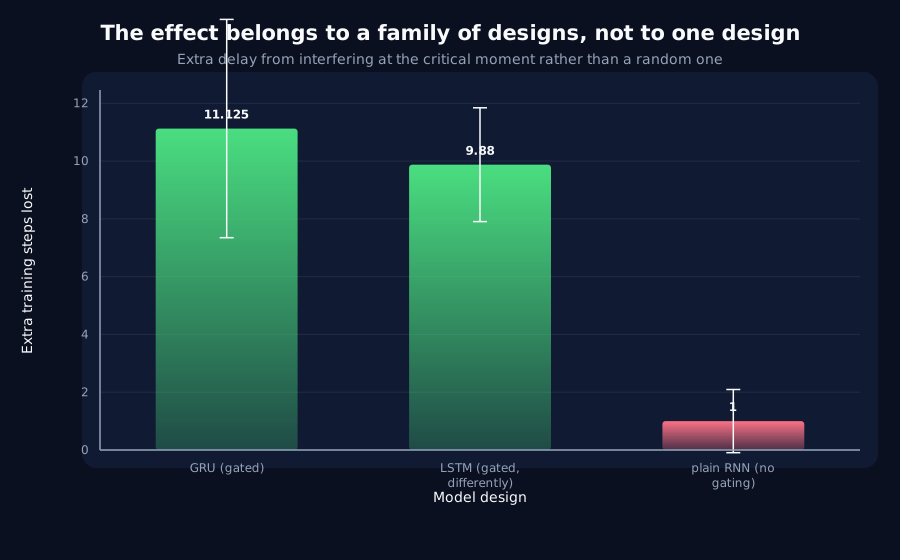
| GRU | 8/8 | 155.2 | +19.0 | +7.9 | +11.1 [+7.3, +14.9] | 7.1% |
| LSTM | 8/8 | 146.2 | +16.6 | +6.8 | +9.9 [+7.9, +11.8] | 6.8% |
| vanilla RNN | 8/8 | 69.5 | +6.1 | +5.1 | +1.0 [-0.1, +2.1] | 1.4% |
The kill test does not fire. The LSTM transitions and shows a material critical period, so the causal structure is a property of gated recurrence rather than of the GRU specifically.
The anchor agrees. D5's fixed 40-step window on the GRU returns +11.0 [+8.4, +13.6] against D5's published +10.6 [+8.3, +13.0].
And the ungated RNN does not have one. Its paired effect is +1.0 [-0.1, +2.1], an interval touching zero. So gating sits on both halves of the phenomenon: E3 found the expansion only in gated architectures, and the critical period follows exactly the same line.
The RNN is a real negative, not a failure to learn
This is the arm the backlog called informative, and it earns that description twice over.
It learns the task better than either gated model. Final accuracy 1.0000, and it transitions at step 69.5 against the GRU's 155.2, roughly twice as fast. So "the RNN shows nothing" is not "the RNN could not do it".
And its shorter run does not explain the absence. The window is proportional to each run's own transition, so the RNN's is smaller in absolute steps, and "the effect is small because the run is short" is the obvious alternative. As a share of the transition the GRU and LSTM sit at 7.1% and 6.8% while the RNN sits at 1.4%: five times lower on the scale-free measure, which is the control K3 established for exactly this confound.
Its speed nearly excluded it from the experiment. Two non-overlapping 40-step windows do not fit before step 69, so a fixed window: D5's design, used unchanged, would have silently skipped the one architecture the kill test calls decisive. K3's proportional window is what makes the arm measurable, and the fixed-window GRU anchor is what shows the substitution is sound.
Verdict
- The kill test does not fire. The LSTM has both the expansion (E3) and the critical period.
- "Gated recurrence" is the right name. Both halves of the phenomenon appear in two gated architectures and are absent in an ungated one that solves the task faster and better.
- This is a confirmatory result, which is unusual here. Most of what this programme has published is a negative or a correction. On the one occasion its central naming has been tested directly, the name held.
- It does not rescue the scaling picture. K3 shows this same critical period vanishing by width 192 in the GRU. Being a gating fact and being a small-model fact are compatible, and both appear to be true.
Limits
- Eight seeds, three architectures, one task, one width, one learning rate. All at width 48, where K3 shows the critical period is comfortably present; it is untested whether the LSTM's survives width the way the GRU's does not.
- One learning rate for all three, deliberately, since screening per architecture would confound the architecture with whatever the screen optimised for. The cost is that the RNN is being run at a rate chosen for the GRU, though it learns faster and better there, so it is not disadvantaged.
- The RNN's
+1.0[-0.1, +2.1]is a null, not a zero. Eight seeds cannot exclude a small effect; the claim is that it is far below the gated architectures on both measures. weight_hhis what gets frozen in all three families. An LSTM's cell state and a GRU's reset gate are different mechanisms sharing a parameter name, and this treats them alike.- The transformer is not included. E3 covers it for the expansion; the freeze endpoint would need a different notion of "the recurrence" and is not defined here.
Terms on this page
Every piece of vocabulary this record uses, in plain language. Generated from the text above, so it cannot drift out of step with it.
- accuracy
- The fraction of answers a model gets right on questions it was not trained on.
- architecture
- The blueprint of a model: what components it has and how they connect. Two models can be the same size and completely different architectures.
- confound
- A second explanation you did not control for. If bigger models both learn faster and score higher, then 'fast learners score higher' may be entirely about size and not about speed.
- critical period
- A stretch of time during which something has to happen for development to proceed normally. Borrowed from biology, where it describes windows in which a young brain must receive certain input.
- gated
- A design where the model has explicit internal switches deciding what to remember and what to discard at each step. GRUs and LSTMs are gated; plain recurrent networks are not.
- GRU
- Gated Recurrent Unit. A compact design for processing sequences one item at a time, with internal switches controlling what it keeps in memory.
- kill test
- A condition written down before running the experiment that says what result would make us abandon the idea. Fixing it in advance is what stops a disappointing result being reinterpreted as an encouraging one.
- learning rate
- How big a step training takes each time it updates the model. Too small and nothing happens; too big and it never settles.
- LSTM
- Long Short-Term Memory. An older and larger relative of the GRU, also gated, also for sequences.
- seed
- The number that fixes all the randomness in a training run. Same seed, same run. Running several seeds is how you tell a real effect from a lucky one.
- transformer
- The architecture behind most modern large language models. It uses attention to look at every part of the input at once, rather than reading in order.
- width
- How many internal numbers a model uses at each layer. The usual way we vary model size in these experiments.
Get new results as we publish them
Roughly monthly, one finding per email, in plain English first. Including the approaches that turned out not to work, which are usually the useful ones. No sales email.
Double opt-in: we send a confirmation link and add nobody who does not click it. One-click unsubscribe on every email.