
The Training Curve Cannot Tell You
Ongoing research. This is an experimental result from active work, not a settled conclusion. The numbers are what we measured and the method is described so you can judge it, but the programme is still running and later experiments may revise what it means.
A note on the language in these records. This is a working laboratory notebook for research into training AI models more cheaply and efficiently, so you will read that an approach did not work, that a result did not hold up, or that one method was worse than another. That is the research doing its job, not a verdict on the engineering we deliver to clients. Ruling an approach out is how the search narrows, and these are the pages that teach us the most: nearly every technique we now rely on came from understanding why something else fell short. Testing our own ideas at least as hard as anyone else's is the point of publishing them. More about this programme and why we run it.
Part of a bigger question: What actually happens at the moment a model learns? – It builds machinery rather than selecting it, working through the task in a reproducible order and trying a simpler wrong rule on the way. The visible training curve cannot tell you which is happening.
In plain English
What we asked. When one of these models suddenly gets good at its task, something reorganises inside it. We had argued that this reorganisation is the model building the machinery it needs, rather than tidying up machinery it already had. That is a claim with a sharp consequence: a model handed the finished machinery should not need to reorganise at all. It is also the version of this question that matters commercially, because almost nobody trains a model from nothing. They start from an existing one.
What we found. So we trained models until they solved the task, then started fresh ones from pieces of them. A model given the finished output stage reorganised exactly as much as one built from scratch. A model given the finished internal machinery barely reorganised at all. The claim holds, and the second comparison is what makes it mean something: if both had gone quiet, the result would have been about starting from an existing model in general rather than about the machinery specifically.
Why it matters. The uncomfortable part was not what we set out to test. The model given the finished machinery still shows a sudden jump in its accuracy, and it learns about four times faster. So if you were watching its training curve you would see the same shape you see when a model builds something from nothing, and you would have no way to tell the two apart. That is worth knowing if you are paying for a model to be fine-tuned on your data: an impressive-looking training curve is consistent with the model having learned something new, and equally consistent with it fitting a thin layer onto capability it already arrived with. Only measuring inside the model separates them.
The rest of this page is the technical record: the design, every number, and the limits. It is written for a reviewer, and you do not need it to have understood the result above.
New here? How to read a research record
- Start at the verdict. Every record states, before the experiment was run, what result would have made us abandon the idea. That is the "kill test". Then it says whether the test fired. Nothing gets reinterpreted after the fact.
- Numbers in square brackets are uncertainty.
23.4 [18.1, 28.7]means our best estimate is 23.4 and the true value is probably somewhere in that range. If a range includes zero, we cannot claim an effect. - Results that rule an idea out are kept. Roughly half of what is published here says an approach did not work, including plenty of our own. Those pages are the output, not a shortfall: knowing which direction is a dead end is what lets the next experiment go somewhere better, and most of what we now rely on came out of understanding why something else fell short. Work that only publishes what worked is not measuring anything.
- Read the Limits section. Every record ends with what it does not show. It is the most honest part of any experiment and usually the shortest.
- Pro tip: the figures near the top are designed to carry the result on their own. If you read nothing else, read the caption under each one, which says what it shows and what to take from it.
EXPLORATORY. Not a preregistered study. Local CPU, 30 training runs, no GPU, no cost.
Program v2 Bucket K, item K7. Decisive computation: analysis/warm_start.pyanalysis/warm_start.jsonpython analysis/warm_start.py, or re-derive the endpoints with --reuse.
The question
Every measurement in this programme is of learning from scratch. F3 says the transition creates features rather than selecting them, which makes a sharp prediction nobody had tested: hand a model an already-solved recurrence and a fresh head, and there should be no transition, because the mechanism the transition builds is already built.
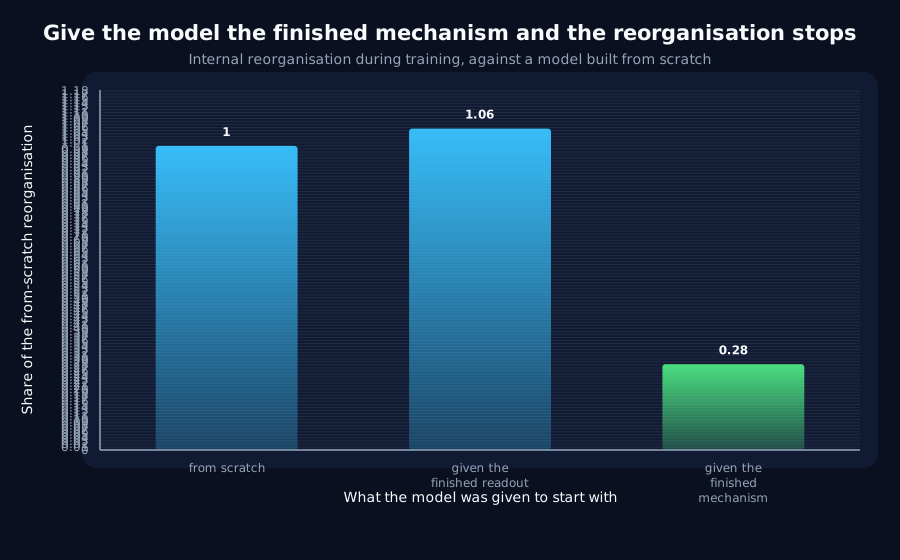
Kill test, fixed in advance: warm-started runs show a transition of the same magnitude as from-scratch ones, on J4's expansion endpoint in a stated frame.
Result
Six seeds, each with its own donor trained to solution. Expansion measured at its best window anywhere in the trajectory (I6's generous endpoint), in both frames because D6 showed the moving-basis quantity mixes rotation with expansion.
| Arm | Start | Final | Transitioned | Expansion (moving) | Expansion (frozen) |
|---|---|---|---|---|---|
| scratch | 0.035 | 0.9876 | 6/6 | +0.2474 [+0.2342, +0.2605] | +0.4896 [+0.4736, +0.5055] |
| warm-recurrence | 0.056 | 0.9933 | 6/6 | +0.0410 [+0.0199, +0.0621] | +0.1800 [+0.1502, +0.2099] |
| warm-head | 0.034 | 0.9904 | 6/6 | +0.2812 [+0.2680, +0.2944] | +0.5141 [+0.5008, +0.5274] |
| warm-all | 0.983 | 0.9932 | 0/6 | +0.0422 | +0.0583 |
The kill test does not fire.
Zero is the wrong reference point, and warm-all says so
The warm-all arm starts solved, never transitions, and still registers +0.0422 and +0.0583. Some of what a best-window endpoint reports is drift that happens to any model being trained, not an event. So every arm is measured against that baseline rather than against zero:
| Arm | Share of the from-scratch expansion retained (moving) | (frozen) |
|---|---|---|
| scratch | 100% | 100% |
| warm-recurrence | -1% | +28% |
| warm-head | +116% | +106% |
| warm-all | 0% | 0% |
Handing over the recurrence removes essentially all of the expansion. Handing over the head removes none of it.
A materiality test alone would have missed this. It calls warm-recurrence's frozen +0.1800 "material" and stops, when the informative fact is that it is a fraction of scratch's +0.4896 and sits close to a baseline that involves no learning event at all.
The converse control is what makes it a claim about the recurrence
If both warm arms had been smooth, the result would have been about warm-starting in general. They are not: warm-head retains 116% and 106%, indistinguishable from scratch, and it transitions in 6/6 runs. The effect is specific to which part is handed over.
And the transplant demonstrably works: warm-all starts at 0.983 and never transitions, which is what proves the weights are really being copied. A warm arm starting at chance would have meant the transplant was a no-op and every other number here was noise.
An unplanned finding: mechanism transfer is worth 4x
warm-recurrence still shows an accuracy jump, but at step 20 against scratch's 85. Given the mechanism, fitting the readout takes a quarter of the time. The accuracy curve still has a step in it; what has gone is the internal reorganisation underneath.
That distinction is the practical content of this record. A jump in the loss curve does not by itself tell you a model is building anything.
What nearly went wrong
The analysis window was inherited from I6 and J4, which take the frozen basis at step 100 because their transitions are near step 150. warm-recurrence transitions at step 20. At FREEZE_AT = 100 the frozen frame would have been established eighty steps after the event it exists to measure across, and the analysis window skipped the first hundred steps entirely, so the one arm the experiment exists to examine would have been measured over the wrong stretch of its own run. Caught in a smoke test, and the constants are now chosen for the fastest arm rather than the slowest.
Verdict
- The kill test does not fire. F3's prediction holds. The expansion accompanies building the mechanism, not fitting the readout.
- In direction and magnitude, not in its strong form. F3 predicts no transition; what is observed is
-1%of the expansion in the moving frame and+28%in the frozen one. Something survives. - "Does this model show a transition" is now a diagnostic, which is what the backlog hoped for: it distinguishes a model building a mechanism from one fitting a readout onto a mechanism it already has. That is the most transferable thing in this programme for anyone fine-tuning a real model, where warm-starting is the normal case rather than the exception.
- And the accuracy curve alone will not tell you. The warm arm still jumps; only the internal measurement separates the two cases.
Limits
- Six seeds, one task, one width, one learning rate, one donor per seed.
- The donor is a solved model of the same architecture on the same task. Real warm-starting transfers from a different task, and nothing here speaks to partial or imperfect transfer.
warm-recurrencecopies four tensors (both recurrent weight matrices and both biases). It does not isolate which of them carries the effect; J3 and K5 suggest the recurrent-to-recurrent matrix is the load-bearing one, but this does not test that.- The
+28%in the frozen frame is unexplained. It may be the readout reorganising the representation it reads from, or residual drift thewarm-allbaseline under-counts. - Best-window endpoints are positive under noise by construction, which is why the baseline arm exists. It is a correction, not a proof that the remainder is signal.
Terms on this page
Every piece of vocabulary this record uses, in plain language. Generated from the text above, so it cannot drift out of step with it.
- accuracy
- The fraction of answers a model gets right on questions it was not trained on.
- architecture
- The blueprint of a model: what components it has and how they connect. Two models can be the same size and completely different architectures.
- baseline
- The thing you compare against. A result without one is not a result.
- fine-tuning
- Continuing to train an already-trained model on a new, usually narrower, task.
- kill test
- A condition written down before running the experiment that says what result would make us abandon the idea. Fixing it in advance is what stops a disappointing result being reinterpreted as an encouraging one.
- learning rate
- How big a step training takes each time it updates the model. Too small and nothing happens; too big and it never settles.
- recurrent
- A design that reads a sequence one item at a time, carrying memory forward. The main alternative is attention, which looks at everything at once.
- residual
- How far the data sits from a proposed description of it, after the description has been fitted as well as it can be. A small residual means the description accounts for what was measured; a large one means something is missing.
- seed
- The number that fixes all the randomness in a training run. Same seed, same run. Running several seeds is how you tell a real effect from a lucky one.
- width
- How many internal numbers a model uses at each layer. The usual way we vary model size in these experiments.
Get new results as we publish them
Roughly monthly, one finding per email, in plain English first. Including the approaches that turned out not to work, which are usually the useful ones. No sales email.
Double opt-in: we send a confirmation link and add nobody who does not click it. One-click unsubscribe on every email.