
The Check We Should Have Run First
Ongoing research. This is an experimental result from active work, not a settled conclusion. The numbers are what we measured and the method is described so you can judge it, but the programme is still running and later experiments may revise what it means.
A note on the language in these records. This is a working laboratory notebook for research into training AI models more cheaply and efficiently, so you will read that an approach did not work, that a result did not hold up, or that one method was worse than another. That is the research doing its job, not a verdict on the engineering we deliver to clients. Ruling an approach out is how the search narrows, and these are the pages that teach us the most: nearly every technique we now rely on came from understanding why something else fell short. Testing our own ideas at least as hard as anyone else's is the point of publishing them. More about this programme and why we run it.
Part of a bigger question: How do we know our own results are real? – Repeatedly, the control rather than the measurement decided the result -- and several striking findings dissolved when the right comparison was finally run.
In plain English
What we asked. This project has published thirty-three write-ups about something that happens inside a model at the moment it learns a task. All thirty-three measured models that were learning. Not one of them measured a model that trained for exactly as long and learned nothing at all. That is a real gap, because without it we could not tell our claim apart from a much more boring one: that this simply happens whenever you train a model of this kind, learning or not.
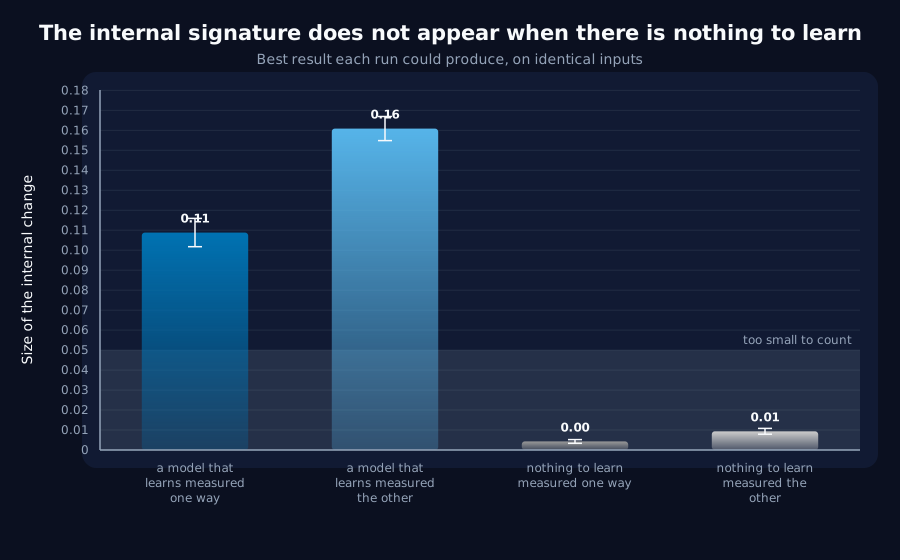
What we found. So we trained a second set of models on exactly the same inputs, with the same settings and the same starting points, but with the correct answers replaced by random noise. There was nothing to learn, and they learned nothing: they finished no better than guessing. The effect we have been reporting all along did not appear in them. The models that learned showed it at seventeen to twenty-five times the size, and the ones that could not learn stayed well inside the range we had agreed in advance was too small to count.
Why it matters. We stacked the deck against ourselves on purpose. The models that could not learn have no particular moment to examine, so we let each one report its single best moment anywhere in training, which is the most flattering measurement possible and is guaranteed to look larger than it should. They still showed nothing. We expected this outcome, and we think it was worth the compute anyway: it was the cheapest experiment available that could have shown our central claim to be about something else entirely, and a project that has never run that experiment is not entitled to say so.
The rest of this page is the technical record: the design, every number, and the limits. It is written for a reviewer, and you do not need it to have understood the result above.
New here? How to read a research record
- Start at the verdict. Every record states, before the experiment was run, what result would have made us abandon the idea. That is the "kill test". Then it says whether the test fired. Nothing gets reinterpreted after the fact.
- Numbers in square brackets are uncertainty.
23.4 [18.1, 28.7]means our best estimate is 23.4 and the true value is probably somewhere in that range. If a range includes zero, we cannot claim an effect. - Results that rule an idea out are kept. Roughly half of what is published here says an approach did not work, including plenty of our own. Those pages are the output, not a shortfall: knowing which direction is a dead end is what lets the next experiment go somewhere better, and most of what we now rely on came out of understanding why something else fell short. Work that only publishes what worked is not measuring anything.
- Read the Limits section. Every record ends with what it does not show. It is the most honest part of any experiment and usually the shortest.
- Pro tip: the figures near the top are designed to carry the result on their own. If you read nothing else, read the caption under each one, which says what it shows and what to take from it.
EXPLORATORY. Not a preregistered study. Local CPU, 16 training runs plus screening, no GPU, no cost.
Program v2 Bucket I, item I6. Decisive computation: analysis/unlearnable_control.pyanalysis/unlearnable_control.jsonpython analysis/unlearnable_control.py, or re-decide the endpoint from the saved series with --reuse.
The question, and why it should have been asked first
Every expansion measurement in this programme has been taken on a model that learns something. Not one had been taken on a model that trains for the same number of steps, on the same inputs, with the same optimiser, and learns nothing at all.
Until that exists, "the expansion accompanies acquisition" has no evidence separating it from "the expansion accompanies training a GRU on anything". Thirty-three records rest on a distinction nothing in the record had tested.
The unlearnable arm keeps everything except the learnability: same vocabulary, same sequence length, same batch size, same optimiser, same schedule, same seeds, same inputs. Only the targets are replaced with fresh uniform noise at every step, so there is no function to fit.
Kill test: the unlearnable arm shows a material expansion somewhere in its trajectory. Then the signature is a fact about training a GRU rather than about acquisition, and a large part of this record changes meaning.
The arms behave as the design requires
| Arm | Final held-out accuracy | Transitioned |
|---|---|---|
| learnable | 0.9909 | 8/8 |
| unlearnable | 0.0317 (chance is 0.0312) | 0/8 |
The unlearnable arm sits at chance after 700 steps. It learned nothing, which is the point.
Result: the control holds, by a factor of 25
The unlearnable arm has no transition, so it is measured at its best window anywhere in the trajectory, the maximum over every placement. That endpoint is biased upward by construction. The learnable arm is measured on the same statistic, because comparing a maximum against a fixed-point value is not a comparison.
| Endpoint | Learnable | Unlearnable | Ratio |
|---|---|---|---|
| best window, moving frame | +0.1088 [+0.1017, +0.1159] | +0.0043 [+0.0034, +0.0052] | 25x |
| best window, frozen frame | +0.1609 [+0.1549, +0.1669] | +0.0094 [+0.0079, +0.0108] | 17x |
| random-time window, moving | -0.0019 [-0.0232, +0.0194] | -0.0025 [-0.0039, -0.0010] | , |
The unlearnable arm is below the 0.05 materiality floor in both frames, by an order of magnitude, despite being handed the most favourable endpoint available. It was given every chance to clear the floor and did not.
The kill test does not fire. The expansion requires learning.
An incidental confirmation of D6
Worth recording because it was not designed for and is a clean replication:
| Learnable arm, window centred at the transition | |
|---|---|
| frozen frame | +0.0873 [+0.0814, +0.0933], material |
| moving frame | +0.0046 [-0.0012, +0.0104], not material |
A symmetric window centred on a peak cancels the rise against the fall, so in the moving frame the at-event number reads as nothing while the best window elsewhere reads +0.1088. In a frozen frame the tail energy does not unwind (D6), so the same window at the same place is material.
This is exactly D6's finding arriving unbidden in a pilot built for something else, and it is a concrete warning: a null from a symmetric window centred on an event is not evidence of no effect until the frame is stated.
Verdict
- The control holds. No material expansion without learning, in either frame, on the most generous endpoint available.
- The programme's central distinction survives its first direct test. "The expansion accompanies acquisition" is now separated from "the expansion accompanies training", which it had never been.
- The prior was that this would not fire, and it did not. It was still worth running: this was the cheapest experiment that could have shown the central claim to be about something other than what it says, and a programme that has never run it cannot say so.
Limits
- **This shows the expansion needs learning, not that it needs acquisition of this task.** An arm that memorises a fixed random labelling: learnable, but with no structure to generalise, is a different and more interesting control, and is E5's grokking question. It is not tested here.
- One task, one width, one architecture, one optimizer, one rank, 8 seeds per arm.
- Random targets are an extreme null. The gradient signal is pure noise, so this rules out the weakest possible alternative explanation. A partially learnable arm: noisy labels at, say, 50% corruption: would test whether the expansion scales with how much there is to learn, and is the obvious follow-up.
- The unlearnable arm's best window is small but not zero (
+0.0043, interval clear of zero). That is what a maximum-over-placements endpoint does to noise, and is why the endpoint was chosen to be generous rather than fair.
Terms on this page
Every piece of vocabulary this record uses, in plain language. Generated from the text above, so it cannot drift out of step with it.
- accuracy
- The fraction of answers a model gets right on questions it was not trained on.
- architecture
- The blueprint of a model: what components it has and how they connect. Two models can be the same size and completely different architectures.
- batch size
- How many examples the model looks at before updating itself once. Bigger batches give a steadier but more expensive update.
- gradient
- The direction and amount by which each of a model's internal numbers should change to do slightly better. Training is repeatedly following it.
- grokking
- When a network that has memorised its training examples suddenly, much later, learns the general rule and starts getting new examples right.
- GRU
- Gated Recurrent Unit. A compact design for processing sequences one item at a time, with internal switches controlling what it keeps in memory.
- held-out
- Data the model was never trained on, kept back specifically to test it. Scoring a model on data it has already seen measures memorisation, not learning.
- kill test
- A condition written down before running the experiment that says what result would make us abandon the idea. Fixing it in advance is what stops a disappointing result being reinterpreted as an encouraging one.
- optimizer
- The algorithm that decides how to change the model given the gradient. AdamW and SGD are two common choices and they behave differently.
- rank
- How many independent directions a set of numbers really uses. A low-rank structure is one that looks high-dimensional but is actually simple underneath.
- seed
- The number that fixes all the randomness in a training run. Same seed, same run. Running several seeds is how you tell a real effect from a lucky one.
- vocabulary
- The set of distinct symbols a model can read and produce.
- width
- How many internal numbers a model uses at each layer. The usual way we vary model size in these experiments.
Get new results as we publish them
Roughly monthly, one finding per email, in plain English first. Including the approaches that turned out not to work, which are usually the useful ones. No sales email.
Double opt-in: we send a confirmation link and add nobody who does not click it. One-click unsubscribe on every email.