
The Fix That Fixed Nothing
Ongoing research. This is an experimental result from active work, not a settled conclusion. The numbers are what we measured and the method is described so you can judge it, but the programme is still running and later experiments may revise what it means.
A note on the language in these records. This is a working laboratory notebook for research into training AI models more cheaply and efficiently, so you will read that an approach did not work, that a result did not hold up, or that one method was worse than another. That is the research doing its job, not a verdict on the engineering we deliver to clients. Ruling an approach out is how the search narrows, and these are the pages that teach us the most: nearly every technique we now rely on came from understanding why something else fell short. Testing our own ideas at least as hard as anyone else's is the point of publishing them. More about this programme and why we run it.
Part of a bigger question: How do we know our own results are real? – Repeatedly, the control rather than the measurement decided the result -- and several striking findings dissolved when the right comparison was finally run.
In plain English
What we asked. An earlier experiment of ours failed for a specific reason: we wanted to watch a model learn something, and it turned out an untrained model could already do it, so there was no moment of learning to look at. That failure told us exactly what a working version would need, so this is our attempt to build one. We had a theory about what went wrong and a redesign meant to fix it.
What we found. The theory was wrong, and we found out for free. The very first measurement, which needs no training at all, showed our redesigned task scoring the same as the original on exactly the thing we had redesigned it to change. We then had one dial left for making the task harder, and the only setting that hid the answer from an untrained model also stopped the trained model from ever finding it. One run in five got anywhere.
Why it matters. The reason is the useful part. Our dial did not make the task deeper, it made the evidence fainter, and faint evidence is hard for a trained model too. So the requirement for the next attempt is sharper than we could have stated before: the thing being learned has to be easy to see but hard to compute, rather than simply hard to see. The original question, which is the biggest unresolved one in this project, is still open. We are also pleased about the order we did this in: the check that killed our theory cost nothing, because we ran it before spending any computer time on the idea it was meant to support.
The rest of this page is the technical record: the design, every number, and the limits. It is written for a reviewer, and you do not need it to have understood the result above.
New here? How to read a research record
- Start at the verdict. Every record states, before the experiment was run, what result would have made us abandon the idea. That is the "kill test". Then it says whether the test fired. Nothing gets reinterpreted after the fact.
- Numbers in square brackets are uncertainty.
23.4 [18.1, 28.7]means our best estimate is 23.4 and the true value is probably somewhere in that range. If a range includes zero, we cannot claim an effect. - Results that rule an idea out are kept. Roughly half of what is published here says an approach did not work, including plenty of our own. Those pages are the output, not a shortfall: knowing which direction is a dead end is what lets the next experiment go somewhere better, and most of what we now rely on came out of understanding why something else fell short. Work that only publishes what worked is not measuring anything.
- Read the Limits section. Every record ends with what it does not show. It is the most honest part of any experiment and usually the shortest.
- Pro tip: the figures near the top are designed to carry the result on their own. If you read nothing else, read the caption under each one, which says what it shows and what to take from it.
EXPLORATORY. Not a preregistered study. Local CPU, 5 training runs plus a free initialisation sweep, no GPU, no cost.
Program v2 Bucket I, item I5. Decisive computation: analysis/composed_world.pyanalysis/composed_world.jsonpython analysis/composed_world.py.
The question
H7 tried to separate this programme's two perfectly-correlated variables, architecture and objective. It could not run, and it ended by stating exactly why: a randomly initialised GRU already read its probe target at R2 = 0.77, and the prediction loss converged smoothly, so there was neither a hidden target nor an abrupt event. That turned H7 into a design specification. I5 builds a task against it.
The diagnosis I5 started from: H7's world clamps the agent at the walls, so position is a linear accumulation of the actions the model is given as input, and a random recurrent network is a good leaky integrator (F3). Make the walls reflect and position becomes a folded accumulation, a triangle wave, which is nonlinear in the action history.
Kill test: a randomly initialised GRU's probe R2 on the new target exceeds 0.3, or the task shows no abrupt event.
The diagnosis was wrong
The free initialisation check runs first and costs no training:
| Step size | Side R2 at init | Position R2 at init | Under the 0.3 ceiling? |
|---|---|---|---|
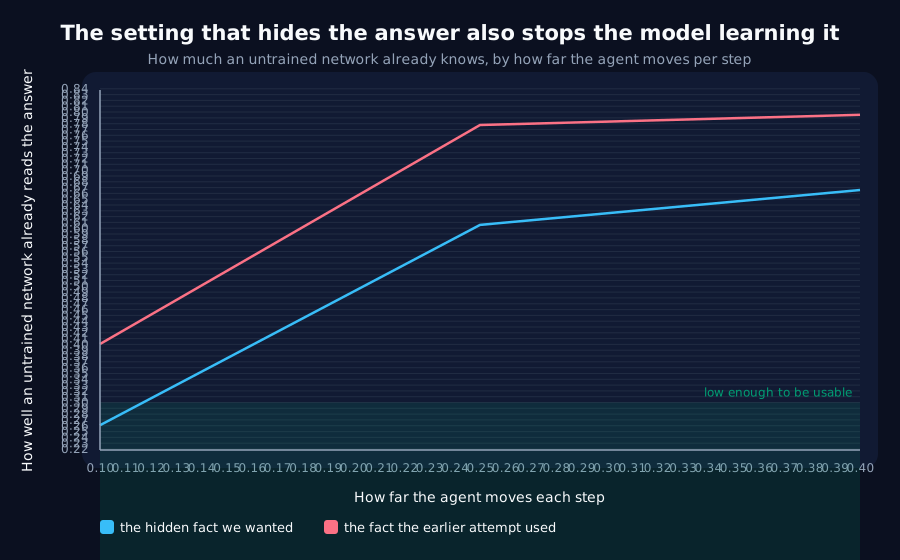
0.10 | +0.261 [+0.245, +0.277] | +0.401 | yes |
0.25 | +0.606 [+0.601, +0.611] | +0.778 [+0.766, +0.790] | no |
0.40 | +0.666 [+0.645, +0.687] | +0.795 | no |
At H7's own step size of 0.25, reflecting walls give position R2 = 0.778 against H7's clamping 0.770. Essentially identical. The wall behaviour was not the binding constraint, and the hypothesis this pilot was built on is refuted by its own first, free measurement.
What actually moves the number is step size, and that is the finding.
And the two halves of the specification pull in opposite directions
Only the 0.10 cell clears the initialisation ceiling, so only it was trained:
| Result | |
|---|---|
runs reaching R2 = 0.5 on the hidden side | 1 of 5 |
| runs beating "predict no change" by 25% | 0 of 5 |
| runs with a resolvable crossing at all | 2 of 5 |
| final loss against the trivial baseline | 0.00543 against 0.00590, 8% better |
The model does not learn the target either. The cell that hides the target from an untrained network also hides it from a trained one.
The reason is structural, and it is the useful output of this pilot. In this world family the free parameter controls signal strength, not compositional depth. The sensor is symmetric, so which side the agent is on is resolved only by the asymmetry that accumulates as it moves; a small step makes the target hard to read at initialisation precisely because it is weakly identified from the data at all. A large step makes it identifiable and therefore readable by the reservoir too.
Hard-to-read-at-init and learnable are in tension whenever difficulty is tuned by weakening the signal. H7's specification cannot be met that way, and this pilot is the demonstration.
Verdict
- The kill test fires. No cell meets both halves of H7's specification. H7 remains unrunnable and the architecture-versus-objective confound remains open, still the largest one in the programme.
- The reflecting-wall hypothesis is refuted, by a free measurement, before any compute was spent on the arm it was meant to enable. That ordering is the design point worth copying.
- The requirement is now sharper than H7 left it. Difficulty has to come from compositional depth, a nonlinear function of a strongly identified state, and not from weakening the signal that identifies the state. A target that is hard because it is faint is not hard in the way this needs.
- What that means concretely for the next attempt: keep the state fully identifiable from the observations, and make the probe target a nonlinear function of it: a parity, a comparison between two distant moments, a count modulo something. The state should be easy; the question asked about it should be hard.
Limits
- One world family, one architecture, one width, one learning rate, 5 seeds, 3 step sizes.
- The comparison against H7's
0.770is close but not exact: H7 used 16-step trajectories and this uses 24. The two numbers are0.770and0.778at the same step size, which is well inside what that difference could produce, so "reflecting walls change nothing here" is the right reading and "they change nothing at all" is not established. - The
0.10cell may be underpowered rather than impossible. 900 steps at one learning rate is not a serious attempt to learn a weakly identified target, and a longer run or a tuned rate might reach it. The tension it demonstrates would still hold, because the mechanism is about identifiability rather than about optimisation. - Sharpness is measured on the probe curve, which is noisy at low
R2; two of five runs had no resolvable crossing, and that is a property of the measurement as much as of the runs.
Terms on this page
Every piece of vocabulary this record uses, in plain language. Generated from the text above, so it cannot drift out of step with it.
- architecture
- The blueprint of a model: what components it has and how they connect. Two models can be the same size and completely different architectures.
- baseline
- The thing you compare against. A result without one is not a result.
- confound
- A second explanation you did not control for. If bigger models both learn faster and score higher, then 'fast learners score higher' may be entirely about size and not about speed.
- GRU
- Gated Recurrent Unit. A compact design for processing sequences one item at a time, with internal switches controlling what it keeps in memory.
- kill test
- A condition written down before running the experiment that says what result would make us abandon the idea. Fixing it in advance is what stops a disappointing result being reinterpreted as an encouraging one.
- learning rate
- How big a step training takes each time it updates the model. Too small and nothing happens; too big and it never settles.
- parity
- Whether a count is odd or even. A classic test puzzle for models, because the answer flips with every single item and cannot be guessed from a rough impression.
- probe
- A small separate model trained to read information out of a bigger model's internals, used as a measuring instrument rather than as a product.
- recurrent
- A design that reads a sequence one item at a time, carrying memory forward. The main alternative is attention, which looks at everything at once.
- seed
- The number that fixes all the randomness in a training run. Same seed, same run. Running several seeds is how you tell a real effect from a lucky one.
- sharpness
- How abrupt a model's improvement is. We measure the biggest change over any short stretch of training as a share of the run's total change, scaled so that a model improving at a perfectly steady rate would score 1. A score of 20 means the fastest stretch was twenty times steeper than a straight line.
- width
- How many internal numbers a model uses at each layer. The usual way we vary model size in these experiments.
Get new results as we publish them
Roughly monthly, one finding per email, in plain English first. Including the approaches that turned out not to work, which are usually the useful ones. No sales email.
Double opt-in: we send a confirmation link and add nobody who does not click it. One-click unsubscribe on every email.