
A Yardstick That Does Not Stretch
Ongoing research. This is an experimental result from active work, not a settled conclusion. The numbers are what we measured and the method is described so you can judge it, but the programme is still running and later experiments may revise what it means.
A note on the language in these records. This is a working laboratory notebook for research into training AI models more cheaply and efficiently, so you will read that an approach did not work, that a result did not hold up, or that one method was worse than another. That is the research doing its job, not a verdict on the engineering we deliver to clients. Ruling an approach out is how the search narrows, and these are the pages that teach us the most: nearly every technique we now rely on came from understanding why something else fell short. Testing our own ideas at least as hard as anyone else's is the point of publishing them. More about this programme and why we run it.
Part of a bigger question: How do we know our own results are real? – Repeatedly, the control rather than the measurement decided the result -- and several striking findings dissolved when the right comparison was finally run.
In plain English
What we asked. The day before, we withdrew a finding because the way we measured it gave different answers depending on how long we had trained the model. That measuring approach was not invented for that one experiment; we had used it before. So the question became whether it can be fixed, and whether the withdrawn finding comes back once it is.
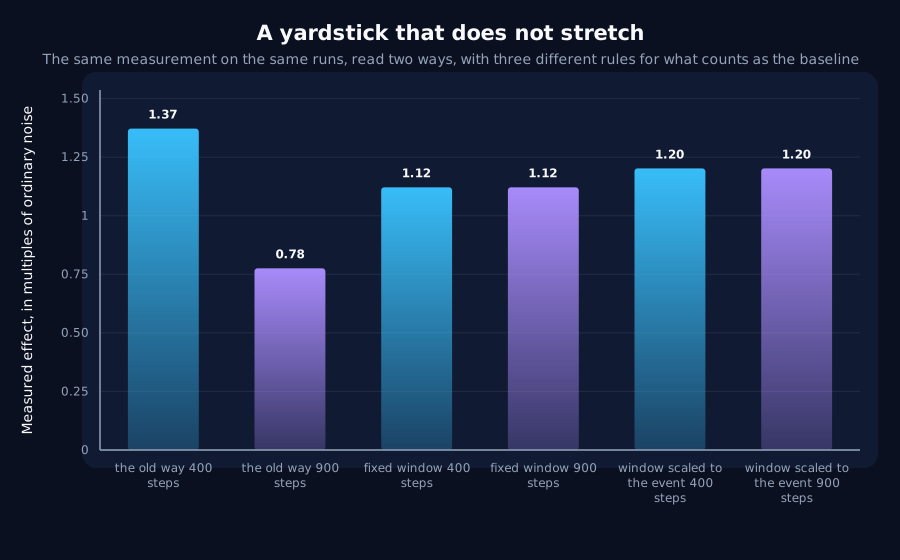
What we found. It can be fixed, and the finding does not come back. The problem was that we compared the moment of learning against a baseline fitted to the entire rest of the run, so a longer run meant a different baseline. Fitting the baseline to a fixed stretch of training either side instead gives exactly the same answer at both run lengths. Under the repaired version the effect we withdrew is still absent, which is an independent confirmation from the same data by a different route.
Why it matters. Two things worth noting. The first is that this cost nothing: a longer run contains the shorter run inside it, so we could compare both without training anything new. Keeping the raw measurements from earlier experiments is what made that possible, and it has now paid for itself several times. The second is a caveat we want to state rather than let the result look better than it is. The repaired versions agree perfectly at the two run lengths we compared, but that is guaranteed by how they are built rather than discovered: their baselines sit entirely inside the shorter run, so they could not have disagreed. It is a correct design, not a surprising finding, and a harder test would move the moment of learning rather than the stopping point.
The rest of this page is the technical record: the design, every number, and the limits. It is written for a reviewer, and you do not need it to have understood the result above.
New here? How to read a research record
- Start at the verdict. Every record states, before the experiment was run, what result would have made us abandon the idea. That is the "kill test". Then it says whether the test fired. Nothing gets reinterpreted after the fact.
- Numbers in square brackets are uncertainty.
23.4 [18.1, 28.7]means our best estimate is 23.4 and the true value is probably somewhere in that range. If a range includes zero, we cannot claim an effect. - Results that rule an idea out are kept. Roughly half of what is published here says an approach did not work, including plenty of our own. Those pages are the output, not a shortfall: knowing which direction is a dead end is what lets the next experiment go somewhere better, and most of what we now rely on came out of understanding why something else fell short. Work that only publishes what worked is not measuring anything.
- Read the Limits section. Every record ends with what it does not show. It is the most honest part of any experiment and usually the shortest.
- Pro tip: the figures near the top are designed to carry the result on their own. If you read nothing else, read the caption under each one, which says what it shows and what to take from it.
EXPLORATORY. No training was run. Local CPU, seconds, reading committed series only. No GPU, no cost.
Program v2 Bucket P, item P13, generated by P12. Decisive computation: analysis/invariant_gate.pyanalysis/invariant_gate.jsonpython analysis/invariant_gate.py.
The question
P12's first case withdrew O7 because its statistic is not run-length invariant: same width, same lag, same seeds, and changing the run from 400 steps to 900 takes the departure from 1.49 to 0.71. The gate fits a line to everything outside the transition window, so a longer run fills the fit with late training and the transition stops looking anomalous.
That gate came from A13 and has been reused since. Can it be repaired?
No training was needed. A 900-step run's first 400 steps are a 400-step run: same seed, same data stream, identical up to truncation. So each variant is evaluated on P12's committed 900-step series and on the same series truncated, which is an exact comparison rather than two experiments.
Kill test, fixed before execution: no variant agrees between the truncated and full runs, where agreeing means overlapping intervals and a point-estimate ratio inside [0.7, 1.4].
Anchor enforced in code: the current gate must reproduce P12's disagreement. It does, 1.37 at 400 steps against 0.78 at 900.
What we found
| Variant | 400 steps | 900 steps | Agrees? | Points the fit sees |
|---|---|---|---|---|
whole-run (current) | 1.37 [1.23, 1.51] | 0.78 [0.56, 0.99] | no | 67 → 167 |
fixed-flank | 1.12 [0.82, 1.43] | 1.12 [0.82, 1.43] | yes | 36 → 36 |
proportional | 1.20 [0.93, 1.47] | 1.20 [0.93, 1.47] | yes | 40 → 40 |
The kill test does not fire. Both repaired variants are invariant, and the mechanism is visible in the last column: the current gate's fit grows from 67 points to 167 as the run lengthens, while the repaired ones see the same 36 or 40 points either way.
The invariance here is by construction, not by discovery
This is the caveat that matters. fixed-flank fits 90 steps either side of the window and proportional fits out to twice the transition step, and at a transition near 130, both of those ranges lie entirely inside the first 400 steps. Truncating at 400 therefore removes nothing they were using, so the agreement is exact and guaranteed rather than empirical.
That is not a flaw in the repair, a gate whose fit range provably cannot see past a point is run-length invariant, which is the property wanted. But it means this record demonstrates the construction is correct, not that it is robust. The harder test is whether these variants agree when the transition itself moves, which is a different quantity and is not tested here.
The repair does not bring O7 back
fixed-flank reads 1.12 [0.82, 1.43] and proportional reads 1.20 [0.93, 1.47] at width
- Both intervals include
1.0, so neither clears the gate. O7's effect does not return under a
corrected measurement: it was 1.49 only under the version that could be moved by choosing when to stop.
That is an independent confirmation of P12's withdrawal, from the same runs by a different route.
What this means for A13 and anything else using the gate
A13's null is safer than a positive would have been, but it was computed with whole-run and its run length should be quoted whenever it is cited. Anything else that used this gate is in the same position: not necessarily wrong, but not comparable across runs of different lengths, which is the same trap N5 documented for a floor-to-ceiling midpoint.
Use fixed-flank for new work. It is the simplest of the two, sees a fixed amount of run by construction, and needs one constant (FLANK) stated alongside the result.
Limits
- One quantity, one width, one lag, six seeds. The comparison is exact for what it covers and covers very little.
- The invariance is guaranteed rather than measured, as above. A test where the fit range would actually be truncated: a much later transition, or a much shorter run, is not done.
FLANK = 90and the2 x transitionrange are choices, not derived. A differentFLANKwould give a different number; what it would not give is a different number at 400 than at 900.- Nothing here says the repaired gate is sensitive enough to find a real effect. It is invariant, which is necessary and not sufficient.
- No training was run, so this inherits every limit of the runs it reads.
Terms on this page
Every piece of vocabulary this record uses, in plain language. Generated from the text above, so it cannot drift out of step with it.
- kill test
- A condition written down before running the experiment that says what result would make us abandon the idea. Fixing it in advance is what stops a disappointing result being reinterpreted as an encouraging one.
- seed
- The number that fixes all the randomness in a training run. Same seed, same run. Running several seeds is how you tell a real effect from a lucky one.
- truncation
- Cutting a record short. Here it means discarding the last part of a finished training run and recomputing a measurement as if the run had stopped earlier, to see whether the answer depends on how long the run went on.
- width
- How many internal numbers a model uses at each layer. The usual way we vary model size in these experiments.
Get new results as we publish them
Roughly monthly, one finding per email, in plain English first. Including the approaches that turned out not to work, which are usually the useful ones. No sales email.
Double opt-in: we send a confirmation link and add nobody who does not click it. One-click unsubscribe on every email.