
We Gave It The Answer Anyway
Ongoing research. This is an experimental result from active work, not a settled conclusion. The numbers are what we measured and the method is described so you can judge it, but the programme is still running and later experiments may revise what it means.
A note on the language in these records. This is a working laboratory notebook for research into training AI models more cheaply and efficiently, so you will read that an approach did not work, that a result did not hold up, or that one method was worse than another. That is the research doing its job, not a verdict on the engineering we deliver to clients. Ruling an approach out is how the search narrows, and these are the pages that teach us the most: nearly every technique we now rely on came from understanding why something else fell short. Testing our own ideas at least as hard as anyone else's is the point of publishing them. More about this programme and why we run it.
Part of a bigger question: What actually happens at the moment a model learns? – It builds machinery rather than selecting it, working through the task in a reproducible order and trying a simpler wrong rule on the way. The visible training curve cannot tell you which is happening.
In plain English
What we asked. When one of these models suddenly gets good at its task, its internals rearrange, and we can measure how much. An earlier experiment of ours found that a model started off with another model's finished internal machinery barely rearranges at all -- it has the machinery already, so there is nothing to build. That suggested a sharper test. What if we do not hand over any machinery, and instead simply wire the correct answer into the model as a shortcut sitting alongside it?
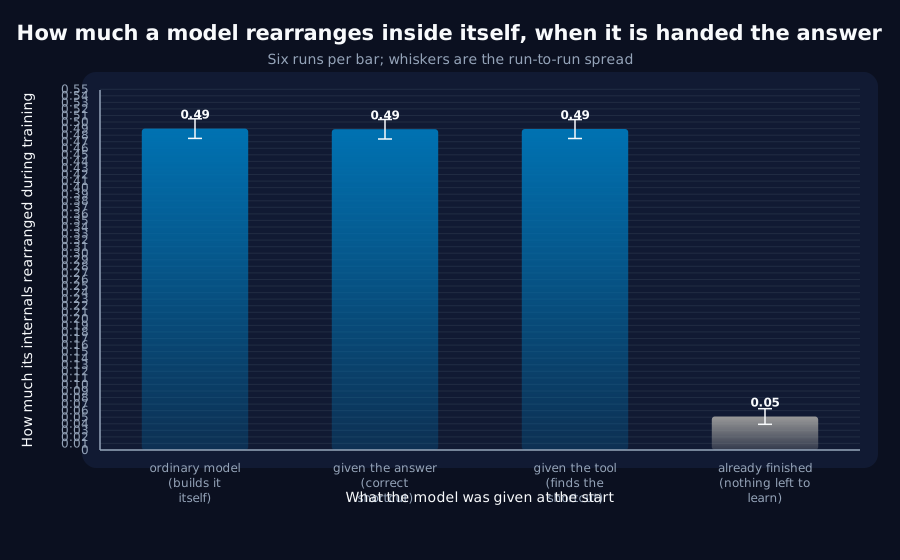
What we found. It made no difference whatsoever. Models given a working shortcut rearranged themselves just as much as models that had to work the task out from nothing, and reached the point of suddenly getting good at almost exactly the same time. We checked carefully that the shortcut was genuinely in use rather than switched off and ignored: the model strengthens it during training, and on its own, with the network taken away, it gets every single answer right. A second version was given the shortcut but not told how to aim it, and aimed it correctly by itself in every run.
Why it matters. Putting the two experiments together tells us what the rearranging actually is. Giving a model finished machinery in its own parts quiets it; giving it a correct answer from outside does not. So the rearranging is the model fitting the task into its own components, which it does whether or not the answer is already available next to it. It also fits an uncomfortable pattern we found separately, where a rule with no parameters solves the same task perfectly and the trained model never quite catches it: the model does not take the easy route even when the easy route is wired directly into its own output. If you are evaluating a model, that is worth remembering -- what a system does internally is not well predicted by what shortcuts you have made available to it.
The rest of this page is the technical record: the design, every number, and the limits. It is written for a reviewer, and you do not need it to have understood the result above.
New here? How to read a research record
- Start at the verdict. Every record states, before the experiment was run, what result would have made us abandon the idea. That is the "kill test". Then it says whether the test fired. Nothing gets reinterpreted after the fact.
- Numbers in square brackets are uncertainty.
23.4 [18.1, 28.7]means our best estimate is 23.4 and the true value is probably somewhere in that range. If a range includes zero, we cannot claim an effect. - Results that rule an idea out are kept. Roughly half of what is published here says an approach did not work, including plenty of our own. Those pages are the output, not a shortfall: knowing which direction is a dead end is what lets the next experiment go somewhere better, and most of what we now rely on came out of understanding why something else fell short. Work that only publishes what worked is not measuring anything.
- Read the Limits section. Every record ends with what it does not show. It is the most honest part of any experiment and usually the shortest.
- Pro tip: the figures near the top are designed to carry the result on their own. If you read nothing else, read the caption under each one, which says what it shows and what to take from it.
EXPLORATORY. Not a preregistered study. Local CPU, 30 training runs, no GPU, no cost.
Program v2 Bucket M, item M4. Decisive computation: analysis/built_in_algorithm.pyanalysis/built_in_algorithm.jsonpython analysis/built_in_algorithm.py, or re-derive every endpoint with --reuse.
The question
K7 showed that a model handed a learned mechanism, another run's recurrent weights, barely reorganises internally: it retains a fraction of a from-scratch run's expansion and transitions at step 20 instead of 84. This asks the same question with a designed mechanism.
The task is delayed copy and the algorithm is "emit the token k places back". So the architecture is given that operation outright, as an additive path beside the recurrent network, and the network is asked whether it still does the thing it does when it has to build the mechanism itself.
Kill test, fixed in advance: it still transitions, on K7's endpoint.
Arms
| arm | what it gets |
|---|---|
plain | an ordinary GRU. K7's scratch, and the anchor |
copy-gate | the GRU plus a copy path at the correct offset, strength learned from a small start |
lag-mixture | the GRU plus a copy path whose offset is a learned distribution over eight candidates, initialised uniform |
warm-all | K7's no-event baseline, reproduced here so the retained share has a reference from these runs |
The endpoint is K7's, imported rather than reimplemented: J4's expansion, the largest rise in residual representation energy over any window, in the moving and the frozen frame (D6), and the share of the from-scratch expansion each arm retains above the no-event baseline rather than above zero.
Result: nothing changes
| arm | transitioned | final accuracy | transition step | expansion (moving) | expansion (frozen) |
|---|---|---|---|---|---|
plain | 6/6 | 0.9875 | 84.0 [81.7, 86.3] | +0.2474 [+0.2342, +0.2605] | +0.4901 [+0.4751, +0.5050] |
copy-gate | 6/6 | 0.9905 | 79.3 [77.2, 81.5] | +0.2476 [+0.2348, +0.2604] | +0.4890 [+0.4742, +0.5039] |
lag-mixture | 6/6 | 0.9918 | 82.0 [79.3, 84.7] | +0.2470 [+0.2340, +0.2599] | +0.4893 [+0.4749, +0.5038] |
warm-all | 0/6 | 0.9927 | never | +0.0332 [+0.0268, +0.0396] | +0.0511 [+0.0391, +0.0630] |
Share of the from-scratch expansion retained, above the no-event baseline:
| arm | moving frame | frozen frame |
|---|---|---|
copy-gate | +100.1% | +99.8% |
lag-mixture | +99.8% | +99.8% |
The kill test fires, and there is nothing marginal about it. Handing the model a working copy path leaves the internal reorganisation at essentially exactly its from-scratch magnitude, in both frames, and moves the transition by about five steps. Both anchors reproduced: plain matches K7's scratch (+0.4896 frozen, transition 83.67) and warm-all matches K7's no-event baseline (+0.0583 frozen, never transitions).
The check that licenses the headline
A path the model never opens is a no-op dressed as an intervention. The first execution of this pilot reported the table above with no evidence that the copy path was used at all, which would have made the result meaningless: this programme has already published one control that removed 0.0% of what it was meant to perturb. So each built-in arm now reports three things at the end of training:
copy-gate | lag-mixture | |
|---|---|---|
learned strength of the path (from 0.127) | 0.371 [0.346, 0.397] | 0.668 [0.573, 0.763] |
| that path's own accuracy, network removed | 1.0000 | 1.0000 |
selector mass on the correct offset (from 0.125) | 1.0000 | 0.598 [0.548, 0.648] |
The path is used, it is strengthened by training, and on its own it is exactly correct. The mixture arm was not even told which offset to read and put 60% of its mass on the right one, with its argmax correct in every seed, so it found the algorithm as well as being given the primitive.
And the network built its own machinery anyway.
What this says
K7 and M4 together separate two things that sound the same:
- Handing a model a learned solution in its own weights removes the reorganisation (K7: warm recurrence transitions at step 20 and retains a fraction).
- Handing it a correct, working, external algorithm removes none of it (M4:
+99.8%retained).
The reorganisation is therefore not the model acquiring the function. It is the recurrent network fitting the task in its own parameters, and it does that whether or not the answer is already available beside it. The GRU does not outsource.
Read with M1, where a zero-parameter cache solves this task outright and the GRU never catches it, the picture is consistent and slightly uncomfortable: the network is not using the cheapest route even when the cheapest route is wired directly into its own output.
Verdict
- The kill test fires. Both built-in arms retain
+99.8%of the from-scratch expansion. - The manipulation is real: the copy path is strengthened during training and scores
1.0000alone; the mixture arm found the correct offset unaided. - Both anchors reproduced,
plainagainst K7'sscratchandwarm-allagainst its no-event baseline. - M4 is a negative for the constructive demonstration it was designed to give, and a positive for what the reorganisation is: parameter fitting, not function acquisition.
Limits
- The copy path is additive at a learned strength, and that strength stayed small (
0.37and0.67). It is enough to be correct on its own but it is not obviously enough to dominate the GRU's logits, so "the model was handed the answer" is true of the path and not necessarily of the output. A version that forces the gate wide open, or that replaces the GRU's contribution rather than adding to it, is a stronger test and is not run here. - Six seeds, one task, one width, one learning rate. The effect size makes six enough; a smaller one would not be.
- The expansion endpoint is a best-window rise, which is positive under noise by construction, which is exactly why K7's no-event arm is the reference rather than zero.
- Representation capture is delegated to the inner GRU, so what is measured is whether the recurrent part reorganises. A measurement over the combined model would be a different quantity and is not what K7 measured.
- This does not show the reorganisation is useful. It shows it happens regardless. Whether the model would be as accurate without it is F4's kind of question, not this one's.
Terms on this page
Every piece of vocabulary this record uses, in plain language. Generated from the text above, so it cannot drift out of step with it.
- accuracy
- The fraction of answers a model gets right on questions it was not trained on.
- architecture
- The blueprint of a model: what components it has and how they connect. Two models can be the same size and completely different architectures.
- argmax
- Short for 'the argument that maximises'. A model outputs a score for every possible next token; the argmax is simply whichever one scored highest. Accuracy is measured on the argmax, which is why accuracy is a thresholded quantity: only the winner counts, and by how much it won is discarded.
- baseline
- The thing you compare against. A result without one is not a result.
- GRU
- Gated Recurrent Unit. A compact design for processing sequences one item at a time, with internal switches controlling what it keeps in memory.
- kill test
- A condition written down before running the experiment that says what result would make us abandon the idea. Fixing it in advance is what stops a disappointing result being reinterpreted as an encouraging one.
- learning rate
- How big a step training takes each time it updates the model. Too small and nothing happens; too big and it never settles.
- logits
- The raw scores a model produces for each possible answer before they are turned into probabilities.
- parameters
- The adjustable numbers inside a model. Training is the process of setting them. Model size is usually quoted as a count of these.
- recurrent
- A design that reads a sequence one item at a time, carrying memory forward. The main alternative is attention, which looks at everything at once.
- residual
- How far the data sits from a proposed description of it, after the description has been fitted as well as it can be. A small residual means the description accounts for what was measured; a large one means something is missing.
- seed
- The number that fixes all the randomness in a training run. Same seed, same run. Running several seeds is how you tell a real effect from a lucky one.
- width
- How many internal numbers a model uses at each layer. The usual way we vary model size in these experiments.
Get new results as we publish them
Roughly monthly, one finding per email, in plain English first. Including the approaches that turned out not to work, which are usually the useful ones. No sales email.
Double opt-in: we send a confirmation link and add nobody who does not click it. One-click unsubscribe on every email.