
Wider Models Still Compete
Ongoing research. This is an experimental result from active work, not a settled conclusion. The numbers are what we measured and the method is described so you can judge it, but the programme is still running and later experiments may revise what it means.
A note on the language in these records. This is a working laboratory notebook for research into training AI models more cheaply and efficiently, so you will read that an approach did not work, that a result did not hold up, or that one method was worse than another. That is the research doing its job, not a verdict on the engineering we deliver to clients. Ruling an approach out is how the search narrows, and these are the pages that teach us the most: nearly every technique we now rely on came from understanding why something else fell short. Testing our own ideas at least as hard as anyone else's is the point of publishing them. More about this programme and why we run it.
Part of a bigger question: What actually happens at the moment a model learns? – It builds machinery rather than selecting it, working through the task in a reproducible order and trying a simpler wrong rule on the way. The visible training curve cannot tell you which is happening.
In plain English
What we asked. We found that teaching a small model one extra skill it does not need slows down everything it learns afterwards. The obvious explanation is that a small model is short of room, so we gave it twice as much room and ran the experiment again.
What we found. It barely changed. With twice the width, the unneeded skill still cost the other skills about a quarter to a third of their learning time. Only one skill showed any easing, and that only weakly.
Why it matters. So the competition is not simply a matter of the model being too small. A likelier explanation is that every skill being taught pulls on the same shared settings, however many of them there are. We have not yet separated the two.
The rest of this page is the technical record: the design, every number, and the limits. It is written for a reviewer, and you do not need it to have understood the result above.
New here? How to read a research record
- Start at the verdict. Every record states, before the experiment was run, what result would have made us abandon the idea. That is the "kill test". Then it says whether the test fired. Nothing gets reinterpreted after the fact.
- Numbers in square brackets are uncertainty.
23.4 [18.1, 28.7]means our best estimate is 23.4 and the true value is probably somewhere in that range. If a range includes zero, we cannot claim an effect. - Results that rule an idea out are kept. Roughly half of what is published here says an approach did not work, including plenty of our own. Those pages are the output, not a shortfall: knowing which direction is a dead end is what lets the next experiment go somewhere better, and most of what we now rely on came out of understanding why something else fell short. Work that only publishes what worked is not measuring anything.
- Read the Limits section. Every record ends with what it does not show. It is the most honest part of any experiment and usually the shortest.
- Pro tip: the figures near the top are designed to carry the result on their own. If you read nothing else, read the caption under each one, which says what it shows and what to take from it.
EXPLORATORY. Not a preregistered study. Local CPU, six seeds, 13 training runs of3000steps. The design and kill test were committed (acd91b3) before any run.
Program v2 Bucket O, item O21. Decisive computation: analysis/competition_width.pyanalysis/competition_width.jsonpython analysis/competition_width.py (about ninety minutes on a throttled laptop CPU); --reuse re-derives every endpoint from the saved series, and was checked to print the identical summary.
The question
O20 found that on identical inputs, teaching a width-64 model a skill nothing needs (G) slows the skills it learns afterwards by hundreds of steps. Two readings fit: capacity (a small model has limited room) and gradient (every supervised skill's loss pulls on the shared weights). Capacity competition should ease as the model grows; gradient competition need not.
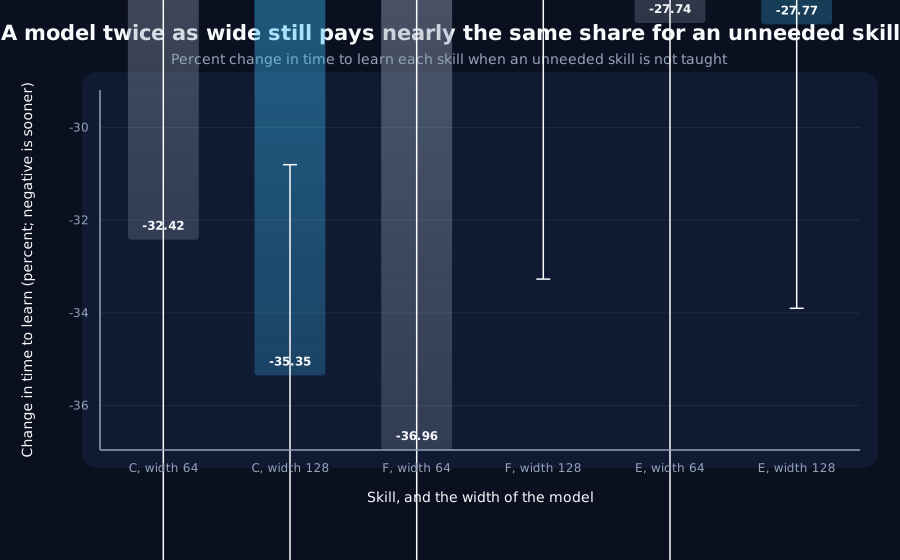
O21 repeats O20 at width 128, same seeds and task, control and G-never, O12's own loop with only the width changed. Endpoint: each composite's paired change as a share of its control time, because a wider model learns everything sooner.
Kill test, fixed before execution: at width 128, F's share has an interval that overlaps width 64's mean share -- no evidence of easing, so the capacity reading loses its distinguishing prediction.
Anchor, in code: seed 9433's width-64 control, re-run through this script's width switch, reproduces O17's committed series exactly. It does.
Standing rule, noted in the pilot: a fixed-task width sweep makes the model progressively oversized (P11). Here that is the hypothesis -- does spare capacity remove competition? -- but it means any easing is about capacity relative to this task, not about scale.
Result: the kill test does not fire -- narrowly, on one skill of three
Acquisition steps at width 128 (all six seeds acquire every skill):
| Arm | B | G | D | A | F | C | E |
|---|---|---|---|---|---|---|---|
| control | 90 | 280 | 332 | 402 | 668 | 758 | 1068 |
G-never | 82 | -- | 225 | 267 | 495 | 490 | 770 |
Paired change without G, as a share of the control's time:
| Skill | Width 64 (O20) | Width 128 |
|---|---|---|
C | -0.324 [-0.766, +0.118] | -0.353 [-0.399, -0.308] |
F | -0.370 [-0.622, -0.117] | -0.261 [-0.333, -0.189] |
E | -0.277 [-0.470, -0.084] | -0.278 [-0.339, -0.216] |
The kill test does not fire: F's width-128 interval [-0.333, -0.189] excludes width 64's mean (-0.370). But read the rest of the table before crediting it. The test is one-sided in a way the design did not intend: width 64's own interval ([-0.622, -0.117]) contains width 128's mean, so the two widths are not distinguishable in the other direction. And C and E do not ease at all: -0.324 against -0.353, -0.277 against -0.278.
Reading it
Doubling the width does not remove the competition. At width 128 every composite still arrives roughly a quarter to a third sooner when G is never taught, and the look-ups A and D are sped too. One skill of three shows a smaller share, with evidence that is weak in one direction and absent in the other. On this evidence the effect is closer to what gradient competition predicts than what pure capacity competition predicts, though this design cannot separate them cleanly.
The practical reading is O20's, now at two widths: an acquisition time is a property of the whole task. Adding a skill nobody needs costs every other skill a share of its time, and a model twice as wide pays nearly the same share.
What stands
- Kill test does not fire, narrowly:
F's share falls from-0.370to-0.261, the only difference of the three and weak in one direction. CandEare unchanged by width (-0.35,-0.28at width128).- Competition persists at width
128at about a quarter to a third of each composite's time.
Limits
- Two widths, one task, six seeds; width-
64's intervals are wide because O20's acquisition times varied by hundreds of steps. - The kill test compared an interval with a mean in one direction only; a symmetric comparison would not have separated the widths. Recorded here as a design weakness, not re-scored.
- Capacity and gradient competition are not separated. A test that keeps
G's loss but blocks its demand on capacity, or the reverse, is the natural next step.
Terms on this page
Every piece of vocabulary this record uses, in plain language. Generated from the text above, so it cannot drift out of step with it.
- gradient
- The direction and amount by which each of a model's internal numbers should change to do slightly better. Training is repeatedly following it.
- kill test
- A condition written down before running the experiment that says what result would make us abandon the idea. Fixing it in advance is what stops a disappointing result being reinterpreted as an encouraging one.
- seed
- The number that fixes all the randomness in a training run. Same seed, same run. Running several seeds is how you tell a real effect from a lucky one.
- width
- How many internal numbers a model uses at each layer. The usual way we vary model size in these experiments.
Get new results as we publish them
Roughly monthly, one finding per email, in plain English first. Including the approaches that turned out not to work, which are usually the useful ones. No sales email.
Double opt-in: we send a confirmation link and add nobody who does not click it. One-click unsubscribe on every email.