
Does Randomness Help AI Learn?
Training an AI model is a partly random process. Every step it looks at a different random handful of examples, so the direction it moves in is never quite the same twice. That randomness is usually treated as a necessary nuisance.
There is a more interesting theory about it. Models we study do not improve smoothly: they sit at a low score for a long stretch and then jump, quite suddenly, to a high one. One explanation for that shape is stochastic escape. The model is stuck in a rut, and the randomness is what eventually knocks it out.
If that were true it would be immediately useful, because it would mean you could add randomness on purpose to make learning arrive sooner. So we tested it.
The first experiment said yes, clearly
The standard way to change how much randomness there is in training is to change how many examples the model looks at before each update. A small handful is noisy; a large one averages out and is much steadier.
So we ran the same total amount of data through models using handfuls of 16, 64 and 256 examples, and a fourth version that looked at every example it had before every single update, which is as close to no randomness as you can get.
The result was large, clean, and pointed exactly the way the theory predicted. The noisiest setting learned after 2,560 examples. The least noisy one took 34,202, more than thirteen times as many. More randomness, faster learning, right across the range.
That is the sort of result it is very tempting to stop at.
It was measuring the wrong thing
Changing the size of the handful does not only change the randomness. It also changes how many times the model gets to update itself. At a fixed amount of data, a model using handfuls of 16 takes sixteen times as many updates as one using handfuls of 256.
So the experiment had two explanations available and no way to tell them apart. More noise, or more practice?
Counting the same runs in updates rather than examples answers it. The ordering reverses. Measured that way the noisiest setting is the slowest, taking 160 updates against the steadiest setting's 33.
The apparent 13x noise effect was mostly the model simply getting more attempts.
The clean version
To ask the question properly you have to change the randomness and nothing else. So we did: same handful size, same number of updates, same everything, but with extra random noise added directly on top of each update, at four different strengths.
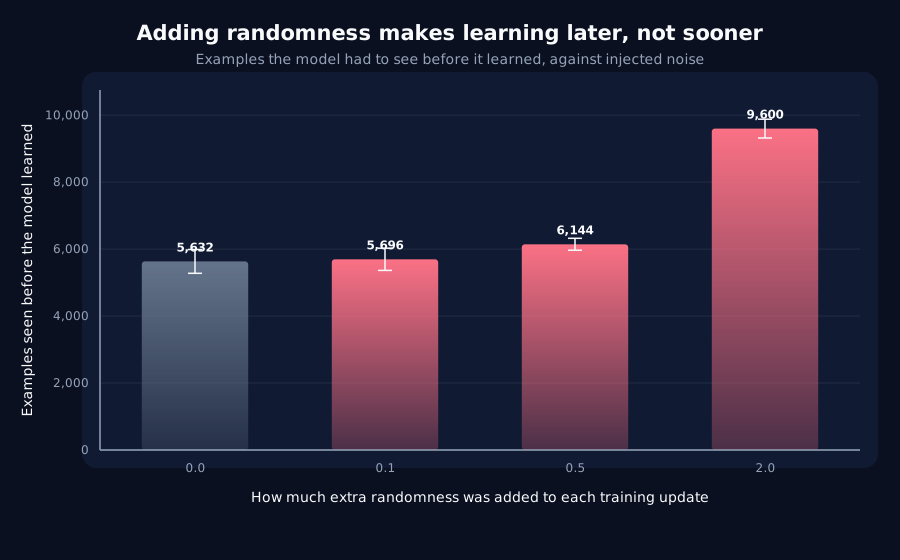
Every increase in randomness made learning take longer. The strongest setting needed 70% more data than the control, and the effect was consistent across all four levels: a little noise did almost nothing, and a lot of noise clearly hurt.
The moment of learning also got blurrier. The jump smeared out over roughly twice the span, so noise did not just delay the event, it degraded it.
In plain English
Imagine trying to find a door in the dark. One theory says that stumbling around randomly is what eventually gets you through it, so you should stumble harder. We tried stumbling harder. It took longer to find the door, and we went through it less cleanly.
The randomness in AI training is not what solves the problem. Something else is doing that, and the randomness is getting in its way. Not enough to stop it, but enough to measure.
Why the direction is the whole result
Our own test for this experiment, written down before we ran it, was whether the moment of learning responds to noise at all. It does: well beyond the run-to-run variation we would expect by chance.
Read as a headline, "learning responds to randomness" sounds like support for the theory. It is the opposite. The theory needed noise to end the stuck period. What noise actually does is make it longer.
We had written the experiment's summary line to report the size of the effect. We changed it to report the direction as well, because the version without it was genuinely misleading about our own result.
What to take from this
- A clean, large, consistent result can still be measuring the wrong variable. Nothing about the first experiment looked shaky. It was monotone across four settings and the effect was enormous. It was also mostly an artifact of a second thing changing at the same time.
- "Responds to X" is not a finding without a direction. Half of the possible answers to "does it respond" support a theory and half refute it, and a summary that omits which is not a summary.
- Adding noise is not a training trick. At least for this kind of model, deliberately increasing randomness costs data and sharpness and buys nothing. We had been holding that idea open as a possible line of work and this closed it.
The broader habit is worth stating plainly, because it is cheap and it keeps paying: when an experiment changes one knob, check what else that knob moves. Here the answer was hiding in a change of units.
Read the full record, with every number and the limits
Get new results as we publish them
Roughly monthly, one finding per email, in plain English first. Including the approaches that turned out not to work, which are usually the useful ones. No sales email.
Double opt-in: we send a confirmation link and add nobody who does not click it. One-click unsubscribe on every email.