
When a Benchmark Is Too Easy to Be Useful
For about a year, our research programme ran experiments that each carried a quality check: did this intervention hurt the model's accuracy? Every single one passed. Not one intervention cost measurable quality.
That reads as a clean run of results. It is partly an artefact, and the reason is embarrassing enough to be worth writing down.
Nothing could have failed
The task we were testing on scored between 96% and 99.5%. A model with 0.4 percentage points of room above it cannot lose 2 points. So "no quality loss" was in part a statement about the task, not about the intervention.
It is not that the checks were wrong. They were correctly computed, correctly reported, and incapable of detecting the thing they existed to detect. A test that everyone aces does not rank anyone.
In plain English
Imagine screening pilots with an eye test where the smallest line on the chart is enormous. Everybody passes. The test is administered honestly and the results are recorded accurately, and it still tells you nothing about anyone's eyesight.
That was our quality check. To find out whether something degrades a model, the model has to be able to visibly get worse.
Building a harder test, and failing twice
So we designed replacement tasks with deliberate difficulty, and set the acceptance rule before running anything: a five-run control has to settle between 60% and 90% accuracy, and it has to actually settle rather than pass through that range on its way to solving the task.
Four candidates. Two passed.
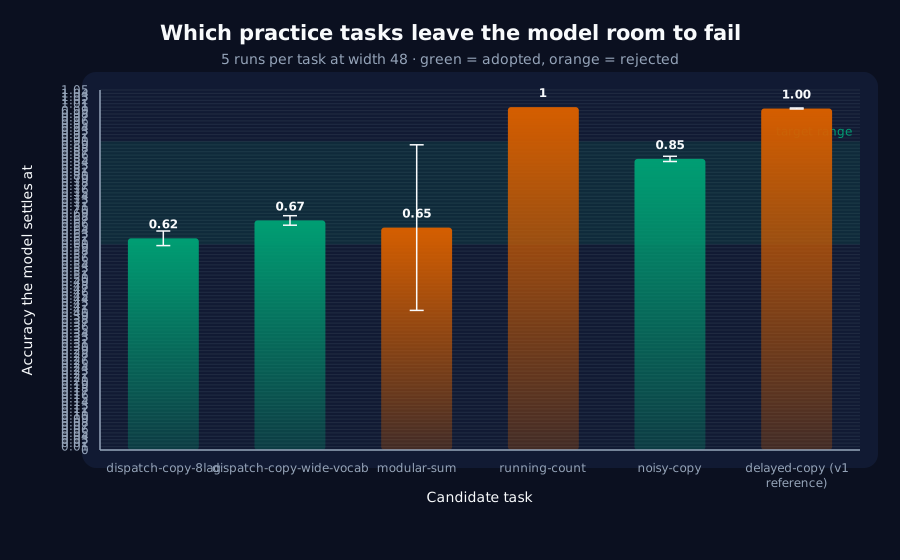
The two failures were more informative than the successes.
One task was all or nothing. Its five-run average was 0.6486, comfortably inside the target band, and it would have been adopted on the average alone. The second half of the rule caught it: individual runs landed anywhere from 0.491 to 0.974. Some solved the task outright and some did not, and the average was an artefact of mixing two different outcomes. Nudging the difficulty did not help. It went from 96.4% to 33.6% between two adjacent settings, with nothing in between. A task like that is a bad instrument, because a small change in conditions produces a large change in score for reasons unrelated to what you are measuring.
One task was trivial. It scored a perfect 1.0000 in every run at every setting we tried. The model architecture we use has a natural counter built into it, so asking it to count creates no difficulty at all. We recorded that as a boundary rather than tuning until something passed.
We also included a calibration task whose ceiling is known by arithmetic, at 0.8547. The measurement came in at 0.8491, an error of half a percentage point. That is what makes the other rows believable: the instrument was checked against a known answer before being trusted on unknown ones.
Quality claims in a unit that means something
With tasks that have room to fail, we changed how quality is reported. Instead of an absolute drop in accuracy, we now report the share of the available range that was given up.
Losing half a percentage point on a task that tops out at 99.6% is 0.5% of the available range. Losing the same half point on a task that tops out at 61.8% is 0.9%, nearly twice as costly, because there was less room to begin with. Same number, different meaning, and only the second version is comparable across tasks.
What to do with this when you are buying
"No measurable accuracy loss" is one of the most common claims in AI procurement, and it is only as strong as the headroom in the benchmark behind it. Three questions:
- What does an unmodified baseline score on this benchmark? If the answer is above about 95%, a no-loss claim is close to unfalsifiable.
- What would a deliberately damaged version score? If nobody has run that, nobody knows whether the check can detect damage.
- Was the pass mark set before or after the results came in? Ours is written into the script, above the code that applies it, and it is the reason two of our four candidate tasks were rejected.
We are not immune to this. We ran a year of experiments on a saturated benchmark and every result was reported accurately. Accurate reporting of an insensitive measurement is still an insensitive measurement.
Read the full record, including the acceptance rule and the code that applies it
Get new results as we publish them
Roughly monthly, one finding per email, in plain English first. Including the approaches that turned out not to work, which are usually the useful ones. No sales email.
Double opt-in: we send a confirmation link and add nobody who does not click it. One-click unsubscribe on every email.