
Does the Early Signal Generalise?
Ongoing research. This is an experimental result from active work, not a settled conclusion. The numbers are what we measured and the method is described so you can judge it, but the programme is still running and later experiments may revise what it means.
A note on the language in these records. This is a working laboratory notebook for research into training AI models more cheaply and efficiently, so you will read that an approach did not work, that a result did not hold up, or that one method was worse than another. That is the research doing its job, not a verdict on the engineering we deliver to clients. Ruling an approach out is how the search narrows, and these are the pages that teach us the most: nearly every technique we now rely on came from understanding why something else fell short. Testing our own ideas at least as hard as anyone else's is the point of publishing them. More about this programme and why we run it.
Part of a bigger question: Can you tell in advance that a model is about to improve? – Yes, repeatedly and by several independent routes -- a probe on the hidden state, gradient statistics, held-out loss, and which earlier word the prediction leans on. The warnings are real; how far ahead they fire varies a great deal.
In plain English
What we asked. We found an early warning signal in one setup. Does it work anywhere else?
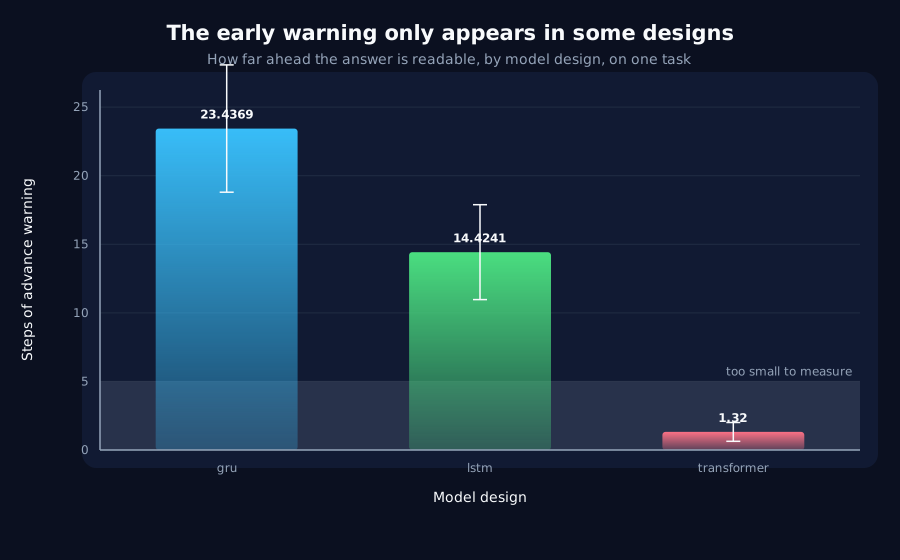
What we found. Partly. The signal arrives about 23 steps early in one design, 14 in another, and is not measurable at all in a third. We ran a calibration check on all three to confirm the instrument works where it reports nothing, and it does, so the absence is real rather than another weak measurement.
Why it matters. A signal that works in some architectures and not others is much less useful than one that works everywhere, and it is honest to say so. The calibration check is the part worth copying: it is what separates 'there is nothing here' from 'we could not see'.
The rest of this page is the technical record: the design, every number, and the limits. It is written for a reviewer, and you do not need it to have understood the result above.
New here? How to read a research record
- Start at the verdict. Every record states, before the experiment was run, what result would have made us abandon the idea. That is the "kill test". Then it says whether the test fired. Nothing gets reinterpreted after the fact.
- Numbers in square brackets are uncertainty.
23.4 [18.1, 28.7]means our best estimate is 23.4 and the true value is probably somewhere in that range. If a range includes zero, we cannot claim an effect. - Results that rule an idea out are kept. Roughly half of what is published here says an approach did not work, including plenty of our own. Those pages are the output, not a shortfall: knowing which direction is a dead end is what lets the next experiment go somewhere better, and most of what we now rely on came out of understanding why something else fell short. Work that only publishes what worked is not measuring anything.
- Read the Limits section. Every record ends with what it does not show. It is the most honest part of any experiment and usually the shortest.
- Pro tip: the figures near the top are designed to carry the result on their own. If you read nothing else, read the caption under each one, which says what it shows and what to take from it.
EXPLORATORY. Not a preregistered study. Local CPU, 15 training runs, no GPU, no cost.
Program v2 tier 3 follow-up to F2 and E3. Decisive computation: analysis/decode_probe_architectures.pyanalysis/decode_probe_architectures.jsonpython analysis/decode_probe_architectures.py in about forty minutes on a throttled laptop CPU.
The question
F2 found the program's only leading indicator, in a GRU. (As of 2026-08-23 it is one of two: F1 added gradient-norm variance. Nothing in this record depends on the count.) E3 found that the expansion is a gated-recurrence phenomenon, present in the LSTM and absent in attention.
Those are different quantities. The expansion is about how a representation reorganises; the decode gap is about whether information arrives before it is used. There is no reason they must travel together, and it matters a great deal which way this falls: the indicator is the one result in this program with practical use, so its scope is the scope of anything useful that comes out of it.
Design. One task, dispatch-copy-wide-vocab, because it is the only cell in the E3 grid where all three architectures genuinely learn. The transformer solves plain delayed-copy almost instantly: that is the confound A1 was written about, and no lead can be measured against a model that arrives already knowing the answer. Learning rates are the ones E3 screened per cell on its excluded seed. Five seeds per arm, crossing measured at 40% accuracy.
Result: they travel together
| Architecture | Lead | Resolvable | Max probe-minus-model gap | Probe / model at end | Instrument check |
|---|---|---|---|---|---|
| gru | +23.4 [+18.8, +28.1] | 5 / 5 | +0.0721 | 0.6216 / 0.6141 | 5 / 5 |
| lstm | +14.4 [+11.0, +17.9] | 5 / 5 | +0.0575 | 0.7156 / 0.7095 | 5 / 5 |
| transformer | +1.3 [+0.6, +2.0] | 0 / 5 | +0.0711 | 0.8300 / 0.8236 | 5 / 5 |
The lead appears where the expansion appears, and not in attention. Both are gated-recurrence properties. That is the second of the three outcomes this pilot was written to distinguish.
Two things that make the transformer's null trustworthy
The instrument check passes in all three arms, including the transformer. An optimally fitted linear readout matches the trained head at convergence in 5 of 5 transformer runs (0.8300 against 0.8236). This is exactly the guard F2's own correction installed, and here it is doing its job: the transformer's null is not the under-powered-probe failure that made F2's first version report the opposite of the truth. The probe works. It simply finds no lead.
The transformer's gap is real but not temporal. Its largest probe-minus-model gap (+0.0711) is comparable to the GRU's (+0.0721). The probe is consistently a little better than the trained head. What it is not is earlier: the two curves rise together, so the gap is a constant offset rather than a lead. That distinction is the whole point of measuring a crossing time rather than a gap size, and a pilot that reported only the gap would have concluded the opposite.
The GRU result replicates on a new task
F2 measured +23.5 steps [+22.1, +24.9] on delayed-copy. This measures +23.4 [+18.8, +28.1] on dispatch-copy-wide-vocab: a different task, a different vocabulary size, a different learning rate, and unseen seeds. That is an independent replication of the program's most important positive result, and it was not the question this pilot was asked.
What this changes
- F2's scope is now known, and it is the same as the expansion's: gated recurrence. Anything built on the leading indicator inherits that limit, and the honest framing of the program's one useful finding is "in gated recurrent models" rather than "in models".
- The two findings are one story, not two. Whatever gating does at the moment of learning produces both the representational expansion and the gap between what the state carries and what the head reads. That strengthens the case for making gating the object of study, which E3 already recommended.
- The transformer remains the interesting negative. It learns the task, takes the longest of any architecture to do it, shows no expansion, and shows no lead, while a calibrated probe confirms the information is slightly more decodable than the head manages throughout. Attention appears to acquire and use information at the same time.
Limits
- One task, five seeds per arm, one width, one optimizer. This is a scope check on F2, not a second independent confirmation of it.
- The crossing is measured at 40% rather than F2's 50%, because the arms plateau between 0.61 and 0.83 on this task and 50% sits too close to the transformer's own curve to time reliably. F2 established that its lead is robust across thresholds from 20% to 90%; that robustness was not re-established here.
- The transformer is one configuration (1 layer, 4 heads). "Attention does not show this" is a claim about that configuration, not about attention at scale.
Terms on this page
Every piece of vocabulary this record uses, in plain language. Generated from the text above, so it cannot drift out of step with it.
- accuracy
- The fraction of answers a model gets right on questions it was not trained on.
- architecture
- The blueprint of a model: what components it has and how they connect. Two models can be the same size and completely different architectures.
- calibrated
- A model is calibrated when its confidence matches how often it is right: answers it gives with 90% confidence should be right about 90% of the time.
- confound
- A second explanation you did not control for. If bigger models both learn faster and score higher, then 'fast learners score higher' may be entirely about size and not about speed.
- gated
- A design where the model has explicit internal switches deciding what to remember and what to discard at each step. GRUs and LSTMs are gated; plain recurrent networks are not.
- gradient
- The direction and amount by which each of a model's internal numbers should change to do slightly better. Training is repeatedly following it.
- GRU
- Gated Recurrent Unit. A compact design for processing sequences one item at a time, with internal switches controlling what it keeps in memory.
- learning rate
- How big a step training takes each time it updates the model. Too small and nothing happens; too big and it never settles.
- LSTM
- Long Short-Term Memory. An older and larger relative of the GRU, also gated, also for sequences.
- optimizer
- The algorithm that decides how to change the model given the gradient. AdamW and SGD are two common choices and they behave differently.
- plateau
- A stretch of training where the model is not visibly improving. Often, though not always, followed by a sudden jump.
- probe
- A small separate model trained to read information out of a bigger model's internals, used as a measuring instrument rather than as a product.
- recurrent
- A design that reads a sequence one item at a time, carrying memory forward. The main alternative is attention, which looks at everything at once.
- seed
- The number that fixes all the randomness in a training run. Same seed, same run. Running several seeds is how you tell a real effect from a lucky one.
- transformer
- The architecture behind most modern large language models. It uses attention to look at every part of the input at once, rather than reading in order.
- variance
- How spread out a set of numbers is. Rising variance in a signal means it is becoming more erratic.
- vocabulary
- The set of distinct symbols a model can read and produce.
- width
- How many internal numbers a model uses at each layer. The usual way we vary model size in these experiments.
Get new results as we publish them
Roughly monthly, one finding per email, in plain English first. Including the approaches that turned out not to work, which are usually the useful ones. No sales email.
Double opt-in: we send a confirmation link and add nobody who does not click it. One-click unsubscribe on every email.