
Does the Warning Cry Wolf?
Ongoing research. This is an experimental result from active work, not a settled conclusion. The numbers are what we measured and the method is described so you can judge it, but the programme is still running and later experiments may revise what it means.
A note on the language in these records. This is a working laboratory notebook for research into training AI models more cheaply and efficiently, so you will read that an approach did not work, that a result did not hold up, or that one method was worse than another. That is the research doing its job, not a verdict on the engineering we deliver to clients. Ruling an approach out is how the search narrows, and these are the pages that teach us the most: nearly every technique we now rely on came from understanding why something else fell short. Testing our own ideas at least as hard as anyone else's is the point of publishing them. More about this programme and why we run it.
Part of a bigger question: Can you tell in advance that a model is about to improve? – Yes, repeatedly and by several independent routes -- a probe on the hidden state, gradient statistics, held-out loss, and which earlier word the prediction leans on. The warnings are real; how far ahead they fire varies a great deal.
In plain English
What we asked. We can read a model's internal state during training and get an early warning that it is about to learn its task. We have published several numbers about how reliable that warning is. Every one of them was measured on runs where the model did eventually learn. That leaves the obvious question unasked, and it is the question anyone relying on the warning would care about most: what does it do on a run that never gets anywhere?
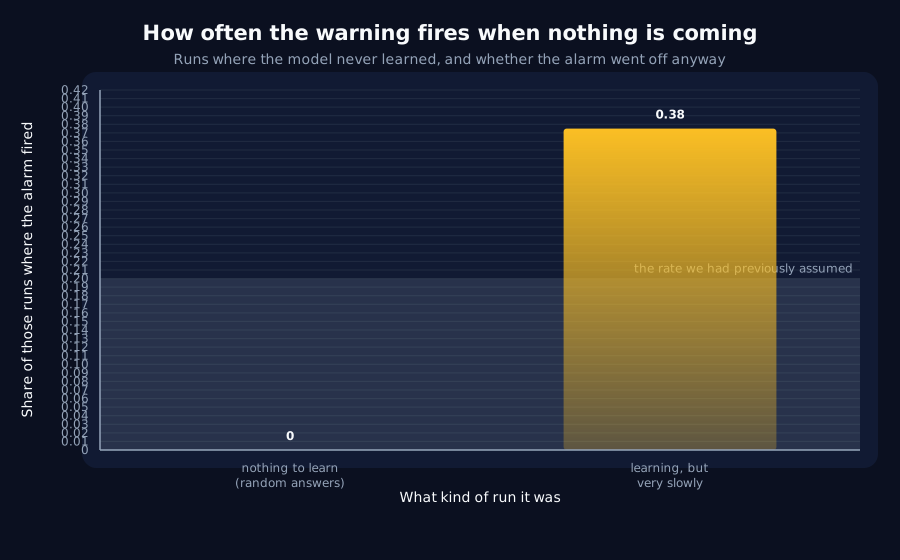
What we found. We built two kinds of failure. The first was models trained on completely random answers, so there was genuinely nothing to learn and any warning would simply be wrong. The second was models given a learning rate so low they had not learned by the end, though they would have eventually. On the first kind the warning never fired once, in eight runs. That is genuinely reassuring, and it is a property every reliability number we have published quietly assumed and none of them had checked.
Why it matters. The second kind is less comfortable. On merely slow models the warning went off more than a third of the time. Those models would have learned eventually, so the warning is early rather than wrong, but nobody watching a slow run can tell those two situations apart at the moment it sounds. The honest summary is that our warning distinguishes 'this model is learning something' from 'this model is learning nothing' very well, and 'soon' from 'eventually' badly. Only the first of those had ever been tested, and it is not the one a user would ask about.
The rest of this page is the technical record: the design, every number, and the limits. It is written for a reviewer, and you do not need it to have understood the result above.
New here? How to read a research record
- Start at the verdict. Every record states, before the experiment was run, what result would have made us abandon the idea. That is the "kill test". Then it says whether the test fired. Nothing gets reinterpreted after the fact.
- Numbers in square brackets are uncertainty.
23.4 [18.1, 28.7]means our best estimate is 23.4 and the true value is probably somewhere in that range. If a range includes zero, we cannot claim an effect. - Results that rule an idea out are kept. Roughly half of what is published here says an approach did not work, including plenty of our own. Those pages are the output, not a shortfall: knowing which direction is a dead end is what lets the next experiment go somewhere better, and most of what we now rely on came out of understanding why something else fell short. Work that only publishes what worked is not measuring anything.
- Read the Limits section. Every record ends with what it does not show. It is the most honest part of any experiment and usually the shortest.
- Pro tip: the figures near the top are designed to carry the result on their own. If you read nothing else, read the caption under each one, which says what it shows and what to take from it.
EXPLORATORY. Not a preregistered study. Local CPU, 24 training runs, no GPU, no cost.
Program v2 Bucket K, item K6. Decisive computation: analysis/failure_population.pyanalysis/failure_population.jsonpython analysis/failure_population.py, or re-derive the endpoints with --reuse.
The question
Every reliability figure in this programme is conditioned on the event happening. F2's 12/12 at a 45-step horizon, G1's 95%, A11's 100% against a 19% surrogate false-alarm rate, every one is computed on runs that transitioned. Nothing characterised runs that never do.
The surrogate rates already published are not this. A surrogate is a shuffled version of a series from a run that did transition; it asks whether the alarm responds to structure or to noise. This asks what the alarm does on a real training run of a model that never learns, real optimisation dynamics, real gradient structure, real loss curve, no arrival.
Kill test, fixed in advance: the indicators' false-alarm rate on never-transitioning runs is no higher than their surrogate rate on transitioning ones (~20%).
Two kinds of failure, because they are not the same thing
| Arm | Construction | An alarm here means |
|---|---|---|
learnable | ordinary runs | the anchor, must reproduce K1's lead |
unlearnable | I6's: targets resampled as uniform noise every step | unambiguously false, nothing is ever learnable |
too-slow | learning rate 0.00012, transition beyond the budget | early, not wrong, the model would learn eventually |
Result
Eight seeds per arm. No run in either failure arm transitioned, so both belong to the kill test's population.
| Arm | Transitioned | global_norm fires | off_top fires |
|---|---|---|---|
| learnable | 8/8 | , | , |
| unlearnable | 0/8 | 0/8 = 0% | 0/8 = 0% |
| too-slow | 0/8 | 3/8 = 38% | 3/8 = 38% |
On runs where there is nothing to learn, the alarm never fires. Not once, on either statistic, in eight runs with real gradients and a real optimiser. The indicator is responding to learnability rather than to optimisation noise, which is the property every published reliability figure in this programme silently assumed, and none of them tested.
The anchor agrees. The learnable arm gives +28.1 [+26.8, +29.5] and +28.0 [+26.6, +29.4] against K1's +31.2 [+26.5, +36.0] and +29.8 [+24.0, +35.5], so this is K1's alarm.
The caveat, which is not small
On runs that are merely slow, the alarm fires 38% of the time, above the surrogate rate. Those runs would transition given a longer budget, so the alarm is early rather than wrong.
But that distinction is invisible at the moment the alarm sounds. A user watching a slow run cannot tell "this is about to learn" from "this will learn in four hundred steps' time", and the published reliability figures do not distinguish them either. The honest statement is that the indicator discriminates learnable from unlearnable cleanly, and discriminates soon from eventually poorly.
Two corrections, both to the measurement rather than the result
The slow arm was not slow enough. At the first rate tried (0.0004) every run transitioned at step 551-584, inside the 900-step budget: a slow success, not a failure. Whether the arm qualifies is now checked in the verdict rather than assumed.
The false-alarm denominator was wrong. The first version divided alarms by every run in the arm, which scored the slow arm at 100% when all of its runs had transitioned and every alarm was a genuine lead. A false alarm is an alarm on a run where the event never happens, so the denominator is the silent runs.
And the anchor test itself was wrong, in a way worth recording. It asked whether K1's point estimate fell inside this pilot's interval, ignoring K1's own uncertainty. K1 measured four seeds (+31.2 [+26.5, +36.0]); this measures eight different ones (+28.1 [+26.8, +29.5]). The two agree, each mean sits inside the other's interval, and the point-in-interval test rejected them, because a narrower interval from more seeds is harder to satisfy. An anchor that gets stricter as the replication gets better is the wrong test. It now checks whether the two intervals overlap, and the same fix was applied to K4, whose conclusion is unchanged.
Verdict
- The kill test does not fire on the unambiguous population.
0%against a20%surrogate rate. - This is the first instrument property in Bucket K to survive its check. J5, K3 and K4 all found something degrading; this finds something holding.
- It is a narrower claim than it looks. The alarm distinguishes learnable from unlearnable perfectly and soon from eventually badly, and only the first of those was tested by anything published before now.
- Every prior reliability figure is retrospectively better supported, on this one axis, at this one width, for these two statistics.
Limits
- Eight seeds per arm, one task, one width, one learning rate, one alarm rule.
- The decode probe is not covered. F2's
12/12and G6's horizon numbers are the programme's headline reliability figures and they belong to a different instrument, which is more expensive to run. This record does not license any claim about the probe's false-alarm behaviour, and that is the obvious follow-up. too-slowis one way of being slow. A lower learning rate is not the same failure mode as a harder task, a worse initialisation, or a model too small to represent the solution.0/8is a rate of zero with a wide interval. Eight runs cannot distinguish a true rate of 0% from one of several percent; the claim is that it is well under the surrogate rate, not that it is exactly zero.
Terms on this page
Every piece of vocabulary this record uses, in plain language. Generated from the text above, so it cannot drift out of step with it.
- false-alarm rate
- How often a warning system goes off when nothing is actually happening. Any detector can be made to fire early by making it twitchier, so a lead time only means something alongside this number.
- gradient
- The direction and amount by which each of a model's internal numbers should change to do slightly better. Training is repeatedly following it.
- kill test
- A condition written down before running the experiment that says what result would make us abandon the idea. Fixing it in advance is what stops a disappointing result being reinterpreted as an encouraging one.
- learning rate
- How big a step training takes each time it updates the model. Too small and nothing happens; too big and it never settles.
- probe
- A small separate model trained to read information out of a bigger model's internals, used as a measuring instrument rather than as a product.
- reliability
- How often something works on an individual case, as opposed to how well it does on average. The two can differ a lot, and only one of them tells you what to expect next time.
- seed
- The number that fixes all the randomness in a training run. Same seed, same run. Running several seeds is how you tell a real effect from a lucky one.
- surrogate
- A fake version of real data, built to keep everything except the effect being tested. If a detector fires just as often on the surrogate, it is responding to something other than what it claims.
- width
- How many internal numbers a model uses at each layer. The usual way we vary model size in these experiments.
Get new results as we publish them
Roughly monthly, one finding per email, in plain English first. Including the approaches that turned out not to work, which are usually the useful ones. No sales email.
Double opt-in: we send a confirmation link and add nobody who does not click it. One-click unsubscribe on every email.