
Where the Shortcut Stops Paying
Ongoing research. This is an experimental result from active work, not a settled conclusion. The numbers are what we measured and the method is described so you can judge it, but the programme is still running and later experiments may revise what it means.
A note on the language in these records. This is a working laboratory notebook for research into training AI models more cheaply and efficiently, so you will read that an approach did not work, that a result did not hold up, or that one method was worse than another. That is the research doing its job, not a verdict on the engineering we deliver to clients. Ruling an approach out is how the search narrows, and these are the pages that teach us the most: nearly every technique we now rely on came from understanding why something else fell short. Testing our own ideas at least as hard as anyone else's is the point of publishing them. More about this programme and why we run it.
Part of a bigger question: How do we know our own results are real? – Repeatedly, the control rather than the measurement decided the result -- and several striking findings dissolved when the right comparison was finally run.
In plain English
What we asked. We have exactly one shortcut that saves anything: partway through training, switch to a cheaper setting that processes less data per step. The page before this one established that whether it helps depends on the size of the model, and left the boundary somewhere between two sizes four times apart. This finds it.
What we found. At four model sizes the shortcut saves 21%, 20%, 13%, and then costs 42%. It pays below about a hundred units of width and not above. Our test asked whether the decline is steady, and technically it is, so the shortcut is a small-model trick that fades away as models grow. But the shape is worth more than the verdict: the first three sizes sit within eight points of one another and the fourth falls fifty-five. That is a cliff, not a fade.
Why it matters. There is a candidate explanation sitting in the control runs, and it is checkable. Simply making the model bigger had itself been buying less and less: going from the first size to the second made training three times cheaper, the next step 1.6 times, and the last step only nine per cent, despite four times the parameters. By the largest size the task has almost stopped rewarding extra capacity, so there is very little left for a cheaper setting to recover while its downside is unchanged. On four points that is a shape rather than a proof, but it makes a prediction: the cliff sits wherever extra size stops paying, not at any fixed width. Separately, and for the fifth time in this programme, timing the switch to each individual run bought nothing over using one fixed moment for all of them - and at the largest size it was actively worse.
The rest of this page is the technical record: the design, every number, and the limits. It is written for a reviewer, and you do not need it to have understood the result above.
New here? How to read a research record
- Start at the verdict. Every record states, before the experiment was run, what result would have made us abandon the idea. That is the "kill test". Then it says whether the test fired. Nothing gets reinterpreted after the fact.
- Numbers in square brackets are uncertainty.
23.4 [18.1, 28.7]means our best estimate is 23.4 and the true value is probably somewhere in that range. If a range includes zero, we cannot claim an effect. - Results that rule an idea out are kept. Roughly half of what is published here says an approach did not work, including plenty of our own. Those pages are the output, not a shortfall: knowing which direction is a dead end is what lets the next experiment go somewhere better, and most of what we now rely on came out of understanding why something else fell short. Work that only publishes what worked is not measuring anything.
- Read the Limits section. Every record ends with what it does not show. It is the most honest part of any experiment and usually the shortest.
- Pro tip: the figures near the top are designed to carry the result on their own. If you read nothing else, read the caption under each one, which says what it shows and what to take from it.
EXPLORATORY. Not a preregistered study. Local CPU, 60 training runs, no GPU, no cost.
Program v2 Bucket Q, item Q12. Decisive computation: analysis/cut_width_sweep.pyanalysis/cut_width_sweep.jsonpython analysis/cut_width_sweep.py; --reuse re-derives every endpoint without retraining.
The question
Q11 left a sign change bracketed and unlocated: cutting the batch 4x saves +19.9% of samples-to-target at width 48 and costs -42.0% at width 192, at the same multiple of each run's own transition on the same task. This is the only efficiency manoeuvre in this archive with a positive region at all, so where its boundary sits is the most useful thing left to know about it.
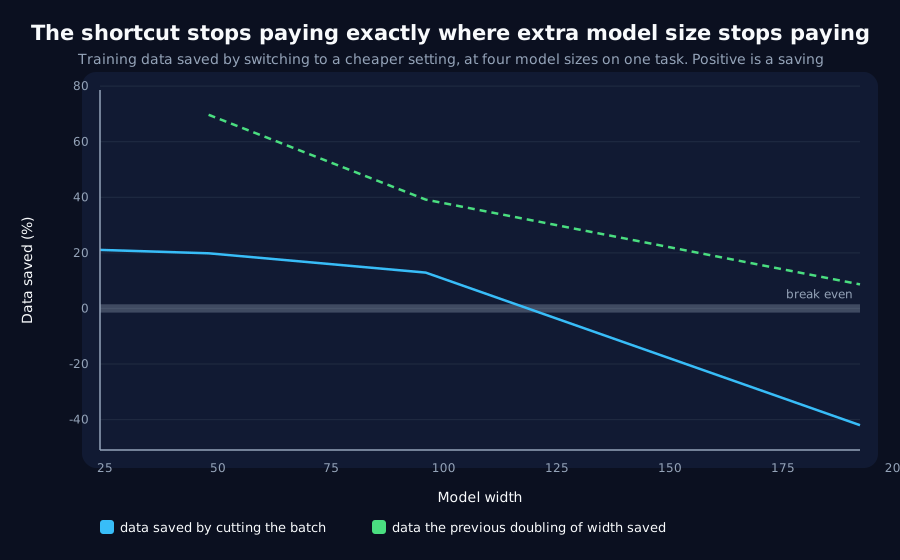
Four widths at lag 4, control against an oracle arm at x0.8 of each run's own transition, Q11's best-performing before-arm, plus a fixed-schedule arm beside it.
Kill test, fixed before execution: the saving is monotone in width. Then the manoeuvre is a small-model effect that extrapolates cleanly to nothing. If it is not monotone, width is standing in for something else and this is a new question rather than a closed one.
The anchors are exact
All four reproduce Q11 to the digit: same seeds, same code path:
| Here | Q11 | |
|---|---|---|
| width 48 control | 10,944 [9,772, 12,116] | 10,944 [9,772, 12,116] |
width 48 x0.8 | 8,771 [7,586, 9,957] | 8,771 [7,586, 9,957] |
| width 192 control | 6,080 [5,799, 6,361] | 6,080 [5,799, 6,361] |
width 192 x0.8 | 8,634 [7,335, 9,933] | 8,634 [7,335, 9,933] |
Result: the kill test fires, and the shape is more interesting than the verdict
| Width | Transition | Control samples to 0.9 | Oracle x0.8 | Fixed step |
|---|---|---|---|---|
| 24 | 138 | 36,080 [20,918, 51,242] | +21.1% | +20.4% |
| 48 | 88 | 10,944 [9,772, 12,116] | +19.9% | +19.3% |
| 96 | 56 | 6,656 [6,324, 6,988] | +12.9% | +12.7% |
| 192 | 39 | 6,080 [5,799, 6,361] | -42.0% | -35.0% |
Monotone, so the kill test fires, and the manoeuvre is a small-model effect. But monotone is doing less work here than it sounds. The first three widths sit within 8 points of each other, +21.1, +19.9, +12.9, and the fourth falls 55 points. That is a cliff, not a fade, and a "small-model effect that extrapolates to nothing" is a fair description of the verdict and a poor description of the curve.
A candidate mechanism, visible in the control column
The control's own cost stops improving at exactly the width where the cut stops paying:
| Step | Control samples to target | Improvement |
|---|---|---|
| 24 → 48 | 36,080 → 10,944 | 3.30x cheaper |
| 48 → 96 | 10,944 → 6,656 | 1.64x cheaper |
| 96 → 192 | 6,656 → 6,080 | 1.09x cheaper |
By width 192 the control is within 9% of the width-96 control despite four times the parameters. The task is saturating in samples-to-target, so there is very little headroom left for a cheaper regime to exploit, and the cheap batch's own cost is unchanged. On four points this is a coincidence of shape rather than a demonstrated cause, but it is checkable and it predicts the cliff sits wherever the marginal return to width collapses, not at any particular width.
The fixed-schedule arm, for the fifth time
Oracle against one population number for every seed: +0.6, +0.6, +0.1 points at widths 24, 48 and 96, and -7.0 at width 192, where the fixed arm is the better of the two. Per-run timing buys nothing anywhere here, and at the width where the manoeuvre fails it actively hurts. That is K2's finding, Q1's, Q5's, Q11's and now this one.
What this settles and what it does not
- The batch cut pays below roughly width 100 on this task and not above it. That is the boundary Q11 bracketed, now located to a factor of two.
- Per-run timing is worthless across the whole range, so the one instrument this manoeuvre was built around (F2's decode probe) has nothing left to contribute even where the manoeuvre works. Combined with Q9's pricing, the probe costs
21.9xthe training it watches at width 48, the economics stay closed. - The cliff wants explaining, and the control column offers a candidate that a difficulty-matched ladder would test directly.
Limits
- This is a fixed-task width sweep, which is P11's confound by construction: deliberately, because the axis under test is width against a fixed task. What "width" means here is therefore spare capacity: the transition falls
138→39across the sweep, so the width-192 model is enormously oversized for lag 4. Whether the cliff survives a ladder where difficulty rises with width is untested and is the obvious follow-up (Q13). - The width-24 control interval is very wide (
20,918to51,242), because a narrow model's time-to-target varies a great deal across seeds. The+21.1%there is the least reliable number in the table. - Four widths locate the crossing to a factor of two and nothing here says the curve is smooth between 96 and 192. A point at 128 or 144 would say whether the cliff is a step or a steep slope.
- One task, one cut ratio, one multiple, one target. All inherited from J7 and Q11 and fixed in advance.
- The oracle arm needs a control run per seed and is not deployable. The fixed arm is what a practitioner would use, and on this evidence it is what they should use.
Terms on this page
Every piece of vocabulary this record uses, in plain language. Generated from the text above, so it cannot drift out of step with it.
- confound
- A second explanation you did not control for. If bigger models both learn faster and score higher, then 'fast learners score higher' may be entirely about size and not about speed.
- kill test
- A condition written down before running the experiment that says what result would make us abandon the idea. Fixing it in advance is what stops a disappointing result being reinterpreted as an encouraging one.
- parameters
- The adjustable numbers inside a model. Training is the process of setting them. Model size is usually quoted as a count of these.
- probe
- A small separate model trained to read information out of a bigger model's internals, used as a measuring instrument rather than as a product.
- seed
- The number that fixes all the randomness in a training run. Same seed, same run. Running several seeds is how you tell a real effect from a lucky one.
- slope
- How steeply one quantity changes as another does. A slope of one between a warning and the event it predicts means the warning shifts exactly in step with the event.
- width
- How many internal numbers a model uses at each layer. The usual way we vary model size in these experiments.
Get new results as we publish them
Roughly monthly, one finding per email, in plain English first. Including the approaches that turned out not to work, which are usually the useful ones. No sales email.
Double opt-in: we send a confirmation link and add nobody who does not click it. One-click unsubscribe on every email.